
Obesity is a widespread disease that is associated with numerous and serious comorbidities. These include metabolic syndrome, diabetes mellitus, cardiovascular-cerebrovascular disease, hypertension, obstructive sleep apnea syndrome, cancer, and sexual and hormonal disorders. The treatment of obesity has therefore become a goal of great clinical and social relevance. Among the therapeutic strategies against obesity, resveratrol has aroused great interest. This polyphenol has anticancer and antioxidant properties and cytoprotective and anti-inflammatory effects. Other favorable effects attributed to resveratrol are anti-lipid, anti-aging, anti-bacterial, anti-viral, and neuroprotective actions. Administration of resveratrol appears to improve the metabolic profile in obese and/or insulin-resistant patients.
- resveratrol
- obesity
- clinical trials
Note: The following contents are extract from your paper. The entry will be online only after author check and submit it.
1. Introduction
In recent years, weight gain has become a troubling reality as the number of overweight/obese people around the world has reached epidemic proportions [1]. The prevalence of obesity in European countries is around 20%, with no significant differences between men and women. Available data show that weight gain is particularly prevalent in Western countries mainly due to the combination of high energy food intake and low levels of physical activity [2][3]. Obesity is an important risk factor for chronic diseases, such as metabolic syndrome, diabetes mellitus, cardiovascular/cerebrovascular diseases, hypertension, obstructive sleep apnea syndrome, oncological diseases, and sexual and hormonal disorders [1]. Weight gain is also linked to accelerated skeletal growth and pubertal development and is associated with the aging process. In this regard, the release of inflammatory cytokines appears to be related to the shorter lifespan reported in obese patients [3].
The scientific interest in resveratrol dates back to 1997 when studies on animal models demonstrated its anticancer properties [7]. Resveratrol also has cytoprotective effects and antioxidant properties, and modulates anti- and pro-apoptotic mediators, protecting cells from DNA damage. This polyphenol also has anti-inflammatory effects. In fact, it inhibits cyclooxygenase-2 (COX-2), nuclear factor-kB (NF-kB), and other molecules involved in inflammatory processes [6][8]. Other favorable effects attributed to resveratrol are anti-lipid, anti-aging, anti-bacterial, anti-viral, and neuroprotective action. Finally, supplementation of resveratrol appears to improve the metabolic profile in obese and/or insulin-resistant patients [3][4][5].
2. Resveratrol and Obesity: Possible Mechanisms of Action
In recent years, many authors have investigated the effects of resveratrol in obesity and metabolic syndrome, reporting an improvement in glucose homeostasis and the cardiovascular risk associated with obesity. However, the exact mechanisms by which resveratrol carries out its beneficial effect have not been fully understood. Resveratrol may affect the activity of various intracellular targets such as adenosine monophosphate-activated protein kinase (AMPK), the deacetylating enzyme sirtuin-1 (SIRT-1), and the peroxisome proliferator-activated receptor γ coactivator-1α (PGC-1α), all altered in the metabolic abnormalities present in patients with obesity [12][13]. In particular, resveratrol can influence gene expression by inducing changes that mimic those seen under calorie restriction conditions [12].
Among these, numerous pieces of evidence suggest that resveratrol activates AMPK [13][16]. AMPK can be activated by an increased ADP/ATP ratio, as occurs in states of energy deficiency by increasing intracellular NAD
+
2+
There is general agreement on the inhibitory effect that resveratrol has on adipogenesis, as numerous studies have examined this aspect in-vitro in animal models and most of them have shown concordant results. Lasa and colleagues [18] incubated pre-adipocyte cells with increasing concentrations of resveratrol (1, 10, and 25 µM) for 24 h, reporting a decrease in triacylglycerol content and a lower expression of acetyl-CoA carboxylase (ACC). The first is an enzyme with a key role in the synthesis of long-chain saturated fatty acids. In the adipose tissue, lipoprotein lipase, which is activated by the peroxisome proliferator-activated receptor-gamma (PPARγ), catalyzed the hydroxylation of triacylglycerol in free fatty acids. Hence, these results suggest the presence of an inhibitory effect of resveratrol on lipoprotein lipase [18]. Consistent with this, another study reported significant downregulation of lipoprotein lipase mRNA in peripheral blood mononuclear cells (PBMC) of pigs after daily administration of resveratrol at a dose of 0.11 mg/kg of body weight for 12 months [19]. Other animal studies, mainly conducted in rats, have shown a reduction of abdominal fat, lipoprotein lipase, and ACC activities after treatment with resveratrol [20][21][22]. Specifically, Rivera and colleagues evaluated the effects of resveratrol on de-novo lipogenesis in obese and lean 13-week-old Zucker rats. They received a dose of 10 mg/kg of body weight for 8 weeks. No changes in food intake were observed in the treated mice. Obese rats were found to have lower abdominal fat content than pre-treatment values, while no change was found in lean ones. Also, an increase in phosphorylated ACC protein expression was found. Since it is an inactive form of ACC, the authors suggested that resveratrol decreased ACC activity and thus de-novo lipogenesis [20].
2+
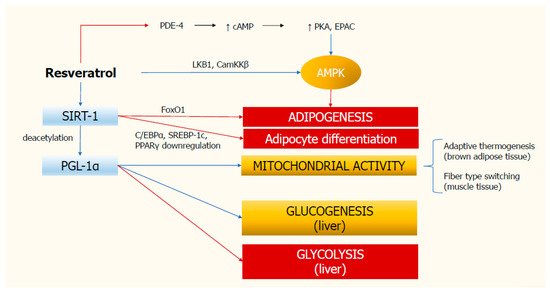
Figure 1.
Molecular mechanisms of resveratrol action.
3. Bioavailability and Pharmacokinetics
4. Obesity and Resveratrol: Clinical Trials in Humans
2
2
2
2
2
2
2
2
2
2max
2
2
Table 1.
| uthors | Type of Study | Patients | Resveratrol Dose | Duration of Resveratrol Administration | Conclusions | ||||
|---|---|---|---|---|---|---|---|---|---|
| Timmers et al., 2011 | Randomized, placebo-controlled, double-blind cross-over | 11 obese otherwise healthy men | 150 mg once daily | 30 days |
| ||||
| Crandall et al., 2011 | Randomized, open-label uncontrolled | 10 overweight/obese adults with moderate insulin-resistance |
| 4 weeks |
| ||||
| Wong et al., 2011 | Randomized, placebo-controlled, double-blind, cross-over | 19 overweight/obese adults with hypertension |
| 4 weeks |
| ||||
| Wong et al., 2013 | Randomized, placebo-controlled, double-blind, cross-over | 28 obese otherwise healthy adults | 75 mg once daily | 6 weeks |
| ||||
| Poulsen et al., 2013 | Investigator-initiated, randomized, place-controlled | 24 male volunteers with obesity but otherwise healthy | 500 mg three times a day | 4 weeks |
| ||||
| Van der Made et al., 2015 | Randomized, placebo-controlled, cross-over | 45 overweight/obese patients with DM2 | 150 mg once daily | 4 weeks |
| ||||
| Knope et al., 2013 | Randomized, placebo-controlled, double-blind, cross-over | 10 obese men | 150 mg once daily | 30 days |
| ||||
| Dash et al., 2013 | Randomized, placebo-controlled, double-blind, cross-over | 8 overweight/obese subjects with mild hypertriglyceridemia | 1000 mg once daily for a week followed by 2000 mg once daily for another week | 2 weeks |
| ||||
| Anton et al., 2014 | Randomized, placebo-controlled, double-blind | 32 overweight/obese adults | Three groups: placebo, moderate resveratrol dose 300 mg once daily, and high resveratrol dose 1000 mg once daily | 90 days |
| ||||
| Konings et al., 2014 | Randomized, placebo-controlled, double-blind, cross-over | 11 obese otherwise healthy men | 150 mg once daily | 30 days |
| ||||
| Walker et al., 2018 | Randomized, placebo-controlled | 28 obese men with metabolic syndrome | 1000 mg twice a day | 30 days |
| ||||
| Kantartzis et al., 2018 | Randomized, placebo-controlled | 112 overweight/obese and insulin-resistant patients | 75 mg twice a day | 12 weeks |
| ||||
| Batista-Jorge et al., 2020 | Randomized, placebo-controlled | 25 obese adults with metabolic syndrome | 250 mg once daily + physical activity program + diet | 3 months |
| ||||
| de Ligt et al., 2020 | Randomized, placebo-controlled, double-blind | 41 overweight/obese adults | 150 mg once daily | 6 months |
|