
Circulating tumour cells (CTCs) are the precursor cells for the formation of metastatic disease. With a simple blood draw, liquid biopsies enable the non-invasive sampling of CTCs from the blood, which have the potential to provide important insights into cancer detection and monitoring. Since gaining FDA approval in 2004, the CellSearch system has been used to determine the prognosis of patients with metastatic breast, prostate and colorectal cancers. This utilises the cell surface marker Epithelial Cell Adhesion Molecule (EpCAM), to enrich CTCs, and many other technologies have adopted this approach. More recently, the role of mesenchymal-like CTCs in metastasis formation has come to light. It has been suggested that these cells are more aggressive metastatic precursors than their epithelial counterparts; however, mesenchymal CTCs remain undetected by EpCAM-based enrichment methods. This has prompted the development of a variety of ‘label free’ enrichment technologies, which exploit the unique physical properties of CTCs (such as size and deformability) compared to other blood components.
- circulating tumour cell (CTC)
- cancer
- metastasis
- liquid biopsy
1. Background
Note: The following contents are extract from your paper. The entry will be online only after author check and submit it.
With a simple blood draw, liquid biopsies enable the non-invasive sampling of CTCs from the blood, which have the potential to provide important insights into cancer detection and monitoring. Since gaining FDA approval in 2004, the CellSearch system has been used to determine the prognosis of patients with metastatic breast, prostate and colorectal cancers. This utilises the cell surface marker Epithelial Cell Adhesion Molecule (EpCAM), to enrich CTCs, and many other technologies have adopted this approach. More recently, the role of mesenchymal-like CTCs in metastasis formation has come to light. It has been suggested that these cells are more aggressive metastatic precursors than their epithelial counterparts; however, mesenchymal CTCs remain undetected by EpCAM-based enrichment methods. This has prompted the development of a variety of ‘label free’ enrichment technologies, which exploit the unique physical properties of CTCs (such as size and deformability) compared to other blood components.
1. Introduction
2. Introduction
Circulating tumour cells (CTCs) are shed into the bloodstream from both primary and metastatic tumours and those that are able to survive in the circulation represent metastatic precursor cells [1]. CTCs are important biomarkers for disease and are a powerful tool to study tumour progression and evolution. They represent a rare and heterogeneous population of cells, typically accounting for ∼1 cells for every 10
Circulating tumour cells (CTCs) are shed into the bloodstream from both primary and metastatic tumours and those that are able to survive in the circulation represent metastatic precursor cells [1]. CTCs are important biomarkers for disease and are a powerful tool to study tumour progression and evolution. They represent a rare and heterogeneous population of cells, typically accounting for ∼1 cells for every 10
5
–10
6
peripheral blood mononuclear cells (PBMCs), so a key challenge for their clinical utility is the development of standardised isolation and characterisation technologies [2]. There are numerous technologies that have been developed to enrich CTCs from normal hematopoietic cells that rely on physical and biological properties of CTCs, including size, density, cellular charge and expression of cellular markers. The enrichment techniques (Table 1) can broadly be divided into immunocapture methods that differentiate cells based on epithelial cell surface marker expression, notably epithelial cell adhesion molecule (EpCAM) (Figure 1A), and those that differentiate based on distinct biophysical properties (Figure 1B,C). If CTC enrichment and characterisation is to be routinely used in the clinical setting, technologies must ideally meet several criteria: they must have high detection and recovery rates, with accurate throughput sample processing and enumeration capability. Further, they must be generally fully automated and easy to use, with little to no pre-processing of blood required. Finally, if they are to have wide clinical applicability, they must be able to detect heterogeneous cells from a wide range of different cancers.
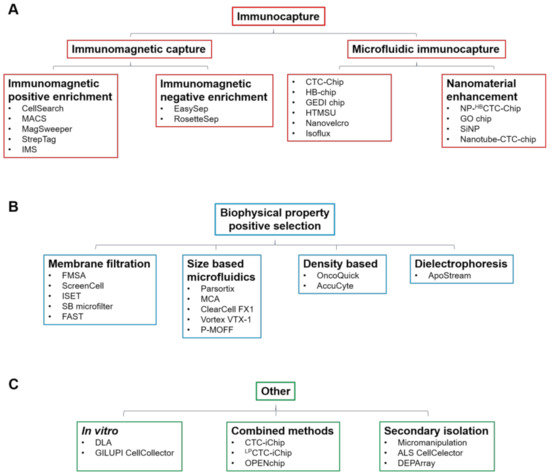
Summary of circulating tumour cell (CTC) enrichment technologies. (
) Immunocapture methods including immunomagnetic positive and negative enrichment methods, microfluidic immunocapture methods, nanomaterial immunocapture enhancement and their relevant technologies; (
) Biophysical property enrichment methods including membrane filtration, size-based microfluidics, density based and dielectrophoresis and associated technologies; (
) Other methods including in vitro, combined and secondary isolation methods and associated technologies.
Table 1. CTC isolation technologies, grouped based on enrichment method. Capture efficiency, recovery rate and advantages and disadvantages of the technologies are also shown.
| Subcategory | Name | Capture Efficiency (%) | Recovery Rate (%) | Advantages | Disadvantages |
|---|---|---|---|---|---|
| Immunomagnetic enrichment | |||||
| Immunomagnetic positive enrichment | CellSearch [3][4][5][6][7] | 42–90 | Semi automated Can process up to 8 samples at a time In device staining CTC enumeration via CellTracks Analyser FDA approved |
Recovery of EpCAM+ CTCs only Only able to detect CTCs expressing high levels of EpCAM |
|
| MACS [8][9] | 25–90 | Cocktail of antibodies available to increase CTC capture Able to process up to 15 mL blood Easy elution of CTCs Pro Separator can process up to 6 samples at once |
Recovery of EpCAM+ CTCs only Suggested the MACS system is better suited for tissue samples |
||
| MagSweeper [10][11] | 60–70 | Nonadherent plastic sleeves allow for multiple rounds of capture to increase capture efficiency | Recovery of EpCAM+ CTCs only | ||
| Strep-tag [12][13] | 79–86 | 70 | Easy release of CTCs by simple addition of d-biotin Possibility to use a cocktail of antibodies to increase capture |
Recovery of EpCAM+ CTCs only | |
| IMS [14] | 92 | Leukocytes repelled so high purity recoveries | Recovery of EpCAM+ CTCs only Not yet tested on patient samples |
||
| Immunomagnetic negative enrichment | EasySep [15][16] | 19–65 | Recovery of heterogeneous population of CTCs | Exclusion of CTC-WBC clusters Variable recovery rates May inadvertantly remove CTCs |
|
| RosetteSep [17] | 62.5 | Recovery of heterogeneous population of CTCs Cocktail of antibodies used to maximise depletion |
Exclusion of CTC-WBC clusters, May inadvertantly remove CTCs |
||
| Microfluidic immunocapture positive enrichment | CTC-Chip [18][19] | >60 | Large surface area for CTC capture High viability of recovered cells |
Recovery of EpCAM+ CTCs only Slow processing rate Complex geometry of chip difficult to scale up Geometry prevents passage of CTC clusters |
|
| HB-chip [20] | 74.5–97 | HB grooves increase CTC-antibody contact for increased cell capture | Recovery of EpCAM+ CTCs only | ||
| GEDI chip [21] | 80–90 | Large surface area for CTC capture Possibility to functionalise with alternative antibodies |
May miss heterogeneity of CTCs | ||
| HTMSU [22] | >97 | Quick processing On-chip single-cell conductometric counting for enumeration |
Recovery of EpCAM+ CTCs only | ||
| Nanovelcro [23] | 70–95 | 4 generations developed for different clinical utilities 3rd and 4th generation chips adapted for easy CTC release |
Recovery of EpCAM+ CTCs only | ||
| Isoflux [4] | 74–90 | 64–75 | Utilises microfluidic approach to increase EpCAM sensitivity Up to 4 samples can be processed in parallel Multiple kits including cocktails of antibodies to capture heterogeneity IsoFlux Cytation Imager for sample scanning |
||
| Capture enhancement by nanomaterials | NP-HBCTC-Chip [24] | 79–97 | Simple release of CTCs by addition of glutathione (GSH) Chip surface can be functionalised with a cocktail of antibodies for enhanced capture efficiency |
Recovery of EpCAM+ CTCs only Very low throughput |
|
| GO chip [25][26] | 67–100 | 91–95 | Simple chip design Large surface area for increased CTC capture |
Recovery of EpCAM+ CTCs only | |
| SiNP [27] | 84–91 | Large surface area for CTC capture | Recovery of EpCAM+ CTCs only | ||
| Capture enhancement by nanomaterials | Nanotube-CTC-chip [28] | 89–100 | Preferential adherence negates need for EpCAM antibodies Planar enrichment surface makes chip visualisation and imaging easy |
Time taken for optimal CTC adherence to substrate is too long | |
| Size based enrichment | |||||
| Membrane filtration | FMSA [29] | 90 | Recovery of heterogeneous population of CTCs Cheap and easy to produce Quick processing time |
Filter clogging highly likely | |
| ScreenCell [30] | 74–91 | Recovery of heterogeneous population of CTCs Cheap and easy to produce Three different devices offered depending on downstream requirements Quick processing time |
Unevenly distributed or fused pores can reduce capture efficiency | ||
| ISET [31][32] | 83–100 | Recovery of heterogeneous population of CTCs Cheap and easy to produce Ability to process 12 samples in parallel |
Slow processing time Blood must be diluted 1:10 to prevent membrane clogging |
||
| SB microfilter [33] | 78–83 | Recovery of heterogeneous population of CTCs Cheap and easy to produce Quick processing time |
Only 1 mL blood can be processed at a time due to device clogging | ||
| FAST [34] | 94–98 | Recovery of heterogeneous population of CTCs Cheap and easy to produce Quick processing time |
|||
| Microfluidics | Parsortix [35] | 42–70 | 54–69 | Recovery of heterogeneous population of CTCs Ability to capture CTC clusters Option for on-chip staining |
Slow processing time On-chip imaging difficult |
| MCA [36] | >90 | 68–100 | Recovery of heterogeneous population of CTCs Option for on-chip staining Ability to process up to 4 samples in parallel |
||
| ClearCell FX1 [37][38] | 52–79 | Recovery of heterogeneous population of CTCs Quick processing time No channel clogging observed |
|||
| Vortex VTX-1 [39][40] | 53.8–71.6 | Recovery of heterogeneous population of CTCs Filters at channel inlet prevent channel clogging Fully automated process Quick processing time Associated BioView for enumeration Option to run in “high recovery” or “high purity” mode |
|||
| p-MOFF [41] | 91.6–93.75 | Recovery of heterogeneous population of CTCs Quick processing time No channel clogging observed |
RBC lysis and Ficoll density centrifugation required | ||
| Density based | OncoQuick [42][43] | 25–87 | Recovery of heterogeneous population of CTCs Up to 25 mL blood can be processed per tube |
Low detection and recoveryrates | |
| AccuCyte [44] | 81–90.5 | Recovery of heterogeneous population of CTCs Allows for processing of multiple samples in parallel Associated CyteFinder and CytePicker systems for imaging and mechanical selection of CTCs |
|||
| Other | |||||
| Dielectrophoresis | ApoStream [45][46] | 55–78.5 | Recovery of heterogeneous population of CTCs Quick processing time iCys laser scanning cytometer for enumeration High viability of recovered cells |
||
| In vivo | Diagnostic leukapheresis (DLA) [47] | Recovery of heterogeneous population of CTCs Recovery of much greater numbers of CTCs |
Only a pre-enrichment step so must be used in combination with another enrichment technology Huge leukocyte background |
||
| GILUPI CellCollector [48] | Potential for much greater numbers recovered | More invasive for the patient than a simple blood draw Recovery of EpCAM+ CTCs only |
|||
| Combined | CTC-iChip [49] | 70–100 | Option for positive or negative enrichment approach Inertial focusing provides high sensitivity selection Quick processing time |
Positive enrichment only allows for recovery of EpCAM+ CTCs Negative enrichment will exclude CTC-WBC clusters |
|
| LPCTC-iChip [50] | 85.5–100 | Potential for much greater numbers recovered Magnetic field directs WBCs to centre of channel to prevent channel clogging Extremely high throughput |
Disregards CTC-WBC clusters Initial debulking step may result in CTC loss |
||
| OPENchip [51] | 50 | Chip allows for CTC enrichment and on-chip downstream molecular analysis | Low throughput, low recovery rates |
CTC isolation technologies, grouped based on enrichment method. Capture efficiency, recovery rate and advantages and disadvantages of the technologies are also shown.
|
Subcategory |
Name |
Capture Efficiency (%) |
Recovery Rate (%) |
Advantages |
Disadvantages |
|
|
Immunomagnetic enrichment |
|
|
|
|
|
|
|
Immunomagnetic positive enrichment |
CellSearch [3–7] |
42–90 |
Semi automated Can process up to 8 samples at a time In device staining CTC enumeration via CellTracks Analyser FDA approved |
Recovery of EpCAM+ CTCs only Only able to detect CTCs expressing high levels of EpCAM |
|
|
|
MACS [8,9] |
25–90 |
Cocktail of antibodies available to increase CTC capture Able to process up to 15 mL blood Easy elution of CTCs Pro Separator can process up to 6 samples at once |
Recovery of EpCAM+ CTCs only Suggested the MACS system is better suited for tissue samples |
|
||
|
MagSweeper [10,11] |
60–70 |
Nonadherent plastic sleeves allow for multiple rounds of capture to increase capture efficiency |
Recovery of EpCAM+ CTCs only |
|
||
|
Strep-tag [12,13] |
79–86 |
70 |
Easy release of CTCs by simple addition of d-biotin Possibility to use a cocktail of antibodies to increase capture |
Recovery of EpCAM+ CTCs only |
|
|
|
IMS [14] |
92 |
Leukocytes repelled so high purity recoveries |
Recovery of EpCAM+ CTCs only Not yet tested on patient samples |
|
||
|
Immunomagnetic negative enrichment |
EasySep [15,16] |
19–65 |
|
Recovery of heterogeneous population of CTCs |
Exclusion of CTC-WBC clusters Variable recovery rates May inadvertantly remove CTCs |
|
|
RosetteSep [17] |
62.5 |
Recovery of heterogeneous population of CTCs Cocktail of antibodies used to maximise depletion |
Exclusion of CTC-WBC clusters, May inadvertantly remove CTCs |
|
||
|
Microfluidic immunocapture positive enrichment |
CTC-Chip [18,19] |
|
>60 |
Large surface area for CTC capture High viability of recovered cells |
Recovery of EpCAM+ CTCs only Slow processing rate Complex geometry of chip difficult to scale up Geometry prevents passage of CTC clusters |
|
|
HB-chip [20] |
74.5–97 |
HB grooves increase CTC-antibody contact for increased cell capture |
Recovery of EpCAM+ CTCs only |
|
||
|
GEDI chip [21] |
80–90 |
Large surface area for CTC capture Possibility to functionalise with alternative antibodies |
May miss heterogeneity of CTCs |
|
||
|
HTMSU [22] |
>97 |
Quick processing On-chip single-cell conductometric counting for enumeration |
Recovery of EpCAM+ CTCs only |
|
||
|
Nanovelcro [23] |
70–95 |
4 generations developed for different clinical utilities 3rd and 4th generation chips adapted for easy CTC release |
Recovery of EpCAM+ CTCs only |
|
||
|
Isoflux [4] |
74–90 |
64–75 |
Utilises microfluidic approach to increase EpCAM sensitivity Up to 4 samples can be processed in parallel Multiple kits including cocktails of antibodies to capture heterogeneity IsoFlux Cytation Imager for sample scanning |
|
||
|
Capture enhancement by nanomaterials |
NP-HBCTC-Chip [24] |
79–97 |
|
Simple release of CTCs by addition of glutathione (GSH) Chip surface can be functionalised with a cocktail of antibodies for enhanced capture efficiency |
Recovery of EpCAM+ CTCs only Very low throughput |
|
|
GO chip [25,26] |
67–100 |
91–95 |
Simple chip design Large surface area for increased CTC capture |
Recovery of EpCAM+ CTCs only |
|
|
|
SiNP [27] |
84–91 |
Large surface area for CTC capture |
Recovery of EpCAM+ CTCs only |
|
||
|
Capture enhancement by nanomaterials |
Nanotube-CTC-chip [28] |
89–100 |
Preferential adherence negates need for EpCAM antibodies Planar enrichment surface makes chip visualisation and imaging easy |
Time taken for optimal CTC adherence to substrate is too long |
|
|
|
Size based enrichment |
|
|
|
|
|
|
|
Membrane filtration |
FMSA [29] |
90 |
|
Recovery of heterogeneous population of CTCs Cheap and easy to produce Quick processing time |
Filter clogging highly likely |
|
|
ScreenCell [30] |
74–91 |
Recovery of heterogeneous population of CTCs Cheap and easy to produce Three different devices offered depending on downstream requirements Quick processing time |
Unevenly distributed or fused pores can reduce capture efficiency |
|
||
|
ISET [31,32] |
83–100 |
Recovery of heterogeneous population of CTCs Cheap and easy to produce Ability to process 12 samples in parallel |
Slow processing time Blood must be diluted 1:10 to prevent membrane clogging |
|
||
|
SB microfilter [33] |
78–83 |
Recovery of heterogeneous population of CTCs Cheap and easy to produce Quick processing time |
Only 1 mL blood can be processed at a time due to device clogging |
|
||
|
FAST [34] |
94–98 |
Recovery of heterogeneous population of CTCs Cheap and easy to produce Quick processing time |
|
|||
|
Microfluidics |
Parsortix [35] |
42–70 |
54–69 |
Recovery of heterogeneous population of CTCs Ability to capture CTC clusters Option for on-chip staining |
Slow processing time On-chip imaging difficult |
|
|
MCA [36] |
>90 |
68–100 |
Recovery of heterogeneous population of CTCs Option for on-chip staining Ability to process up to 4 samples in parallel |
|
||
|
ClearCell FX1 [37,38] |
52–79 |
Recovery of heterogeneous population of CTCs Quick processing time No channel clogging observed |
|
|||
|
Vortex VTX-1 [39,40] |
53.8–71.6 |
Recovery of heterogeneous population of CTCs Filters at channel inlet prevent channel clogging Fully automated process Quick processing time Associated BioView for enumeration Option to run in “high recovery” or “high purity” mode |
|
|||
|
p-MOFF [41] |
91.6–93.75 |
Recovery of heterogeneous population of CTCs Quick processing time No channel clogging observed |
RBC lysis and Ficoll density centrifugation required |
|
||
|
Density based |
OncoQuick [42,43] |
25–87 |
|
Recovery of heterogeneous population of CTCs Up to 25 mL blood can be processed per tube |
Low detection and recoveryrates |
|
|
AccuCyte [44] |
81–90.5 |
Recovery of heterogeneous population of CTCs Allows for processing of multiple samples in parallel Associated CyteFinder and CytePicker systems for imaging and mechanical selection of CTCs |
|
|||
|
Other |
|
|
|
|
|
|
|
Dielectrophoresis |
ApoStream [45,46] |
|
55–78.5 |
Recovery of heterogeneous population of CTCs Quick processing time iCys laser scanning cytometer for enumeration High viability of recovered cells |
|
|
|
In vivo |
Diagnostic leukapheresis (DLA) [47] |
|
|
Recovery of heterogeneous population of CTCs Recovery of much greater numbers of CTCs |
Only a pre-enrichment step so must be used in combination with another enrichment technology Huge leukocyte background |
|
|
GILUPI CellCollector [48] |
Potential for much greater numbers recovered |
More invasive for the patient than a simple blood draw Recovery of EpCAM+ CTCs only |
|
|||
|
Combined |
CTC-iChip [49] |
|
70–100 |
Option for positive or negative enrichment approach Inertial focusing provides high sensitivity selection Quick processing time |
Positive enrichment only allows for recovery of EpCAM+ CTCs Negative enrichment will exclude CTC-WBC clusters |
|
|
LPCTC-iChip [50] |
85.5–100 |
Potential for much greater numbers recovered Magnetic field directs WBCs to centre of channel to prevent channel clogging Extremely high throughput |
Disregards CTC-WBC clusters Initial debulking step may result in CTC loss |
|
||
|
|
OPENchip [51] |
|
50 |
Chip allows for CTC enrichment and on-chip downstream molecular analysis |
Low throughput, low recovery rates |
|