
- nanoparticles
- Duchenne Muscular Dystrophy
- myotonic dystrophy
- antisense oligonucleotides
- small molecules
- CRISPR/Cas9
1. Introduction
Muscular dystrophies (MDs) are a group of chronic inherited genetic diseases, with a worldwide estimated prevalence of 19.8–25.1 per 100,000 persons [1][2]. These multi-organ diseases mainly affect muscles, especially skeletal muscles, which undergo a progressive degeneration causing severe health problems that lead to poor life quality, loss of independence, disability and premature death [3][4]. Among the various types of MDs described so far, the most commons are the Duchenne Muscular Dystrophy (DMD) and Myotonic Dystrophies (DMs) [2][3][5].
Over the last several years, drug delivery nanosystems, referred to as nanomedicine, have been extensively explored for the development of more effective and safer treatments with main applications in cancers [6][7][8][9], central nervous system-related disorders [10][11][12] and immune diseases [13][14][15]. More recently, nanomedicine has also been investigated for the treatment of viral infections [16] such as the lately approved Moderna’s and Pfizer’s Covid-19 nanoparticle-based vaccines [17][18][19][20]. In cancer therapy, nanomedicine holds potential to improve current treatments by reducing side effects of chemotherapeutic agents. Moreover, combination approaches and immunomodulation strategies have been successfully developed to boost their performances [21][22][23]. Nevertheless, only 15 nanoparticle-based cancer therapies have received clinical approval and entered the market, such as the recent liposomal Onivyde
®
Currently, novel nanomedicines are optimized for the treatment of skeletal muscle pathologies like MDs. However, multiple biological and pharmaceutical barriers challenge nanomedicine delivery to skeletal muscles. Biological barriers are embodied by the complex architecture of the skeletal muscle, which encompasses the skeletal muscle parenchyma itself, connective tissue, blood vessels and nerves. One of the main hurdles for delivery to skeletal muscles lies in the presence of the dense extracellular matrix (ECM), which accounts for 1 to 10% of the muscle mass [26][27][28]. Mostly made of fibrous-forming proteins (collagens, glycoproteins, proteoglycans and glycosaminoglycans) it hampers nanoparticles (NPs) penetration by retaining them in the ECM via electrostatic and mechanical interactions [29][30].
2. New Treatments based on Nanocarriers as Alternative Strategies to Facilitate Skeletal Muscle Targeting
Over the last years, the application of nanomedicine as a promising innovative approach to treat different pathologies such as MDs has been investigated. The architectural and structural complexities of skeletal muscles challenge nanomedicine delivery, especially due to the important presence of ECM [28][31]. To restrict interactions with ECM, administration of NPs by I.V. appears as a potential strategy for targeting skeletal muscle. The dense blood capillary network of skeletal muscles increases NPs access to muscle fibres [32][33]. However, once in the blood circulation, NPs can be rapidly cleared through the mononuclear phagocyte system via opsonisation or complexation with plasma proteins [34][35][36][37]. Physical and chemical instability [38][39], immunogenicity [40][41] or premature degradation [42] are other limiting factors that might interfere with NPs delivery.
Over the last years, the application of nanomedicine as a promising innovative approach to treat different pathologies such as MDs has been investigated. The architectural and structural complexities of skeletal muscles challenge nanomedicine delivery, especially due to the important presence of ECM [45,140]. To restrict interactions with ECM, administration of NPs by I.V. appears as a potential strategy for targeting skeletal muscle. The dense blood capillary network of skeletal muscles increases NPs access to muscle fibres [141,142]. However, once in the blood circulation, NPs can be rapidly cleared through the mononuclear phagocyte system via opsonisation or complexation with plasma proteins [143,144,145,146]. Physical and chemical instability [147,148], immunogenicity [149,150] or premature degradation [151] are other limiting factors that might interfere with NPs delivery.In addition, long-term administration is required to cure chronic disorders such as MDs, which makes biocompatibility and biodegradability of the nanosystems important requirements [43]. NPs should persist long enough to reverse muscle damages without involving any additional muscle degeneration, before undergoing gradual degradation [44][45]. Therefore, their design has to be optimised to associate or encapsulate active compounds and to deliver them to skeletal muscles. As illustrated in
In addition, long-term administration is required to cure chronic disorders such as MDs, which makes biocompatibility and biodegradability of the nanosystems important requirements [152]. NPs should persist long enough to reverse muscle damages without involving any additional muscle degeneration, before undergoing gradual degradation [51,153]. Therefore, their design has to be optimised to associate or encapsulate active compounds and to deliver them to skeletal muscles. As illustrated inFigure 1, various NPs structures have been described [46]. RNA- and DNA-based nanocarriers are obtained via electrostatic and hydrophobic-hydrophobic interactions with polymers or lipids [47][48][49]. In the case of delivery of the small molecules, their chemical properties, such as their molecular size, structure and n-octanol-water partition coefficient have an impact on the selection criteria for nanocarrier strategy [50][51]. Interestingly, synthetic nanocarriers interacting by electrostatic and hydrophobic-hydrophobic interactions have been demonstrated to deliver complex CRISPR/Cas9 systems under various forms such as DNA, mRNA or ribonucleoproteins [52][53][54].
3, various NPs structures have been described [154]. RNA- and DNA-based nanocarriers are obtained via electrostatic and hydrophobic-hydrophobic interactions with polymers or lipids [155,156,157]. In the case of delivery of the small molecules, their chemical properties, such as their molecular size, structure and n-octanol-water partition coefficient have an impact on the selection criteria for nanocarrier strategy [158,159]. Interestingly, synthetic nanocarriers interacting by electrostatic and hydrophobic-hydrophobic interactions have been demonstrated to deliver complex CRISPR/Cas9 systems under various forms such as DNA, mRNA or ribonucleoproteins [160,161,162].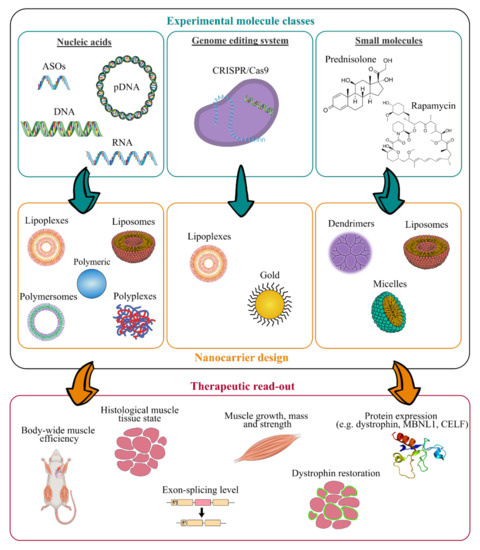
Figure 13. Work flow for the design of innovative nanomedicine and therapeutic readout. (ASOs, antisense oligonucleotides; CRISPR, clustered regularly interspaced short palindromic repeats).
As illustrated in
As illustrated inFigure 1, many experimental molecules and macromolecules have been selected as candidates for MD therapies, and a wide range of nanocarriers has allowed their delivery to skeletal muscles, promoting in most of the cases their therapeutic potential.
3, many experimental molecules and macromolecules have been selected as candidates for MD therapies, and a wide range of nanocarriers has allowed their delivery to skeletal muscles, promoting in most of the cases their therapeutic potential. The present section aims at highlighting nanosystems used for DMD and DM applications that reached preclinical studies. An overview of the various described nanosystems is reported in 2.Table 12.
co
|
Class of Nanocarriers Class of Nanocarriers |
Nanocarrier Composition Nanocarrier Composition |
Muscle Pathology Muscle Pathology |
Loaded Molecules LoadedMolecules |
Therapeutic Target Therapeutic Target |
Mouse Model Mouse Model |
Advantages and Limitations Advantages and Limitations |
Admin. Route Admin. Route |
Ref. Ref. |
|---|---|---|---|---|---|---|---|---|
|
Polymeric Polymeric |
PEI-PEG PEI-PEG |
DMD DMD |
2′-OMe ASO 2′-OMe ASO |
Dystrophin pre-mRNA Dystrophin pre-mRNA |
mdx mdx |
(+) high dystrophin-positive fibers increased (+) long term residual efficacy over 6 weeks (-) low general transfection efficiency (+) high dystrophin-positive fibers increased(+) long term residual efficacy over 6 weeks (-) low general transfection efficiency |
I.M. I.M. |
[55][163] |
|
PEI-PEG/PLGA PEI-PEG/PLGA |
DMD DMD |
2′-OMe ASO 2′-OMe ASO |
Dystrophin pre-mRNA Dystrophin pre-mRNA |
mdx mdx |
(-) no improvement compared to PEI-PEG-ASO (-) no improvement compared to PEI-PEG-ASO |
I.M. I.M. |
[56][164] | |
|
PEI-Pluronic® PEI-Pluronic® |
DMD DMD |
PMO ASO PMO ASO |
Dystrophin pre-mRNA Dystrophin pre-mRNA |
mdx mdx |
(+) dystrophin-positive fibers increased up to 4-fold after I.M. (+) dystrophin-positive fibers increased up to 3-fold in all skeletal muscles after I.V. (+) dystrophin-positive fibers increased up to 5-fold in heart after I.V. (+) low muscle tissue, liver and kidney toxicity (-) mild general transfection efficiency (+) dystrophin-positive fibers increased up to 4-fold after I.M.(+) dystrophin-positive fibers increased up to 3-fold in all skeletal muscles after I.V. (+) dystrophin-positive fibers increased up to 5-fold in heart after I.V. (+) low muscle tissue, liver and kidney toxicity (-) mild general transfection efficiency |
I.M./I.V. I.M./I.V. |
[57][165] | |
|
DMD DMD |
2′-OMe ASO 2′-OMe ASO |
Dystrophin pre-mRNA Dystrophin pre-mRNA |
mdx mdx |
(+) dystrophin-positive fibers increased up to 10-fold (+) dystrophin-positive fibers increased up to 10-fold |
I.M. I.M. |
[58][166] | ||
|
PEG-polycaprolactone PEG-(polylactic acid) PEG-polycaprolactonePEG-(polylactic acid) |
DMD DMD |
PMO ASO PMO ASO |
Dystrophin pre-mRNA Dystrophin pre-mRNA |
mdx mdx |
(+) dystrophin-positive fibers increased up to 3-fold (+) low muscle tissue toxicity (-) mild general transfection efficiency (+) dystrophin-positive fibers increased up to 3-fold(+) low muscle tissue toxicity (-) mild general transfection efficiency |
I.M. I.M. |
[59][167] | |
|
PMMA PMMA |
DMD DMD |
2′-OMe ASO 2′-OMe ASO |
Dystrophin pre-mRNA Dystrophin pre-mRNA |
mdx mdx |
(+) dystrophin-positive fibers increased up to 7-fold (-) slow biodegradability (+) dystrophin-positive fibers increased up to 7-fold(-) slow biodegradability |
I.P. I.P. |
[60][168] | |
|
PMMA/NIPAM PMMA/NIPAM |
DMD DMD |
2′-OMe ASO 2′-OMe ASO |
Dystrophin pre-mRNA Dystrophin pre-mRNA |
mdx mdx |
(+) dystrophin-positive fibers increased up to 4-fold (+) body-wide dystrophin restoration after I.V. (+) exon-skipping level enhanced up to 20-fold (+) long term residual efficacy over 90 days (+) dystrophin-positive fibers increased up to 4-fold(+) body-wide dystrophin restoration after I.V. (+) exon-skipping level enhanced up to 20-fold (+) long term residual efficacy over 90 days |
I.P./I.V. I.P./I.V. |
[61][62][169,170] | |
|
PEA PEA |
DMD DMD |
2′-OMe ASO 2′-OMe ASO |
Dystrophin pre-mRNA Dystrophin pre-mRNA |
mdx mdx |
(+) dystrophin-positive fibers increased up to 3–10-fold (+) dystrophin-positive fibers increased up to 3–10-fold |
I.M. I.M. |
[63][171] | |
|
DMD DMD |
PMO ASO PMO ASO |
Dystrophin pre-mRNA Dystrophin pre-mRNA |
mdx mdx |
(+) dystrophin-positive fibers increased up to 3-fold after I.M. (+) body-wide dystrophin-positive fibers increased up to 3-fold after I.V. (+) dystrophin-positive fibers increased up to 3-fold after I.M.(+) body-wide dystrophin-positive fibers increased up to 3-fold after I.V. |
I.M./I.V. I.M./I.V. |
[63][171] | ||
|
Muscle atrophy/ DMD Muscle atrophy/DMD |
pDNA pDNA |
Cell nucleus Cell nucleus |
mdx mdx |
(+) transfection efficiency enhanced up to 6-fold (+) transfection efficiency enhanced up to 6-fold |
I.M. I.M. |
[64][172] | ||
|
PLys-PEG PLys-PEG |
Muscle atrophy Muscle atrophy |
pDNA pDNA |
Cell nucleus Cell nucleus |
Balb/c Balb/c |
(+) transfection efficiency enhanced up to 10-fold (+) transfection efficiency enhanced up to 10-fold |
I.V. I.V. |
[65][173] | |
|
PPE-EA PPE-EA |
Muscle atrophy Muscle atrophy |
pDNA pDNA |
Cell nucleus Cell nucleus |
Balb/c Balb/c |
(+) transfection efficiency enhanced up to 13-fold (+) long term residual efficacy over 14 days (+) transfection efficiency enhanced up to 13-fold(+) long term residual efficacy over 14 days |
I.M. I.M. |
[66][174] | |
|
Atelocollagen Atelocollagen |
Muscle atrophy/ DMD Muscle atrophy/DMD |
siRNA siRNA |
Cytoplasm Cytoplasm |
mdx mdx |
(+) higher mass muscle increase (+) higher mass muscle increase |
I.M./I.V. I.M./I.V. |
[67][175] | |
|
PAMAM-OH PAMAM-OH |
Muscle atrophy Muscle atrophy |
Angiotensin (1–7) Angiotensin (1–7) |
Cytoplasm Cytoplasm |
Balb/c Balb/c |
(+) higher anti-atrophic effects (+) higher anti-atrophic effects |
I.P. I.P. |
[68][176] | |
|
Lipidic Lipidic |
PEG-bubble liposomes PEG-bubbleliposomes |
DMD DMD |
PMO ASO PMO ASO |
Dystrophin pre-mRNA Dystrophin pre-mRNA |
mdx mdx |
(+) dystrophin-positive fibers increased up to 1.5-fold (+) exon-skipping level enhanced up to 5-fold (+) dystrophin-positive fibers increased up to 1.5-fold(+) exon-skipping level enhanced up to 5-fold |
I.M. I.M. |
[69][177] |
|
DM1 DM1 |
PMO ASO PMO ASO |
Clcn1 pre-mRNA Clcn1 pre-mRNA |
HSALR HSALR |
(+) increased expression of Clcn1 protein up to 1.4-fold (+) increased expression of Clcn1 protein up to 1.4-fold |
I.M. I.M. |
[70][178] | ||
|
Nanolipodendrosomes Nanolipodendrosomes |
DMD DMD |
MyoD and GA MyoD and GA |
Cytoplasm Cytoplasm |
SW-1 SW-1 |
(+) slight mass muscle increase (+) slight mass muscle increase |
I.M. I.M. |
[71][179] | |
|
Nanoliposomes Nanoliposomes |
DMD DMD |
Glucocorticoide Glucocorticoide |
Cell nucleus Cell nucleus |
mdx mdx |
(+) lower inflammatory induced response (+) lower bone catabolic effects (+) lower inflammatory induced response(+) lower bone catabolic effects |
I.V. I.V. |
[72][180] | |
|
Hybrid liposomes DMPC and (C12(EO)23) Hybrid liposomes DMPC and (C12(EO)23) |
DMD DMD |
Gentamicin Gentamicin |
Ribosomes Ribosomes |
mdx mdx |
(+) dystrophin-positive fibers increased up to 4-fold (+) lower ototoxicity and nephrotoxicity (+) dystrophin-positive fibers increased up to 4-fold(+) lower ototoxicity and nephrotoxicity |
I.P. I.P. |
[73][181] | |
|
Perfluorocarbon Perfluorocarbon |
DMD DMD |
Rapamycin Rapamycin |
mTORC1 complex mTORC1 complex |
mdx mdx |
(+) high muscle strength increase (+) high cardiac contractile performance increase (+) high muscle strength increase(+) high cardiac contractile performance increase |
I.V. I.V. |
[74][182] | |
|
Lipid NPs Lipid NPs |
DMD DMD |
CRISPR/Cas9 CRISPR/Cas9 |
Dystrophin DNA sequence Dystrophin DNAsequence |
ΔEx44 ΔEx44 |
(+) dystrophin expression restored up to 5% (+) dystrophin expression restored up to 5% |
I.M. I.M. |
[75][183] | |
|
Inorganic Inorganic |
Gold Gold |
DMD DMD |
CRISPR/Cas9 CRISPR/Cas9 |
Dystrophin DNA sequence Dystrophin DNAsequence |
mdx mdx |
(+) HDR in the dystrophin gene enhanced up to 18-fold (+) HDR in the dystrophin gene enhanced up to 18-fold |
I.M. I.M. |
[76][184] |
3. Future Perspectives
The recent understanding of the pathogenic mechanisms of MDs highlights the urgent need of new and more effective treatments [77][78]. Nanomedicine demonstrated to enhance the therapeutic potential of gene therapy and drug repurposing approaches. As an example, pentamidine-loaded nanomedicines were used to explore the activity of the drug, not only as an anti-leishmaniasis agent but also as an anticancer agent to reduce drug associated toxicity, such as its severe nephrotoxicity [79][80]. Ongoing investigations are aimed at demonstrating the efficacy of this novel formulation to treat DM1 (study in progress).
To disclose the potential of nanomedicine application to MDs treatment, the gap between in vitro and in vivo testing has to be filled. In addition, to understand the fate of nanosystems once administered to MDs mice, biodistribution studies need to be addressed. To date, only a few investigations reported NPs biodistribution into skeletal muscles through different administration routes as I.V., I.P. and I.M. (tibialis anterior and gastrocnemius muscles) [65][81][82]. After systemic administration, NPs spread into tissues through blood systemic circulation, then, extravasate into the ECM before reaching muscle fibres. It has been suggested that the dense blood capillary network wrapping skeletal myofibers could be favourable to NPs accumulation and distribution following I.V. injection [83]. Hydrodynamic injection is also known to facilitate gene delivery by transient enhancement of the plasma membrane’s permeability [33][84][85]. However, the applied pressure due to the hindrance of the blood flow might cause oedema and inflammation, restricting the translation of this technique to clinic [86].
Overcoming the ECM barrier remains another important goal to improve NPs distribution in skeletal muscle fibres. Surface engineered nanosystems have been designed to actively promote the interaction between nanosystems and cells [87]. The high specificity of antibodies for their corresponding antigen provides a selective and potent approach for therapeutic NPs targeting [88]. As an example, the murine monoclonal antibody (3E10), capable of binding the surface of muscle cells, has been reported to improve active targeting [89][90]. However, no scientific studies on antibody-functionalised NPs have been conducted for skeletal muscle targeting so far. More commonly used, short peptides sequences (
e.g., ASSLNIA or SKTFNTHPQSTP) have proved promising as NPs functionalization for specific tissue-targeting [91][92][93]. Several examples of peptides targeting muscle cells have been reported [94][95][96] and association to nanosystems may lead to improved selectivity of NPs for skeletal muscle. Polymeric nanosystems have been functionalised with active targeting agents that preferentially bind active molecules or receptors expressed on the surface of muscle cells. Active targeting-dependent uptake has been demonstrated using PLGA nanocarriers functionalised with a muscle-homing peptide M12 [97]. Biodistribution studies revealed a preferential accumulation of targeted NPs in skeletal muscle cells in