
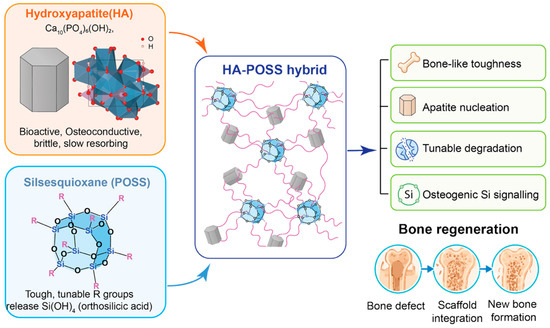
The repair of critical bone defects remains a substantial clinical challenge. A regenerative material must support osteogenesis, provide appropriate mechanical function, and degrade at a rate compatible with tissue formation. Hydroxyapatite (HA) is osteoconductive and chemically similar to bone mineral, but its brittleness and slow resorption limit its use as a stand-alone load-bearing material. Silsesquioxanes, particularly polyhedral oligomeric silsesquioxanes (POSS), provide molecularly defined silicon–oxygen frameworks with modifiable organic substituents. These can be incorporated as fillers or covalent network components. This review critically evaluates silsesquioxane-based biomaterials for bone regeneration. It distinguishes direct evidence from HA-containing systems from mechanistic analogues. These analogues include silicate-substituted HA, bioactive glass, dental POSS composites, and related polymer–POSS materials. Sol–gel processing, in situ mineralisation, particle incorporation, surface grafting, and network formation are assessed in relation to interfacial bonding, apatite nucleation, mechanical behaviour, and degradation. Current evidence indicates that reinforcement depends on cage functionality, dispersion, loading, matrix chemistry, and interfacial integration. Direct evidence that implanted HA–POSS systems release orthosilicic acid at biologically active concentrations remains unavailable. Cross-system comparisons further show that reported mechanical values cannot be ranked without accounting for physical form, porosity, test mode, and environmental conditions. The principal translational barriers are (i) the scarcity of load-bearing in vivo studies, (ii) uncertain degradation-product fate, and (iii) sterilisation sensitivity in some POSS-modified polymers. Further barriers are (iv) limited manufacturing standardisation and (v) the absence of clinically validated HA–POSS implants. The most defensible rationale for these hybrids is therefore their capacity for multifunctional interfacial design rather than universal mechanical superiority.
- hydroxyapatite
- polyhedral oligomeric silsesquioxane (POSS)
- organic–inorganic hybrid
- bone tissue engineering
- interfacial engineering
- biomineralisation
References
- Baldwin, P.; Li, D.J.; Auston, D.A.; Mir, H.S.; Yoon, R.S.; Koval, K.J. Autograft, allograft, and bone graft substitutes: Clinical evidence and indications for use in the setting of orthopaedic trauma surgery. J. Orthop. Trauma 2019, 33, 203–213.
- Bucholz, R.W. Nonallograft osteoconductive bone graft substitutes. Clin. Orthop. Relat. Res. 2002, 395, 44–52.
- Gupta, A.; Kukkar, N.; Sharif, K.; Main, B.J.; Albers, C.E.; El-Amin, S.F., III. Bone graft substitutes for spine fusion: A brief review. World J. Orthop. 2015, 6, 449–456.
- Viateau, V.; Guillemin, G.; Bousson, V.; Oudina, K.; Hannouche, D.; Sedel, L.; Logeart-Avramoglou, D.; Petite, H. Long-bone critical-size defects treated with tissue-engineered grafts: A study on sheep. J. Orthop. Res. 2007, 25, 741–749.
- Dimitriou, R.; Jones, E.; McGonagle, D.; Giannoudis, P.V. Bone regeneration: Current concepts and future directions. BMC Med. 2011, 9, 66.
- Zimmermann, E.A.; Ritchie, R.O. Bone as a structural material. Adv. Healthc. Mater. 2015, 4, 1287–1304.
- Liu, Y.; Luo, D.; Wang, T. Hierarchical structures of bone and bioinspired bone tissue engineering. Small 2016, 12, 4611–4632.
- Gupta, H.S.; Seto, J.; Wagermaier, W.; Zaslansky, P.; Boesecke, P.; Fratzl, P. Cooperative deformation of mineral and collagen in bone at the nanoscale. Proc. Natl. Acad. Sci. USA 2006, 103, 17741–17746.
- Aldegaither, N.; Sernicola, G.; Mesgarnejad, A.; Karma, A.; Balint, D.; Wang, J.; Saiz, E.; Shefelbine, S.J.; Porter, A.E.; Giuliani, F. Fracture toughness of bone at the microscale. Acta Biomater. 2021, 121, 475–483.
- Owen, G.R.; Dard, M.; Larjava, H. Hydroxyapatite/beta-tricalcium phosphate biphasic ceramics as regenerative material for the repair of complex bone defects. J. Biomed. Mater. Res. B Appl. Biomater. 2018, 106, 2493–2512.
- Rezwan, K.; Chen, Q.Z.; Blaker, J.J.; Boccaccini, A.R. Biodegradable and bioactive porous polymer/inorganic composite scaffolds for bone tissue engineering. Biomaterials 2006, 27, 3413–3431.
- Arcos, D.; Vallet-Regí, M. Sol–gel silica-based biomaterials and bone tissue regeneration. Acta Biomater. 2010, 6, 2874–2888.
- Bagheri, L.; Jafari-Gharabaghlou, D.; Dashti, M.-R.; Zarghami, N. An update on implication of POSS-based nanocomposites in bone tissue engineering: A review. J. Biomater. Sci. Polym. Ed. 2025, 36, 1587–1610.
- Ghanbari, H.; Cousins, B.G.; Seifalian, A.M. A nanocage for nanomedicine: Polyhedral oligomeric silsesquioxane (POSS). Macromol. Rapid Commun. 2011, 32, 1032–1046.