Digital entrepreneurship has increasingly become an ecosystem phenomenon in which digital infrastructure, human capital, innovation capacity, institutional support, finance, internationalization, sustainability, and digital resilience interact to shape entrepreneurial development. However, existing research remains fragmented and provides limited guidance for systematically assessing the maturity of national digital entrepreneurial ecosystems, particularly in small economies. This study develops the Digital Entrepreneurship Ecosystem Assessment Framework (DEEAF), a multidimensional conceptual framework integrating eight interconnected dimensions into a unified model for assessing ecosystem maturity. The authors developed the framework through a structured synthesis of the literature on entrepreneurial ecosystems, digital entrepreneurship, innovation systems, institutional economics, digital transformation, sustainability, and resilience. The study also proposes using the Analytic Hierarchy Process (AHP) to establish dimension weights and the Digital Entrepreneurship Ecosystem Index (DEEI) to support future empirical assessment and benchmarking. Cyprus is used as an illustrative small-economy context through which the framework’s relevance and practical applicability are examined. The conceptual analysis indicates that digital entrepreneurial performance cannot be understood through isolated indicators because weaknesses in infrastructure, skills, finance, innovation, institutions, internationalization, sustainability, or resilience can constrain the wider ecosystem. DEEAF contributes to the literature by integrating these dimensions within a single assessment architecture and by linking conceptual ecosystem analysis to a future measurement mechanism. The framework remains conceptual and requires empirical validation, expert-based AHP weighting, and implementation using national-level indicators.
Digital technologies, ref.
[1], have fundamentally transformed entrepreneurial activities by altering how opportunities are identified, developed, financed, commercialized, and scaled. Innovations like artificial intelligence (AI), cloud computing, digital platforms, data analytics, blockchain, the Internet of Things (IoT), and digital payment systems have lowered information and transaction costs, enabling ventures to reach customers, suppliers, investors, and international markets beyond traditional geographic limits
[2]. As a result, digital entrepreneurship has moved beyond merely adopting digital tools, now integrating these technologies into stages such as opportunity recognition, business-model creation, resource mobilization, value generation, and growth
[1,3,4][1][3][4].
This shift in focus has redirected attention from individual ventures to the larger ecosystems where digital entrepreneurship thrives. These ecosystems include interconnected entrepreneurs, governments, universities, investors, research institutions, technology providers, incubators, accelerators, and other stakeholders, whose resources, capabilities, and relationships shape entrepreneurial success
[5,6][5][6].
Digital technologies have further strengthened these connections by linking entrepreneurial activities to digital infrastructure, human capital, innovation systems, financial resources, institutional frameworks, international networks, and key issues such as sustainability and resilience. Nevertheless, despite growing research on digital entrepreneurship and ecosystems, the field remains conceptually fragmented, with ongoing uncertainty about how to integrate and assess the various components of digital entrepreneurial ecosystems
[7,8][7][8].
A key consequence of this fragmentation is the absence of a coherent framework for assessing the maturity of a national digital entrepreneurship ecosystem. Existing studies offer valuable explanations of digital entrepreneurship, identify ecosystem actors and relationships, and examine specific elements such as innovation, digital readiness, entrepreneurial finance, or institutional support
[5,9][5][9]. Nevertheless, these approaches offer limited guidance on systematically assessing the maturity of a national ecosystem across multiple interconnected dimensions. Assessing digital entrepreneurship through isolated indicators may capture individual aspects of ecosystem performance but does not adequately explain how technological, institutional, human, financial, innovative, and relational capabilities interact to shape an ecosystem’s overall capacity to support sustainable entrepreneurial development
[10,11][10][11]. In addition, existing approaches tend to examine infrastructure, finance, innovation, human capital, or institutional conditions in isolation, thereby providing limited explanation of how these conditions interact to produce ecosystem-level entrepreneurial capacity
[8,12,13][8][12][13].
This scholarly gap is especially critical in small- and medium-sized economies, where ecosystem components tend to be more interconnected. Unlike larger economies with vast domestic markets, abundant venture capital, extensive talent pools, and economies of scale, smaller economies often rely on digital technologies, innovation, internationalization, specialized human capital, and external networks to address structural challenges driven by market size and geographical barriers
[12,14][12][14]. In these settings, weaknesses in one area can limit the potential of others. For instance, having advanced digital infrastructure alone may not produce entrepreneurial value without the necessary digital skills and innovation capabilities. Similarly, a strong innovation capacity might still have limited commercial impact if access to finance, technology transfer, or international markets remains restricted. Therefore, a national assessment framework must account for these interdependencies rather than view ecosystem features as isolated indicators.
Artificial intelligence is closely linked to entrepreneurship because it impacts key entrepreneurial activities beyond just operational use. AI-powered analytics can enhance opportunity identification by detecting patterns in customer behaviour, market demand, and emerging trends
[6,15][6][15]. Meanwhile, predictive and generative AI tools help evaluate opportunities, develop products, test ideas, and make strategic choices. AI also reduces information-processing and transaction costs, enabling startups to perform tasks that once required significant financial or human resources
[9]. Therefore, AI’s role in entrepreneurship is both technological and strategic: it broadens entrepreneurs’ ability to discover and capitalize on opportunities while transforming how resources are obtained, coordinated, and used. Nonetheless, the advantages of AI adoption depend on complementary skills, including digital proficiency, data access, organizational preparedness, ethical governance, and institutional support. Thus, AI should be viewed as an enabling element within modern entrepreneurial ecosystems rather than a standalone technology
[16].
From an ecosystem-maturity standpoint, ref.
[9], these requirements link AI adoption to multiple DEEAF dimensions. Digital infrastructure provides the essential technological base for AI deployment; human capital supplies the skills needed to develop and operate AI; institutional support creates governance and regulatory frameworks; innovation capacity enables the transformation of AI capabilities into new products and processes; and digital resilience addresses the cybersecurity and continuity risks that come with greater technological reliance
[3,17][3][17].
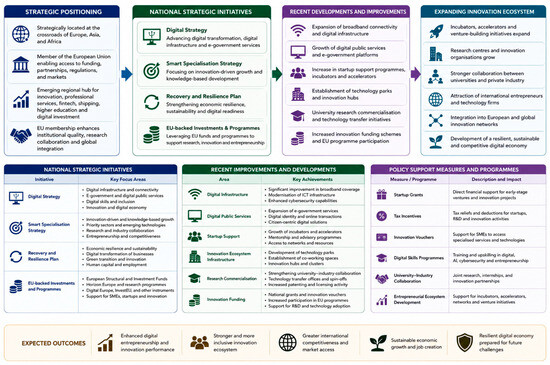
Overall, these developments show that Cyprus has key elements supporting digital entrepreneurship, such as solid digital infrastructure, institutional backing, research capabilities, and access to European markets. However, it also faces challenges related to market size, funding, skills, commercialization, and cybersecurity. Figure 1 visualizes these enabling factors and constraints, highlighting how the different components interact in shaping Cyprus’s digital entrepreneurial ecosystem.
Figure 1. Strategic Components Supporting the Development of the Digital Entrepreneurial Ecosystem in Cyprus.
Figure 1 outlines the key enabling conditions and structural constraints influencing the Cypriot digital entrepreneurial ecosystem. Instead of viewing these factors as isolated, the figure shows how they operate within the larger ecosystem, emphasizing the combined role of infrastructure, institutional support, innovation skills, human capital, financial resources, international links, and the growing need for resilience and sustainability in digital entrepreneurship.
Current studies on entrepreneurship in Cyprus have primarily focused on innovation policy, startup growth, economic diversification, and national competitiveness
[12,13][12][13]. In contrast, relatively little research has analyzed Cyprus’s digital entrepreneurial ecosystem using a cohesive conceptual framework to systematically evaluate its maturity across interrelated dimensions
[10]. Furthermore, earlier evaluation methods often relied on single metrics such as startup creation rates, venture capital funding, innovation spending, or digital infrastructure, and failed to capture the interconnections among institutional quality, technological preparedness, human resources, sustainability, financial accessibility, and global connectivity
[17].
This research emphasizes that Cyprus’s main challenge is not the lack of individual digital entrepreneurship initiatives but rather the absence of a cohesive framework that explains how different supporting factors interact within the ecosystem. Current assessments typically examine areas like technological readiness, innovation, funding, institutional quality, human capital, or internationalization in isolation. This piecemeal approach offers limited insight into whether improving one aspect can compensate for weaknesses in another or whether a mature ecosystem requires the simultaneous development of multiple capabilities. Such constraints are particularly critical for small economies, where limited markets, scarce investments, talent gaps, and dependence on international networks create complex interdependencies among ecosystem components.
Thus, a more comprehensive assessment framework is necessary to view digital entrepreneurship as a multidimensional ecosystem phenomenon, rather than merely a result of technological adoption. This framework should incorporate traditional entrepreneurial ecosystem factors alongside new conditions associated with digital transformation, such as artificial intelligence, sustainability, cybersecurity, and digital resilience.
Gaps in current research on Cyprus underscore the need for an integrated perspective. Past studies mainly focus on innovation policy, startup growth, economic diversification, digital transformation, and national competitiveness, with limited efforts to assess the maturity of the country’s digital entrepreneurial ecosystem using a unified conceptual model
[10,12,13][10][12][13]. Similarly, existing evaluation methods often concentrate on individual metrics like startup activity, venture capital, innovation spending, or digital infrastructure, without adequately considering how institutional quality, technological readiness, human capital, financial access, sustainability, internationalization, and resilience interrelate
[17]. The key issue is not the lack of specific digital entrepreneurship initiatives but the absence of an analytical framework for understanding how these capabilities collectively influence ecosystem maturity.
Against this background, this study introduces the Digital Entrepreneurship Ecosystem Assessment Framework (DEEAF), a multidimensional model for evaluating the maturity of national digital entrepreneurial ecosystems. Building on theoretical perspectives from entrepreneurial ecosystem theory, digital entrepreneurship, innovation systems, institutional economics, digital transformation, sustainability, and resilience, DEEAF conceptualizes digital entrepreneurial maturity as a systemic outcome arising from the interaction of eight interconnected dimensions: digital infrastructure, human capital, innovation capacity, institutional support, access to finance, internationalization, sustainability, and digital resilience
[14,18][14][18].
In response to the identified gap in existing approaches, which tend to examine individual ecosystem factors rather than their interrelationships within a unified assessment structure, the study aims to develop a theoretically grounded and practically useful framework for evaluating digital entrepreneurship ecosystem maturity. To support systematic assessment, DEEAF incorporates the Analytic Hierarchy Process (AHP) to assess the relative importance of its dimensions and proposes a composite Digital Entrepreneurship Ecosystem Index (DEEI) to support future empirical assessment, benchmarking, and ongoing monitoring.
Cyprus serves as an illustrative case of a small economy, demonstrating the framework’s relevance and its potential applicability to other economies with similar structural characteristics. The study contributes to the literature by shifting the focus from describing digital entrepreneurial ecosystems towards systematically conceptualizing and assessing their maturity through the integration of technological, institutional, human capital, financial, international, sustainability, and resilience dimensions within a unified framework. Importantly, DEEAF remains conceptual and has not yet been empirically tested; at this stage, its primary purpose is to provide a consistent foundation for future empirical research, national benchmarking, policy assessment, and comparative studies of Cyprus and other small- or medium-sized economies undergoing digital transformation.