Employee experience management (EXM) is a strategic and systematic approach through which organisations design, coordinate, and continuously improve the structural conditions, organisational mechanisms, and interactions in the workplace. These interactions shape the experiences lived by employees throughout their professional trajectory. Based on organisational psychology, human resource management (HRM), organisational behaviour, human-centred design, and technological studies, EXM seeks to understand how employees perceive, interpret, and attribute meaning to their interactions with organisational environments. Employee experience (EX) thus emerges from the dynamic interaction between structural conditions, organisational mechanisms, and the psychological interpretation that employees make of their experiences in the workplace, influencing well-being, engagement, performance, and organisational sustainability.
Employee experience management (EXM) has emerged as a central concept in contemporary people management, reflecting the transition from traditional approaches to human resource management (HRM) towards more systemic, people-centred and experience-oriented perspectives. This evolution has been influenced by the development of the experience economy, which recognised experiences as a source of value creation and competitive differentiation
[1], as well as by research on customer experience, which has demonstrated the importance of perceptions, emotions and interactions in building relationships between individuals and organisations
[2].
In this context, there has been a growing recognition that employees, just like customers, continually interpret their interactions with leaders, colleagues, technologies, organisational processes and work environments. Consequently, employee experience (EX) is now considered a key element in understanding how individuals perceive, interpret and respond to organisational life
[3][4][3,4].
A review of recent literature suggests that EX goes beyond traditional concepts such as job satisfaction, organisational commitment or engagement. Rather than merely representing an attitudinal outcome, the experience corresponds to a broader, more dynamic and cumulative phenomenon. It emerges through workplace interactions that occur across employees’ organisational journeys
[5][6][5,6].
From this perspective, EX is understood as a continuous process of interpretation and meaning making. Each interaction with supervisors, colleagues, customers, technologies, management practices or organisational systems contributes to the formation of perceptions that evolve over time and influence attitudes, behaviours, well-being, performance and the employee’s relationship with the organisation itself.
Drawing on the work of refs.
[3][4][7][3,4,7] and contemporary literature on organisational behaviour, the EX can be defined as the lived experience through which individuals perceive, interpret, emotionally respond to and assign meaning to the structural conditions, organisational practices, social interactions and psychological exchanges encountered throughout their careers. It reflects not only what the organisation offers its employees but above all the way in which they understand and experience these interactions over time.
Our definition emphasises that EX is both organisationally enabled and individually experienced. Organisations create structures, processes and conditions that frame the experience, but it is the employees who construct the meaning of these conditions through ongoing processes of psychological and social interpretation.
Based on this understanding, EXM can be defined as a strategic and systematic process through which organisations design, coordinate and continuously improve the structural conditions, organisational mechanisms and workplace interactions that shape employees’ lived experiences throughout their employment journey.
This definition positions EXM as a comprehensive organisational capability, rather than merely a set of isolated human resources practices. The experience arises from the interaction between organisational systems, culture, leadership, technology and the processes of meaning-making developed by the employees themselves.
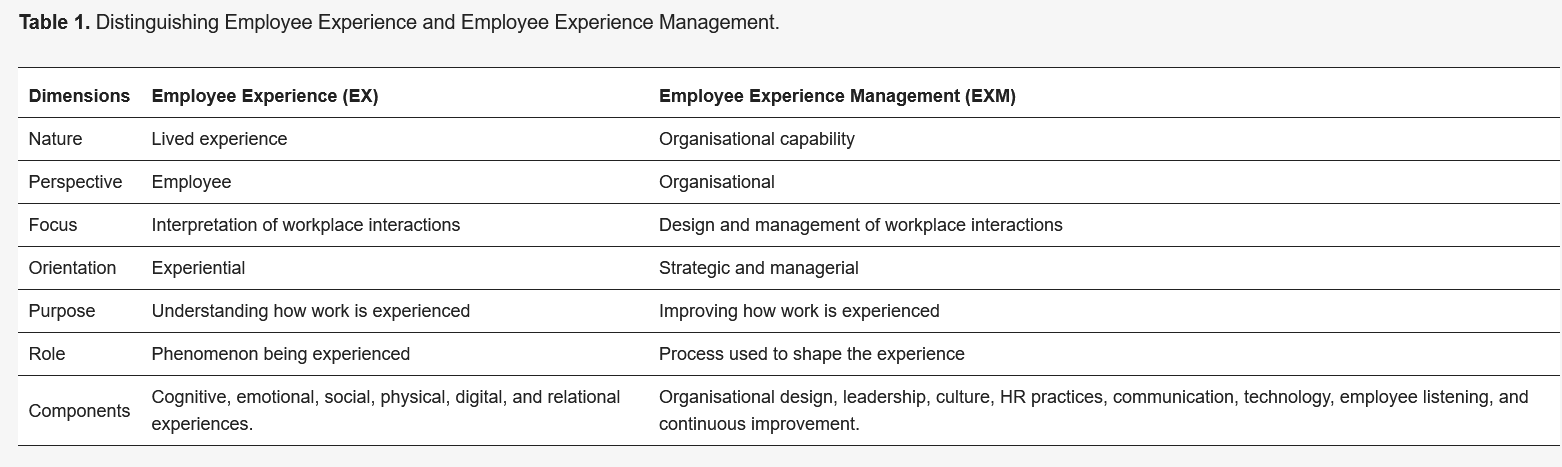
Although closely related, EX and EXM represent distinct concepts. EX refers to the lived and interpreted experiences accumulated through employees’ interactions with organisational environments throughout their employment journey. EXM, by contrast, refers to the organisational capability through which organisations intentionally design, coordinate and improve the conditions, practices and interactions that shape those experiences. In this sense, EX constitutes the phenomenon being experienced, whereas EXM represents the managerial approach used to influence and enhance that experience (Table 1).
Table 1. Distinguishing Employee Experience and Employee Experience Management.
Despite growing academic and professional interest in the subject, the field continues to present significant conceptual challenges. EX is frequently analysed alongside concepts such as engagement, organisational climate, organisational culture, satisfaction and well-being, without their clearly defined conceptual boundaries
[8]. This situation has contributed to some theoretical ambiguity and hindered the development of cumulative knowledge.
This article analyses the evolution and theoretical foundations of EXM and proposes an integrative perspective for understanding how experience is constructed within organisations. This synthesis stems from various contributions from organisational psychology, HRM, organisational behaviour, human-centred design and technology studies.
This encyclopedia entry aims to synthesise current knowledge on EX and EXM across organisational psychology, HRM, organisational behaviour, human-centred design, and technology-related research.
Rather than proposing a new theory, the article integrates existing literature into a coherent framework that helps explain how EX is produced and managed within organisations. The integrative perspectives presented throughout the article should therefore be understood as literature-based conceptual syntheses intended to organise existing knowledge rather than empirically validated causal models.
The content of this encyclopedia entry is based on a narrative synthesis of foundational and contemporary literature on EX and EXM. Relevant publications were identified through searches in major academic databases, including Scopus, Web of Science and Google Scholar, using keywords such as “employee experience”, “employee experience management”, “employee engagement”, “employee journey”, “organisational climate”, “organisational culture”, and “employee well-being”. Priority was given to peer-reviewed journal articles, academic books and influential theoretical contributions, complemented by recent research reflecting contemporary developments in the field.
The selected literature includes both seminal contributions that established the foundations of EX research and recent studies reflecting current developments in organisational psychology, HRM, organisational behaviour and digital workplace research.
The main contribution of this entry is the integration of dispersed literature into a multidimensional framework that connects structural conditions, organisational mechanisms and psychological interpretation. Unlike many existing EX models that primarily classify dimensions or lifecycle stages, this framework seeks to explain how EX develops through the interaction between structural conditions, organisational mechanisms and psychological interpretation.