The adoption of data science in manufacturing has significantly advanced process performance, quality assurance, and decision-support capabilities. Key applications include optimization of process parameters, development of online advisory tools, predictive defect analysis, energy usage forecasting, and real-time system monitoring. In recent years, many industrial sectors have integrated data models into digital twin and digital shadow environments, enabling dynamic process optimization and facilitating data-informed operational decisions.
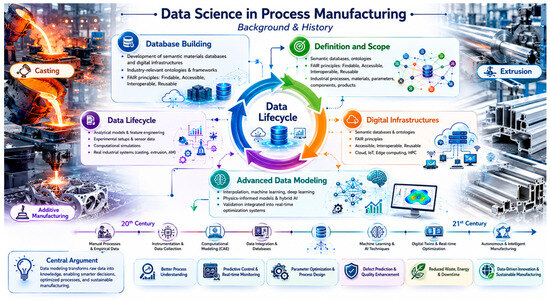
Definition and Scope: Data science in materials process engineering can be understood as the structured application of advanced computational and analytical techniques, such as numerical solvers, interpolation methods, and machine learning algorithms, to extract meaningful knowledge from complex, multi-physical, and multiscale data generated across the materials lifecycle. This work presents a comprehensive perspective on the role of data-driven approaches in process design, optimization, and control, highlighting current methodologies, prevailing trends, and future research directions in the domain.
The scope of this review spans the full data lifecycle, beginning with data acquisition from a wide range of sources, including analytical formulations, laboratory experiments, high-fidelity simulations, and real industrial operations. These data sources encompass both real-time sensor measurements and offline datasets obtained from controlled studies and computational models. Key challenges, such as data heterogeneity, quality assurance, scalability, and consistency, are critically examined, along with established practices for data preprocessing, curation, standardization, and effective metadata management to support reliable and reproducible data-driven modeling.
A major focus is placed on the development of semantic materials databases and digital infrastructures that support industry-relevant ontological frameworks and comply with FAIR principles (Findable, Accessible, Interoperable, and Reusable). This includes the creation of custom repositories and domain-specific knowledge datasets tailored to materials engineering applications (see Figure 1).
Figure 1. Pictorial view of data science components for manufacturing processes featuring different aspects of industrial digitalization.
The article further explores advanced data modeling techniques, including interpolation, machine learning, and model validation within industrial environments. It examines how these models integrate into real-time control systems, predictive-corrective frameworks, digital twins, and autonomous feedback loops for intelligent manufacturing. Emerging trends such as dynamic database construction, hybrid control systems, transfer learning for human–machine interfaces, and generative data modeling are also discussed.
Finally, the paper highlights the industrial impact of data-driven materials processing and identifies critical future directions, including the establishment of standardized benchmarks, cross-platform interoperability, and the convergence of data models with high-throughput experimentation, cost-efficiency strategies, and next-generation manufacturing technologies. This work serves as an authoritative reference for researchers, engineers, and technologists working at the intersection of materials science, manufacturing, and data science.
Motivation: The evolution of advanced materials and the inherently complex, multi-physical characteristics of modern manufacturing processes, combined with heightened requirements for efficiency, sustainability, and performance, has intensified the demand for more intelligent and adaptive engineering solutions. Traditional methodologies, such as trial-and-error experimentation, physics-based models, and high-resolution numerical simulations, provide critical insights but are often insufficient to fully represent the nonlinear and multiscale dynamics of real-world processing systems. At the same time, the rapid expansion of data generated from high-throughput experiments, embedded sensors, and simulation platforms has created unprecedented opportunities. However, much of this data remains underexploited, particularly for real-time decision-making and process control. The advancement of data-driven methodologies is therefore motivated by the need for autonomous, data-enabled systems and the increasing accessibility of complex, multi-source datasets. These approaches present a transformative pathway toward improved process understanding, enhanced robustness, and intelligent real-time optimization in manufacturing systems.
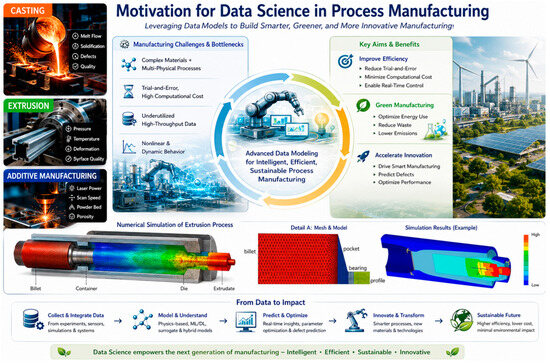
By integrating machine learning algorithms, physics-informed analytics, and advanced data modeling techniques into materials process engineering, researchers and practitioners can uncover hidden patterns, predict defects, and optimize performance with unprecedented precision. As the field moves toward autonomous experimentation and smart manufacturing, a systematic understanding of how to apply data science, from acquisition and infrastructure development to database construction and sampling strategies is essential. Figure 2 illustrates a pictorial summary of motivations, key targets and benefits for implementing data science in manufacturing processes.
Figure 2. Pictorial illustration of data science motivation and benefits for process manufacturing.
Publishing a comprehensive, forward-looking reference on this topic serves not only to consolidate fragmented knowledge across manufacturing domains but also to provide a strategic roadmap for future research, standardization, and industrial implementation. Such a contribution will guide future directions, foster interdisciplinary collaboration among materials scientists, data scientists, and process engineers, and support the transition toward intelligent, sustainable manufacturing ecosystems.
Historical Context: Over the past two decades, the integration of data science into manufacturing has evolved significantly, driven by advances in digital technologies, sensor networks, and computational capabilities. Early applications in the late 20th and early 21st centuries focused on statistical process control (SPC) and design of experiments (DOEs), establishing the foundation for data-driven methodologies in industrial settings
[1][2][3][4][5][6][7][8][9][1,2,3,4,5,6,7,8,9]. Techniques such as multivariate analysis, neural networks, and support vector machines were initially explored for fault detection, process optimization, and property prediction
[10][11][12][13][14][15][16][17][18][10,11,12,13,14,15,16,17,18]. However, widespread adoption was limited by constrained computational resources and fragmented data ecosystems.
The early 2000s saw the emergence of data mining and business intelligence tools, enabling manufacturers to uncover hidden patterns in production data
[19][20][21][22][23][24][25][26][27][28][19,20,21,22,23,24,25,26,27,28]. As global competition intensified and product lifecycles shortened, the need for agile, data-informed decision-making became more pronounced, leading to the adoption of more sophisticated analytics aimed at improving operational flexibility, reducing waste, and enhancing responsiveness. A major turning point occurred in the 2010s with the rise of Industry 4.0, which emphasized the integration of cyber-physical systems, IoT-enabled data acquisition, and real-time analytics
[29][30][31][32][33][34][35][36][37][38][39][40][41][42][43][44][45][46][47][48][49][29,30,31,32,33,34,35,36,37,38,39,40,41,42,43,44,45,46,47,48,49]. During this period, machine learning and predictive modeling became central to process optimization, quality assurance, and predictive maintenance. In parallel, the materials processing domain began to embrace data science more deeply, enabled by improvements in sensor technology, digital storage, and computational modeling
[50][51][52][53][54][55][56][57][58][59][60][61][62][63][64][50,51,52,53,54,55,56,57,58,59,60,61,62,63,64].
Highlighted by a critical review of developments over the past five decades, the evolution of data science techniques in manufacturing has progressed from statistically grounded, domain-informed methodologies toward increasingly complex, data-driven and integrated frameworks. Early techniques such as SPC and DOEs provide robust and interpretable tools for quality assurance and process optimization, relying heavily on structured experiments and well-defined assumptions. While these methods offered strong reliability and transparency, their capability to address highly nonlinear and multivariate industrial processes remained limited. The subsequent introduction of multivariate analysis, neural networks, and support vector machines marked a shift toward more flexible modeling of complex relationships; however, their adoption was constrained by computational limitations and insufficient data infrastructure.
The emergence of data mining and business intelligence in the early 2000s significantly improved the ability to extract actionable insights from large production datasets, enabling more adaptive and data-informed decision-making. Nevertheless, these approaches often remained retrospective and dependent on data availability and quality. The advent of Industry 4.0 in the 2010s, which integrated cyber-physical systems, IoT, and real-time data analytics, enabled advanced machine learning models to support predictive maintenance, dynamic process optimization, and digital twin frameworks. Despite their enhanced predictive capabilities, modern approaches face critical challenges related to data quality, model interpretability, generalizability, and integration with physical knowledge. Overall, the evolution reflects a transition from reliability and interpretability toward scalability and predictive power, highlighting the ongoing need for hybrid, physics-informed, and data-efficient modeling strategies
[65][66][67][68][69][70][71][72][65,66,67,68,69,70,71,72].
Key developments included the creation of open-access materials databases, the use of machine learning for structure–property prediction, and the application of reinforcement learning (RL) and Bayesian optimization for autonomous process control. RL has emerged as a highly promising data-driven technique for process control and optimization, particularly in complex and dynamic manufacturing environments. Unlike traditional control strategies that rely on predefined models or static optimization, RL enables systems to learn optimal control policies through iterative interaction with the process environment, using feedback in the form of rewards or penalties. This makes RL especially well-suited for handling nonlinear, multivariate, and time-dependent process behaviors where explicit modeling is difficult or impractical. In manufacturing applications, RL has demonstrated significant potential in areas such as adaptive process control, real-time optimization, scheduling, and energy management. Despite these advancements, challenges such as data heterogeneity, lack of standardization, limited model interpretability, and cultural resistance within conservative industrial sectors persisted
[73][74][75][76][77][78][79][73,74,75,76,77,78,79].
Lessons learned from this historical progression underscore the importance of hybrid modeling approaches that integrate domain expertise with data-driven inference, the necessity of high-quality, context-rich datasets, and the value of interdisciplinary collaboration. Looking ahead, the convergence of data science, materials engineering, and manufacturing technologies is expected to enable fully autonomous, adaptive, and sustainable processing systems. These systems will be underpinned by robust data infrastructures, transparent AI models, and intelligent feedback mechanisms, reflecting a broader shift toward knowledge-driven engineering, where data actively guide real-time decision-making in complex material systems.
In summary, manufacturing process modeling has evolved from traditional statistical and physics-based methods to data-driven and machine learning approaches capable of capturing complex, nonlinear process behavior. Although these techniques offer enhanced predictive performance and real-time decision-making capabilities, challenges associated with data quality, generalization, interpretability, and industrial deployment persist. Consequently, hybrid frameworks that combine data science, machine learning, and domain-specific engineering knowledge are emerging as the most promising pathways toward robust, scalable, and intelligent manufacturing systems.
A critical review of the historical progression of data science techniques in industrial processes over the past fifty years highlights a clear transition from robust, interpretable, and domain-driven methods toward highly flexible, data-intensive, and automated approaches. Early statistical techniques emphasized reliability, transparency, and strong physical intuition, but were limited in handling complex, nonlinear systems. Subsequent advances in machine learning introduced greater modeling flexibility and predictive capability, yet often at the cost of interpretability and higher data dependence. The emergence of Industry 4.0 further enabled real-time analytics and system integration, significantly enhancing responsiveness and scalability. However, this evolution has also revealed persistent challenges, particularly regarding data quality, model generalizability, and the integration of data-driven models with physical knowledge. A key lesson is that no single methodology is universally sufficient; instead, the most effective solutions increasingly rely on hybrid approaches that combine data-driven techniques with domain expertise. Overall, the field has shifted from data scarcity to data complexity, underscoring the importance of balanced, context-aware, and scientifically grounded modeling strategies.