Sickle Cell Disease (SCD) is a pervasive monogenic disorder characterized by chronic hemolytic anemia, unpredictable vaso-occlusive crises, and progressive multi-organ damage, representing a significant global health burden. Driven by a point mutation in the β-globin gene, the resulting abnormal Hemoglobin S (HbS) polymerizes under deoxygenated conditions, leading to erythrocyte sickling and systemic endothelial dysfunction. While supportive therapies such as hydroxyurea and transfusions manage symptoms, the mandate for definitive curative therapies is urgent. Historically, allogeneic hematopoietic stem cell transplantation (HSCT) utilizing matched sibling donors (MSD) has been the sole curative option, offering high survival rates but constrained by limited donor availability and the risk of graft-versus-host disease (GVHD). Consequently, alternative donor sources, including matched unrelated donors, umbilical cord blood, and haploidentical donors, have expanded patient access, particularly with the integration of post-transplant cyclophosphamide (PTCy) to mitigate alloreactivity. Concurrently, the advent of autologous gene therapy, encompassing lentiviral gene addition (Lyfgenia) and CRISPR-Cas9 gene editing (Casgevy) offers a revolutionary donor-independent approach that eliminates GVHD risk. Lyfgenia employs a lentiviral vector to introduce an anti-sickling βT87Q hemoglobin variant into autologous hematopoietic stem cells, while Casgevy employs CRISPR-Cas9 to disrupt the erythroid-specific enhancer of the BCL11A transcription factor, derepressing γ-globin expression and elevating fetal hemoglobin. This review synthesizes the pathophysiological mechanisms of SCD, evaluates the clinical outcomes and limitations of both allogeneic HSCT and autologous gene therapies, and outlines the clinical decision-making paradigms and future innovations required to achieve equitable global access to these transformative treatments.
This review advances a central argument: that the field of curative therapy for Sickle Cell Disease has reached an inflection point at which the primary barrier to progress is no longer biological but structural
[1][2][1,2]. The science of curing SCD is, by any measure, mature: two autologous gene therapies (Casgevy and Lyfgenia) received FDA approval in December 2023
[1][3][4][1,3,4], haploidentical transplantation with post-transplant cyclophosphamide achieves outcomes comparable to matched sibling transplant
[1][5][6][1,5,6], and myeloablative conditioning protocols are well established
[5][7][8][5,7,8]. What has not kept pace is the architecture of delivery. Curative therapies remain concentrated in high-income, high-infrastructure settings
[1][9][1,9], while approximately 75% of global SCD births occur in sub-Saharan Africa
[2][9][10][2,9,10], where gene therapy remains unavailable and transplant infrastructure is limited to seven countries
[1][11][1,11], serving a population of over 300 million affected individuals
[12]. This review therefore evaluates allogeneic hematopoietic stem cell transplantation (HSCT) and autologous gene therapy not only on their clinical efficacy but on their scalability, logistical requirements, and fitness for deployment across diverse healthcare environments, a lens that distinguishes this synthesis from descriptive overviews of existing literature.
Sickle Cell Disease (SCD) represents a group of inherited hemoglobinopathies that constitute a profound global health burden, characterized by chronic hemolytic anemia, unpredictable vaso-occlusive crises, and progressive multi-organ damage
[2][13][14][2,13,14]. As a monogenic disorder with complex systemic manifestations, SCD remains a primary focus of hematologic research due to its significant morbidity and mortality. At its molecular core, SCD is caused by a highly specific single-point mutation in the β-globin gene (
HBB) located on chromosome 11, where the nucleotide adenine is substituted by thymine (GAG → GTG)
[13][14][13,14]. This genetic alteration results in the replacement of the hydrophilic amino acid glutamic acid with the hydrophobic amino acid valine at the sixth position of the β-globin protein chain, leading to the production of abnormal Hemoglobin S (HbS)
[13][14][13,14].
The primary driver of the disease’s clinical severity is the behavior of HbS under physiological stress. Unlike normal adult Hemoglobin A (HbA), which remains soluble regardless of oxygen tension, HbS molecules undergo rapid hydrophobic interactions and polymerize into long, rigid, multi-stranded filaments when deoxygenated
[13][15][13,15]. This polymerization fundamentally alters the erythrocyte’s structure, distorting it from a flexible biconcave disc into a rigid, “sickle” shape
[13][14][13,14]. This morphological change is initially reversible upon reoxygenation, but repeated cycles of sickling and unsickling eventually lead to permanent membrane damage and a perpetually dehydrated, dense erythrocyte
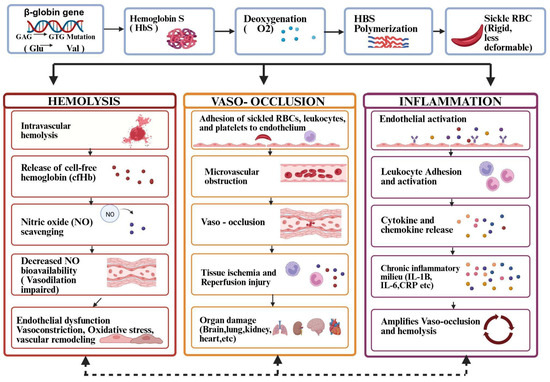
[13][14][13,14]. The pathophysiology of SCD is an integrated process involving rheological obstruction, hemolysis, and systemic inflammation
[13][14][13,14]. The rigid, sickled cells possess increased adherence to the vascular endothelium, primarily in the post-capillary venules, which triggers vaso-occlusion
[13][14][13,14]. Furthermore, the fragile nature of the sickled membrane leads to both intravascular and extravascular hemolysis
[13][14][13,14]. The resulting release of cell-free hemoglobin and arginase into the plasma depletes nitric oxide, a critical vasodilator, thereby driving systemic endothelial dysfunction, oxidative stress, and a chronic inflammatory milieu
[14].
These mechanisms culminate in the hallmark of the disease: the vaso-occlusive episode (VOE)
[2][13][14][2,13,14]. Beyond acute pain, these episodes can manifest as life-threatening acute chest syndrome (ACS), cerebral infarcts leading to overt stroke, and splenic sequestration
[13][14][13,14]. Over the long term, repeated ischemic insults and chronic hemolysis result in irreversible organ damage, including chronic kidney disease, pulmonary hypertension, and osteonecrosis, which significantly shorten life expectancy
[2][13][2,13]. The integrated pathophysiology of SCD is summarized in
Figure 1.
Figure 1. Pathophysiology of Sickle Cell Disease: From Molecular Mutation to Systemic Consequence. A point mutation in the β-globin gene (GAG → GTG) substitutes valine for glutamic acid at position 6, producing Hemoglobin S (HbS). Under deoxygenated conditions, HbS polymerizes into rigid fibers, distorting erythrocytes into the characteristic sickle morphology. This triggers three parallel downstream pathways: hemolysis (
top), characterized by intravascular red cell destruction, release of cell-free hemoglobin, nitric oxide depletion, and progressive endothelial dysfunction; vaso-occlusion (
center), in which rigid sickled cells obstruct the microvasculature, causing recurrent tissue ischemia and cumulative end-organ damage including chronic kidney disease, pulmonary hypertension, osteonecrosis, and stroke; and systemic inflammation (
bottom), driven by leukocyte and platelet activation, endothelial adhesion molecule upregulation, and a self-perpetuating chronic inflammatory milieu. These three pathways are mechanistically interconnected and collectively account for the clinical severity of SCD. Created in BioRender. Vallabhaneni, H. (2026)
https://BioRender.com/wykbwq9.
Epidemiologically, SCD is one of the most common and lethal genetic disorders worldwide. It is estimated that over 300,000 infants are born with SCD annually, with a disproportionate burden, approximately 75% of cases occurring in Sub-Saharan Africa
[2][3][9][10][16][2,3,9,10,16]. While newborn screening and comprehensive prophylactic care have transformed SCD into a manageable chronic condition in high-income countries, mortality remains alarmingly high in low-resource settings, where many children succumb to infection or anemia before the age of five
[9][17][18][9,17,18]. The disparity in outcomes is stark: median survival exceeds 50 years in the United States
[19], while early-life mortality in parts of sub-Saharan Africa reaches 50–90%
[17][18][17,18], with many children succumbing to infection or anemia before age five
[9], underscoring a critical global health inequality.
The clinical heterogeneity of SCD is shaped by both genotype and haplotype
[20]. At the genotypic level, SCD encompasses several distinct molecular entities beyond the classic homozygous HbSS genotype, including sickle cell-β thalassemia (HbSβ-thal) and compound heterozygous HbSC
[20]. HbSβ
0-thalassemia, in which no functional β-globin is produced from the affected allele, results in a phenotype clinically similar to HbSS in terms of severity and complication profile
[20]. By contrast, HbSβ
+-thalassemia, in which residual β-globin production is preserved, typically produces a milder phenotype with higher baseline hemoglobin levels
[20]. The compound heterozygous HbSC genotype, arising from coinheritance of one HbS and one HbC allele, produces an intermediate phenotype notable for a higher hematocrit and distinct complication patterns including proliferative retinopathy and splenic complications persisting into adulthood
[20]. Disease severity varies considerably based on these genetic factors and baseline fetal hemoglobin levels
[6][21][6,21].
Current therapeutic strategies remain largely supportive. Hydroxyurea, the pharmacological mainstay approved by the FDA in 1998
[22], functions primarily by inducing the production of fetal hemoglobin (HbF), which prevents HbS polymerization
[6][14][21][6,14,21]. While the clinical efficacy of hydroxyurea is primarily due to its HbF induction, the exact mechanism of how it increases HbF remains not fully understood
[6]. Additionally, chronic blood transfusions are utilized to dilute HbS concentrations and reduce the risk of stroke
[14]. However, these treatments require lifelong adherence and carry risks of iron overload and alloimmunization
[22][23][22,23].
Hematopoietic stem cell transplantation (HSCT) was the only established curative option until late 2023, when two autologous gene therapies received FDA approval
[3][4][3,4], though HSCT remains more widely accessible and has decades of outcome data
[1][24][1,24]. Allogeneic HSCT offers a 90% success rate with suitable donors
[7][24][7,24], but its application is severely limited by the scarcity of HLA-matched sibling donors, with less than 20–25% of patients having a suitable donor
[16][25][16,25]. Furthermore, individuals with SCD face an elevated risk of complications during stem cell transplantation, including graft-versus-host disease and graft rejection
[4][7][4,7]. Consequently, there is an urgent clinical mandate to advance curative approaches, such as gene editing and lentiviral-based gene therapy, to provide definitive resolution for this debilitating condition
[1][2][3][1,2,3].
Literature Search Strategy
A structured narrative review was conducted to synthesize the clinical and translational evidence base for curative therapies in SCD. Electronic searches were performed in PubMed/MEDLINE, Embase, and ClinicalTrials.gov from inception through March 2026. Search terms included combinations of the following: “sickle cell disease”, “hematopoietic stem cell transplantation”, “haploidentical transplantation”, “post-transplant cyclophosphamide”, “gene therapy”, “lentiviral vector”, ”CRISPR-Cas9”, “BCL11A”, “Lyfgenia”, “Casgevy”, “exagamglogene autotemcel”, and “lovotibeglogene maroxaparvovec”. Reference lists of included articles and relevant systematic reviews were manually screened for additional sources. Priority was given to prospective clinical trials, peer-reviewed cohort studies, and authoritative consensus documents; case reports and non-peer-reviewed sources were excluded. As this is a narrative rather than a systematic review, a formal PRISMA protocol was not registered; the synthesis is therefore subject to inherent selection bias, and the authors acknowledge this limitation explicitly. The review focuses on comparative clinical outcomes, decision-making frameworks, and equity-of-access considerations rather than exhaustive enumeration of all available literature.