
The transition from traditional wastewater treatment to Water Resource Recovery Facilities (WRRFs) requires highly selective, energy-efficient separation technologies. Electro-driven membranes (EDMs), including Electrodialysis (ED) and Membrane Capacitive Deionization (MCDI), offer a mechanistic advantage over pressure-driven systems like Reverse Osmosis (RO) by actively transporting charged solute ions rather than forcing bulk water molecules through a semi-permeable barrier. This topic review explores the fundamentals of EDMs, highlighting their operational sweet spots for low-to-moderate salinity streams. It critically examines the application of EDMs in urban mining—specifically the extraction of critical minerals (e.g., lithium) and agricultural nutrients (e.g., phosphate and ammonium) from aqueous waste. Furthermore, it addresses current technical bottlenecks, including monovalent ion selectivity, membrane fouling, and the thermodynamic limits of specific energy consumption (SEC), charting the future trajectory of electrochemical water mining in a circular economy.
- Electro-driven membranes
- resource recovery
- electrodialysis
- membrane capacitive deionization
- urban mining
- specific energy consumption
- monovalent ion selectivity
- circular economy.
- bipolar membranes
- chemical upcycling
1. Introduction
The global paradigm of water management is undergoing a fundamental shift. For decades, wastewater treatment plants operated with a singular objective: the removal and destruction of contaminants to safely discharge effluent into the environment. Today, driven by global resource scarcity and the principles of a circular economy, these systems are being reconceptualized as Water Resource Recovery Facilities (WRRFs).[1] Aqueous waste streams, including industrial brine, municipal wastewater, and agricultural runoff, are no longer viewed merely as environmental hazards, but as low-grade resource reservoirs ripe for "urban mining".[2]
Traditional desalination and separation technologies, primarily Reverse Osmosis (RO), are pressure-driven. They rely on overcoming high osmotic pressures to force bulk water molecules through a semi-permeable membrane, leaving the concentrated salts behind. While RO is highly effective for seawater desalination, it is thermodynamically energy-intensive when applied to resource recovery, as it expends energy moving the solvent (water) rather than the target solute (the valuable ions).[3] To bridge this gap, electro-driven membranes (EDMs) have emerged as the leading technology for energy-efficient, selective ion recovery and chemical upcycling.
2. Fundamentals of Electro-Driven Membranes
Unlike hydraulic systems, EDMs operate by applying a direct electrical current across a series of ion-exchange membranes (IEMs). These membranes contain fixed functional groups—anionic groups in Cation Exchange Membranes (CEMs) that allow only positively charged cations to pass, and cationic groups in Anion Exchange Membranes (AEMs) that allow only negatively charged anions to pass.[4] The fundamental transport mechanism in EDMs is governed by the Nernst-Planck equation, which dictates that the flux of an ion (Ji) is driven by both the concentration gradient (diffusion) and the electrical potential gradient (electromigration):

Where Di is the diffusion coefficient, Ci is the ion concentration, zi is the valence, ui is the ionic mobility, and ∇Φ is the electrical potential gradient.[1] Because EDMs extract the minority component (ions) from the majority component (water), their energy consumption scales directly with the salinity of the feed stream, making them highly advantageous for specific concentration ranges.
3. Dominant EDM Technologies
The electro-driven membrane landscape is primarily dominated by two technologies, each suited to different operational regimes.
3.1 Electrodialysis (ED)
Electrodialysis utilizes alternating sequences of CEMs and AEMs placed between a single anode and cathode. As water flows through the channels, the electric field drives cations toward the cathode and anions toward the anode. The arrangement of the membranes creates alternating "diluate" (purified water) and "concentrate" (resource-rich brine) streams.[4] ED is robust, highly scalable, and structurally mature, making it the preferred EDM for high-salinity brines and heavy industrial ion concentration.
3.2 Membrane Capacitive Deionization (MCDI)
MCDI is a newer, highly efficient variant of capacitive deionization. It pairs IEMs with porous carbon electrodes. During the adsorption phase, an electrical potential is applied, drawing ions through the membranes and trapping them in the electrical double layer (EDL) of the porous carbon.[5] Once the electrodes are saturated, the polarity is reversed or zeroed, releasing a highly concentrated brine. MCDI is characterized by exceptional energy efficiency and is particularly suited for low-to-moderate salinity streams (typically <10 g/L).
3.3 Electrodialysis with Bipolar Membranes (EDBM)
While traditional ED and MCDI are primarily utilized to separate and concentrate ions, Electrodialysis with Bipolar Membranes (EDBM) advances the paradigm of urban mining by chemically upcycling waste streams. Bipolar membranes (BPMs) consist of a cation-exchange layer and an anion-exchange layer laminated together. When subjected to an electrical potential, the interfacial layer facilitates the catalytic dissociation of water molecules into protons (H⁺) and hydroxide ions (OH⁻). By integrating BPMs with standard monopolar IEMs, an EDBM system can convert aqueous salt solutions (such as waste NaCl brine) directly into their corresponding high-purity acids (HCl) and bases (NaOH).[1] This technology perfectly aligns with the goals of Water Resource Recovery Facilities (WRRFs), allowing plants to synthesize their own chemical reagents onsite for pH adjustment, membrane cleaning, or commercial sale, thereby closing the chemical loop and eliminating the need for external reagent transportation.
4. Targeted Resource Recovery Applications
The true value of EDMs lies in their ability to selectively recover specific elements that are critical to the modern industrial and agricultural sectors.
4.1 Critical Minerals: Lithium Extraction
Lithium (Li⁺) is the cornerstone of modern energy storage and electric vehicle manufacturing. Traditional lithium extraction from salt flat brines relies on solar evaporation, a process that takes 12 to 18 months and suffers from low recovery rates. EDM systems can actively drive Li⁺ through highly specific CEMs, separating it from competing divalent cations (like Mg²⁺ and Ca²⁺), drastically reducing the extraction timeline from months to hours while yielding high-purity lithium concentrates.[1][6]
4.2 Nutrient Recovery: Phosphate and Ammonium
Municipal wastewater is rich in nitrogen and phosphorus—two elements critical for global fertilizer production. Through electrodialysis, ammonium (NH₄⁺) and phosphate (PO₄³⁻) can be selectively concentrated from wastewater effluents and anaerobic digestates. This not only prevents environmental eutrophication but also produces a viable liquid fertilizer, closing the loop on the urban nutrient cycle.[2][7]
5. Technical Bottlenecks: Selectivity and Fouling
Despite their immense potential, the widespread commercialization of EDMs for resource recovery faces two primary technical bottlenecks.[1]
5.1 Monovalent Ion Selectivity
While standard IEMs easily separate ions based on their electrical charge (cations vs. anions), separating ions of the same charge and valence—such as distinguishing Li⁺ from Na⁺, or NO₃⁻ from Cl⁻—remains immensely difficult. The hydration radii and solvation energies of these ions are remarkably similar. Developing ultra-selective monovalent membranes using surface cross-linking, layer-by-layer polyelectrolyte deposition, or biomimetic artificial channels is currently the most active area of EDM materials science.[6]
5.2 Membrane Fouling and Scaling
Wastewater and industrial brines contain high loads of natural organic matter (NOM) and scaling precursors (e.g., calcium carbonate). In EDM systems, organic molecules can irreversibly bind to the membrane surface or penetrate the polymer matrix, neutralizing the fixed charges and increasing electrical resistance. This fouling exponentially increases the specific energy required to maintain constant ion flux, necessitating frequent chemical cleaning and reducing membrane lifespan.[8]
6. Energy Efficiency and Economic Viability
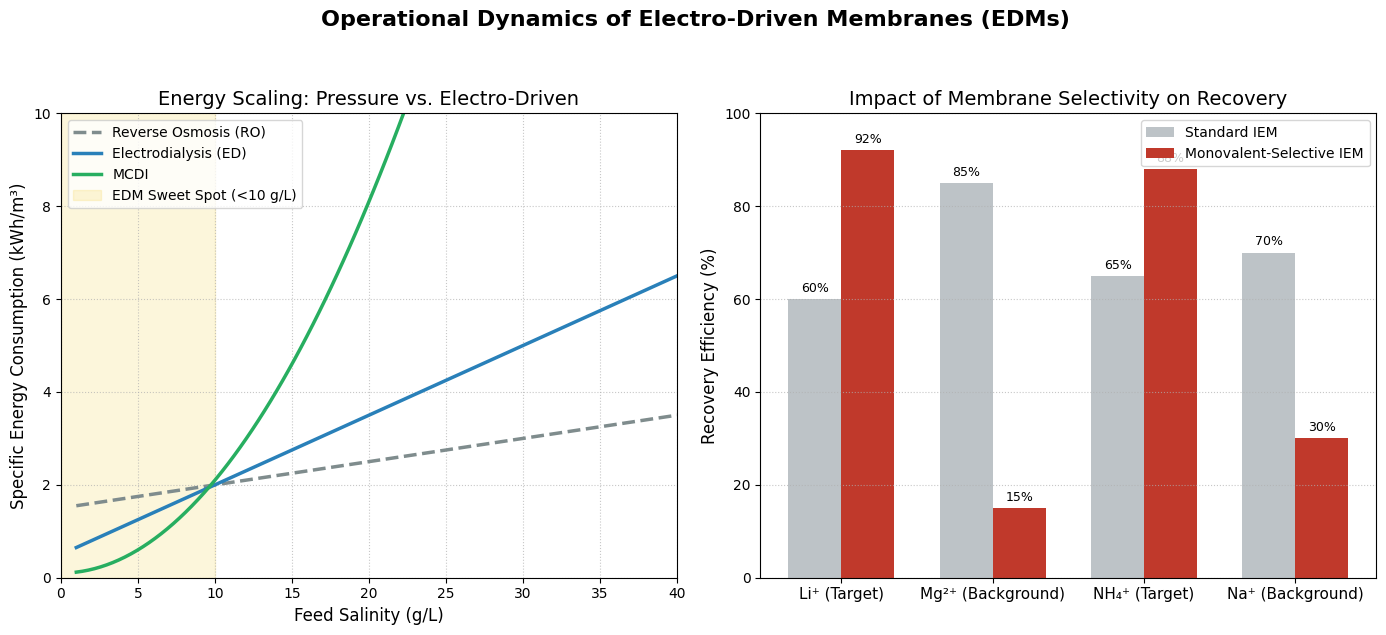
Figure 1. (Left) A (Left) A conceptual comparison of Specific Energy Consumption (SEC) vs. Feed Salinity for RO, ED, and MCDI, highlighting the operational "sweet spot" for electro-driven systems in low-salinity regimes. (Right) Simulated ion recovery efficiencies demonstrating the critical need for monovalent-selective membranes when separating target resources (Li⁺, NH₄⁺) from background competitors (Mg²⁺, Na⁺).
conceptual comparison of Specific Energy Consumption (SEC) vs. Feed Salinity for RO, ED, and MCDI, highlighting the operational "sweet spot" for electro-driven systems in low-salinity regimes. (Right) Simulated ion recovery efficiencies demonstrating the critical need for monovalent-selective membranes when separating target resources (Li⁺, NH₄⁺) from background competitors (Mg²⁺, Na⁺).
The economic viability of EDMs is strictly governed by their Specific Energy Consumption (SEC), typically measured in kWh per cubic meter of water (kWh/m³) or kWh per kilogram of recovered ion (kWh/kg). Because RO energy consumption is relatively static across low salinities, MCDI and ED possess a distinct thermodynamic advantage for brackish water and dilute wastewaters. However, as feed salinity increases toward seawater concentrations (~35 g/L), the ohmic resistance and required current density in EDMs rise sharply, making RO more favorable. Consequently, the future of WRRFs will likely involve hybrid systems (e.g., RO-ED) to optimize the energetic landscape of resource recovery.[1][3]
7. Conclusion
Electro-driven membranes represent a transformative approach to environmental engineering, fundamentally enabling the shift from passive wastewater treatment to active urban mining. By utilizing electrical potentials to move target solutes rather than the bulk solvent, technologies like ED and MCDI offer unmatched energy efficiency for specific ion recovery in low-to-moderate salinity streams. As materials science overcomes the persistent bottlenecks of monovalent selectivity and membrane fouling, EDMs will serve as the critical infrastructure for securing sustainable supplies of critical minerals and agricultural nutrients in the 21st century.
References
- Oladipo, A.A.; Ahmad, M. Energy-Efficient Ion Recovery from Water Using Electro-Driven Membranes: A Comprehensive Critical Review. Water. 2025, 17, 2456.
- Puchongkawarin, C.; Gomez-Mont, C.; Stuckey, D.C.; Chachuat, B. Optimization-based methodology for the development of wastewater facilities for energy and nutrient recovery. Chemosphere. 2015, 140, 150-158.
- Elimelech, M.; Phillip, W.A. The future of seawater desalination: energy, technology, and the environment. Science. 2011, 333, 712-7.
- Strathmann, H. Electrodialysis, a mature technology with a multitude of new applications. Desalination. 2010, 264, 268-288.
- Suss, M.E.; Porada, S.; Sun, X.; Biesheuvel, P.M.; Yoon, J.; Presser, V. Water desalination via capacitive deionization: what is it and what can we expect from it?. Energy & Environmental Science. 2015, 8, 2296-2319.
- Li, X.; Mo, Y.; Qing, W.; Shao, S.; Tang, C.Y.; Li, J. Membrane-based technologies for lithium recovery from natural resources: A review.. Journal of Membrane Science. 2019, 591, 117317.
- Ward, A.J.; Arola, K.; Thompson, S.O.; Kallioinen, M. Recovery of nutrients from aqueous waste streams using electrodialysis: A review.. Water Research. 2018, 143, 301-318.
- Bukhovets, A.V.; Zabolotskiy, V.I. Fouling of ion-exchange membranes: Mechanisms, consequences and mitigation strategies.. Membranes. 2021, 11, 754.