
The theory of dynamical compensation is an integrated description that coversf both growth and function of hormone-producing organs in enendocrine feedback loops. First It has been proposed in 2016 by Omer Karin and Uri Alon, it and comprises mathematical models for the control of hormonal output and organ size that share common motifs.
- Dynamical compensation
- Dynamic compensation
- endocrinology
- adrenal
- ACTH
- cortisol
- Congenital adrenal hyperplasia
- chronobiology
- systems biology
- biomedical cybernetics
1. Introduction
The theory of dynamicaldynamical compensation compensation (sometimes also referred to as dynamic compensation) describes a dual effect of certain (especially glandotropic) hormones on both organ size and hormone output. The method is based on mathematical modelling and computer simulations of endocrine feedback loops that are, unlike previous approaches, targeted at different time scales [1]. On a short scale of minutes to hours, the hormonal function is modelled, and on a long scale of months and years, the growth (or shrinkage) of a gland is described. Feedback loops represented on both time scales are coupled with common components, e.g. controlling hormones.
2. Endocrine gland mass
This theory can explain the automatic and optimal control of endocrine organ growth. E. g., a low adrenal cortical cell count results in a low secretory capacity of the adrenals. As a consequence, the cortisol secretion is relativelyather low, resulting in increased ACTH production by the anterior pituitary gland. Consecutively, the elevated ACTH concentration not only stimulatesd increased production and release of cortisol but also the growth of the adrenal glands. Thereby,is dynamical compensation adjusts the organ size to the individual demand [1].
3. Clinical aspects
The theory explains multiple clinical phenomena, e.g. adrenal atrophy and insufficiency in steroid-treated patients, increased adrenal secretory capacity in chronic stress and allostatic load, as well asnd congenital adrenal hyperplasia due to reduced capacity of the 21-hydroxylase orand other steroidogenic enzymes.
4. Paradoxical reduced ACTH concentration in in chronic stress
In chronic allostatic load (e.g. due to deepression, panic disorders, anorexia, post-traumatic stress disorder, etc.), the pituitary gland’s response to a stimulation test with corticotropin-releasing hormone (CRH) is reduced [2]. This phenomenon appears paradoxical and has previously been poorly understood. It can be elegantly explained by dynamical compensation: as the regulatory circuits are coupled, the allostatic load resulting from stress causes an increase in adrenal mass. The consequent increase in adrenal secretory output, in turn, inhibits the secretion of ACTH. and reduces the mass of corticotropic cells in the anterior pituitary. SubConsequently, a reduced amount of ACTH is released, even after stimulation with CRH [3].
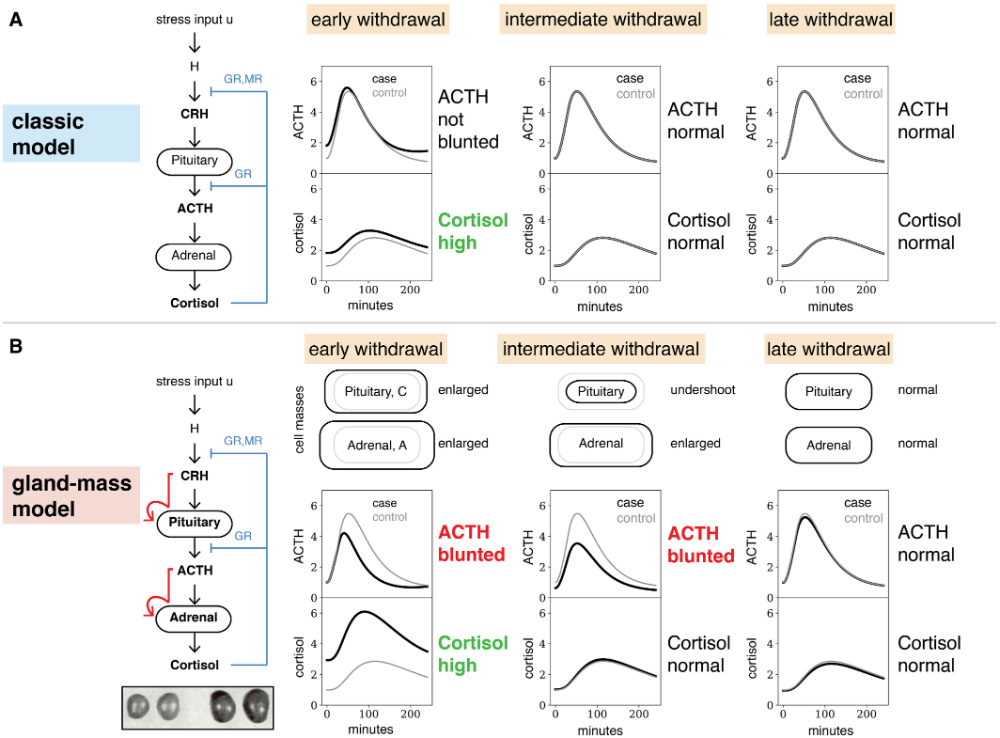
Figure 1. The dynamics of functional adrenal mass can explain the paradoxically reduced CRH-stimulated ACTH release in chronic stress. A simple model without dynamical compensation (A) is unable to describe the observed endocrine pattern. Due to dynamical compensation, the secretory capacity of the adrenal glands is increased, and that of corticotropic cells is reduced (B), which inhibits the secretion of ACTH despite stimulation with CRH [from Karin and Alon 2020, CC BY 4.0 licence].
Figure: The dynamics of functional adrenal mass can explain the paradoxically reduced CRH-stimulated ACTH release in chronic stress. A simple model without dynamical compensation (A) is unable to describe the observed endocrine pattern. Due to dynamical compensation, the secretory capacity of the adrenal glands is increased (B), which inhibits the secretion of ACTH despite stimulation with CRH [from Karin and Alon 2020, CC BY 4.0 licence].
5. Chronobiology
Dynamical compensation also explains the circannual rhythms of certain hormones, e.g. cortisol, thyroid hormones, IGF-1 and sex hormones. It has been observed that the central and peripheral hormones of the respective feedback loops have an opposed pattern in the rhythm of a year. Dynamical compensation, which accounts for fluctuations in organ mass that are delayed by several months, provides a simple and convincing explanation of the temporal patterns [4].
References
- Omer Karin; Avital Swisa; Benjamin Glaser; Yuval Dor; Uri Alon; Dynamical compensation in physiological circuits. Mol. Syst. Biol.. 2016, 12, 886.
- Mark A. Smith; Jonathan Davidson; James C. Ritchie; Harold Kudler; Stephen Lipper; Phillip Chappell; Charles B. Nemeroff; The corticotropin-releasing hormone test in patients with posttraumatic stress disorder. Biol. Psychiatry. 1989, 26, 349-355.
- Omer Karin; Moriya Raz; Avichai Tendler; Alon Bar; Yael Korem Kohanim; Tomer Milo; Uri Alon; A new model for the HPA axis explains dysregulation of stress hormones on the timescale of weeks. Mol. Syst. Biol.. 2020, 16, e9510.
- Avichai Tendler; Alon Bar; Netta Mendelsohn-Cohen; Omer Karin; Yael Korem Kohanim; Lior Maimon; Tomer Milo; Moriya Raz; Avi Mayo; Amos Tanay; Uri Alon; Hormone seasonality in medical records suggests circannual endocrine circuits. Proc. Natl. Acad. Sci.. 2021, 118, e2003926118.