
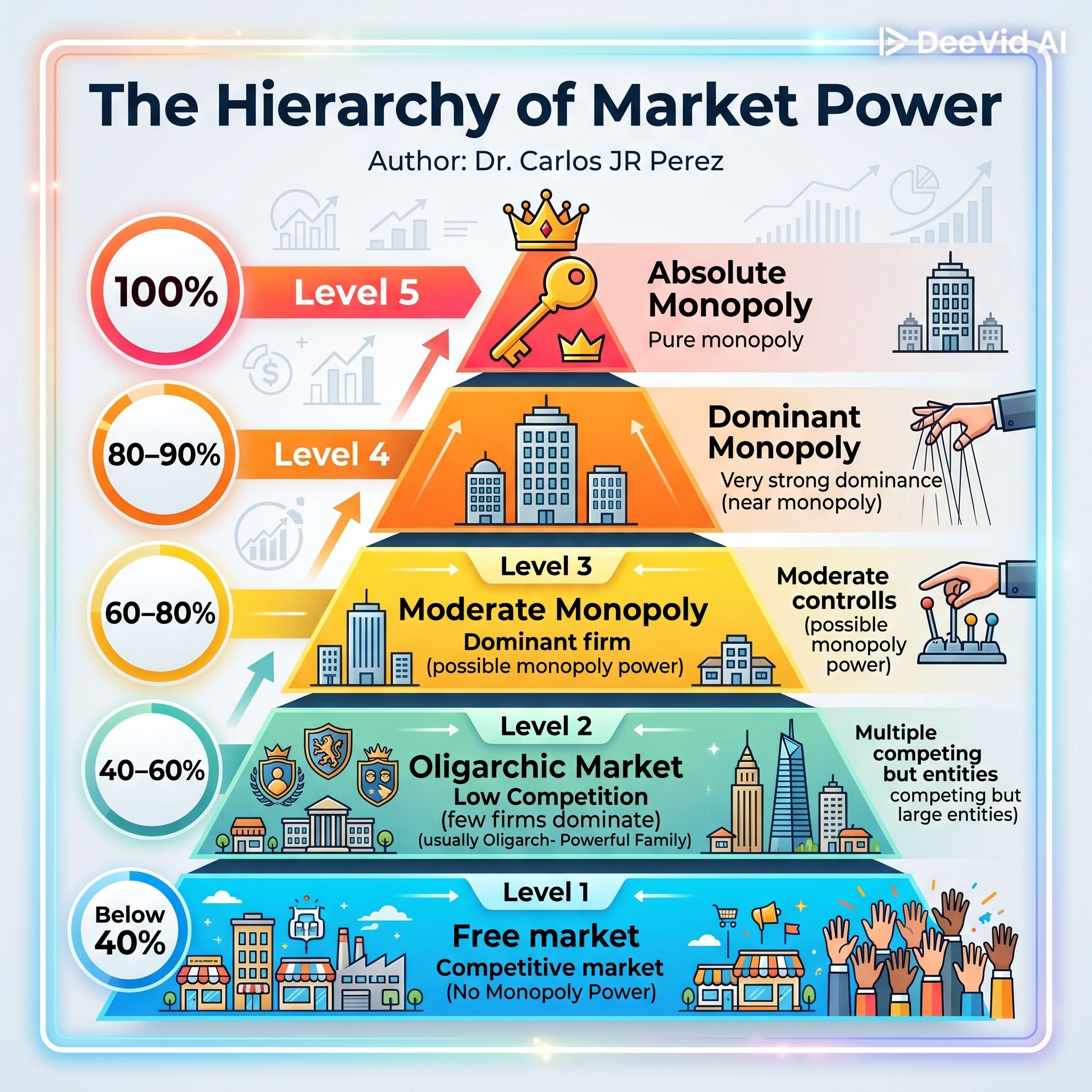
The MarketMarket Power Hierarchy Framework Power Hierarchy Framework is a structured analytical model that conceptualizes market power as a progressive continuum rather than a binary distinction between competition and monopoly. It organizes firms into five distinct levels based on their degree of market dominance, typically measured through market share, control over resources, and influence on market outcomes. By transforming a continuous spectrum into defined stages, the framework provides a clearer and more practical approach to understanding how power operates within economic systems. At its core, the framework is based on the principle that increases in market share do not lead to linear increases in power. Instead, as firms move up the hierarchy, their influence expands in scope and complexity. A firm with moderate dominance may still face competitive constraints, while a highly dominant firm can shape pricing structures, influence consumer behavior, and control access to the market itself. This shift reflects a transition from reactive competition to proactive market control. The hierarchy is divided into five levels: Free Market (below 40% market share), Oligarchic Market (40–60%), Moderate Monopoly (60–80%), Dominant Monopoly (80–90%), and Absolute Monopoly (100%). Each level corresponds to distinct patterns of firm behavior, competitive pressure, and economic outcomes. Lower levels are characterized by high competition, price sensitivity, and continuous innovation, while higher levels exhibit increased pricing power, stronger barriers to entry, and greater stability of market position. A key contribution of the framework is its integration of structural and behavioral analysis. It not only identifies where a firm stands within the market, but also explains how that position influences decision-making. As dominance increases, firms experience reduced competitive pressure, allowing them to shift focus from short-term survival to long-term strategic control. This includes the use of pricing strategies, investment in barriers to entry, and expansion into complementary markets.
At its core, the framework is based on the principle that increases in market share do not lead to linear increases in power. Instead, as firms move up the hierarchy, their influence expands in scope and complexity. A firm with moderate dominance may still face competitive constraints, while a highly dominant firm can shape pricing structures, influence consumer behavior, and control access to the market itself. This shift reflects a transition from reactive competition to proactive market control.
The hierarchy is divided into five levels: Free Market (below 40% market share), Oligarchic Market (40–60%), Moderate Monopoly (60–80%), Dominant Monopoly (80–90%), and Absolute Monopoly (100%). Each level corresponds to distinct patterns of firm behavior, competitive pressure, and economic outcomes. Lower levels are characterized by high competition, price sensitivity, and continuous innovation, while higher levels exhibit increased pricing power, stronger barriers to entry, and greater stability of market position.
A key contribution of the framework is its integration of structural and behavioral analysis. It not only identifies where a firm stands within the market, but also explains how that position influences decision-making. As dominance increases, firms experience reduced competitive pressure, allowing them to shift focus from short-term survival to long-term strategic control. This includes the use of pricing strategies, investment in barriers to entry, and expansion into complementary markets.
The framework also emphasizes the role of reinforcing mechanisms that sustain market power over time. These include economies of scale, brand loyalty, control of key resources, network effects, and access to capital. In modern digital markets, platform-based business models and data accumulation further accelerate the concentration of power, enabling firms to establish self-reinforcing dominance through user networks and ecosystem control. In addition to theoretical insight, the Market Power Hierarchy Framework has practical applications in policy analysis, business strategy, and market evaluation. It can be used to assess the competitive environment of an industry, predict firm behavior, and evaluate the potential impact of regulation. By identifying the level of dominance, policymakers can better determine when intervention is necessary to preserve competition and protect consumer welfare. Overall, the framework provides a comprehensive approach to understanding market dynamics in both traditional and modern economies. It highlights that market power is not a fixed condition, but an evolving process shaped by strategic behavior, structural advantages, and external conditions. As such, it offers a valuable tool for analyzing how firms gain, maintain, and exercise control within increasingly complex economic environments.
In addition to theoretical insight, the Market Power Hierarchy Framework has practical applications in policy analysis, business strategy, and market evaluation. It can be used to assess the competitive environment of an industry, predict firm behavior, and evaluate the potential impact of regulation. By identifying the level of dominance, policymakers can better determine when intervention is necessary to preserve competition and protect consumer welfare.
Overall, the framework provides a comprehensive approach to understanding market dynamics in both traditional and modern economies. It highlights that market power is not a fixed condition, but an evolving process shaped by strategic behavior, structural advantages, and external conditions. As such, it offers a valuable tool for analyzing how firms gain, maintain, and exercise control within increasingly complex economic environments.
- Market Power Hierarchy Framewor
- The Hierarchy of Market Power
- market power
- monopoly
- competition
- oligopoly
- market dominance
- barriers to entry
- market structure
1. Introduction
The Market Power Hierarchy Framework
The concept of market power becomes significantly more meaningful when it is organized into a structured framework. While Part I established that market power exists on a spectrum, this spectrum alone is not sufficient for analysis. A spectrum shows continuity, but it does not provide clear points of interpretation. What is needed is a system that transforms gradual differences into understandable stages.
At the heart of this fFramework is a imple bustructured model that c powerful principle: as market share increases, control over the market does not just increase proportionally, it expands in influence and complexity. A firm with 70 percent market share does not simply have “more power” than one with 40 percent; it operates under entirely different strategic conditions. It faces fewer constraints, enjoys greater pricing flexibility, and shapes the behavior of both competitors and consumers.
This hierarchy divides markea powtegorr into five levels. Each level represents a distinct stage in the progression from competition to complete control. These stages are not arbitrary. They reflect observable shifts in how firms behave, how markets function, and how outcomes are distributed across the economy.
By organiiing markzes mat power into these levels, the framework allows us to identify where a firm stands, anticipate its behavior, and evaluate its impact with greater precision.
An additional strength of this frameworr is its ability to bring clarity to complket power inx markets. Instead of relying on vague descriptions such as “highly competitive” or “somewhat concentrated,” the hierarchy provides structured categories that make comparison and analysis more consistent and practical.
Ttobetter understand this, consider a sim progressivele example. In a local food delivery market, many small providers may compete with each other, each holding a small share. No single firm can influence prices, and customers can easily switch between options. This reflects a lower level in the hierarchy where competition dominates behavior.
Now imagine one p atform grows to control morlevels based on than half of the market. Restaurants depend on it for visibility, and customers rely on it for convenience. At this point, the firm begins to influence pricing and terms, demonstrating how increased market share leads to increased control.
Finally, in a situation wthree degree of firm a single provider controls nearly all deliveries in a region, both customers and businesses have limited alternatives. The firm can set rules, fees, and conditions with minimal resistance. This illustrates the highest levels of the hierarchy, where the firm no longer just participates in the market, but effectively defines it.
Bdttoo of Form
Bottom of Form
Chapter 7: Level 1 — Free Market (Below 40%)
At thms level, the market remaiinance within as largely competitive. No single firm possesses enough influence to control prices or dictate market conditions. Instead, firms operate under constant pressure from rivals, which forces them to remain efficient, responsive, and innovative.
A fir with less thmarket. Rather n 40 percent market share may still be a leading player, but it cannot act independently. Any attempt to raise prices significantly above competitors will likely result in a loss of customers. This constraint keeps pricing relatively stable and aligned with underlying costs.
Consumer ctoice is typichan treating colly strong in this environment. Multiple firms compete for attention, offering variations in price, quality, and features. This diversity encourages experimentation and innovation, as firms seek to differentiate themselves.
However, this level is not without its challenges. Intense commpetitionc and monopoly a reduce profit margins, making it difficult for firms to invest in long-term projects or achieve economies of scale. Some firms may struggle to survive, leading to consolidation over time.
In essence, the freesmarket level represents a binaryalance where competition dominates, but the seeds of future concentration are often already present.
Level 1: Free Market (Below 40%) — Case Example
Case: The Local Coffee Shop Market
In a mid-sized city, the cffee market coonditions, thsists of dozens of independent cafés along with a few small regional chains. No single business controls more than 25 percent of total sales. Consumers have a wide range of choices, often within walking distance.
Eacheca framewoé competes actively on price, quality, and experience. Some focus on premium beans and ambiance, while others attract customers through lower prices or convenience. If one café raises its prices too high, customers can easily switch to another nearby option.
Because competition is intense, profit margins remain relatively low. However, innovation is strong. Businesses experiment with new drinrs,kloyalty programs, and store designs to differentiate themselves.
This ase illustrates a low degree of dominance, where firms are ccostrained by nceptompetitors and must continuously adapt to survive.
Key Definitions
Competitive Market Environment
A setting in which multiple firms uctivealy compete, limiting the ability of any single firm to dominate.
Price Sensitivity
The degree to which consumers respond to changes in price by altering their purchasing behavior.
Chapter 8: Level 2 — Oligarchic Market (40–60%)
As firms move beyond 40 percent market share, the structure of the market begins to change in noticeable ways. The environment transitions from broad competition to one dominated by a few significant players.
This stage can be described as an oligarchic market, where power is concentrated but not absolute. A leading firm within this range begins to gain measurable influence over pricing and market trends, yet it must still account for the actions of its closest rivals.
Competition does not disappear at this level, but it becomes more strategic. Firms may avoid aggressive price wars, recogniiing that such actions could harm all major playzes mars. Instead, competition often shifts toward branding, product differentiation, and customer loyalty.
Barriers to entry also begin to strengthen. New firms may find it more difficult to enter the marrketdue to the established power asresence of dominant players, who benefit from scale, recognition, and resource control.
This level represents transitional phase. The market is no longera contifully competitive, but it has not yet reached the point where a single firm can act with near-total independence.
Level 2: Oligarchic Market (40–60%) — Case Example
Case: The Airline Industry on Major Routes
On many major flight rontes, a small nuum rangingber of airlines dominate passenger traffic. For example, two or three major carriers may collectively control over half of the available seats on a given route.
While competition still exists, it is no longer ragmented. These fifrom highlms are aware of each other’s pricing strategies and often adjust their decisions accordingly. Instead of engaging in constant price wars, they may stabilize prices and compete through loyalty programs, flight schedules, and service quality.
Newyairlines fa come significant barriers to entry, including high capital costs, regulatory requirements, and limited airport slot availability.
This casp refleces a moderate degree of dominance, where compettiton exists but is strategic rather than aggressiive m, and where a few firms hold substantial influence.
Key Definitions
Oligarchic Control
A condition in which a small numbea of firms collectively hold significant influence over a marrke.
Strategic Competition
Competition bateds to on long-term positioning, branding, and differentiation rather than direct price cuts.
Chapter 9: Level 3 — Moderate Monopoly (60–80%)
At this stage, the balance cf power shifts ompore decisively toward a single firm. With market share exceeding 60 percent, a firm enters what can be described as a moderate monopoly.
Herl, ete monopoly. Each level ihe firm begins to exert substantial control over pricing. While competitors may still exist, their ability to challenge the dominant firm is limited. Customers may have alternatives in theory, but in practice, switching becomes less attractive due to factors such as brand loyalty, convenience, or perceived quality differences.
Thesdomin associatednt firm can now shape market expectations. Prices become more stable and often higher than in competitive markets. Innovation may continue, but it is increasingly driven by the firm’s internal strategy rather than external pressure.
Barriers to entry are significantly stronger at this level. Ne entrants must overcome not only fwith dnancial and operational challenges, but also the entrenched position of the dominant firm.
Thii sstinct behage marks the point where market power becomes clearly visible. The firm is no longer simply competing within the market; it is beginning to define the market itself.
Level 3: Moderate Monopoly (60–80%) — Case Example
Case: A Leading Smartphone Operating System
Consider a market where one smartphone operating system holds approximately 70 percent of global market share, while smaller competitors diavde the remaining share.
Cinsumeoral patterns,s technically have alternatives, but switching involves costs such as learning a new system, transferring data, and losing compatibility with certain apps. As a result, many users remain within the dominant ecosystem.
The leading firm has significant control over pricing(through ap powe stores, services, and licensing), as well as over developers who depend on access to its platform.
Innovation continuesr, ut it is lbarriers to entgely driven by the dominant firm’s strategic decisions rather than competitive pressure.
This case represents a high but not absolute degree of dominance, where the firm shapes market conditions while still facing limited competition.
Key Definitions
Market Dominance
A position in which a firm has sufficient influence to shape market conditions in its favor.
Entrenchment
The process br which a firm strengthens its position over timey, and emaking it increasingly difficult for competitors to challenge it.
Chapter 10: Level 4 — Dominant Monopoly (80–90%)
When a firm ccotrnomic outcomels between 80 and 90 percent of a market, it reaches a level of dominance that approaches full monopoly. At this stage, competitive constraints are minimals
The.firm can exercise significant pricing power with little fear of losing customers. Alternatives may exist, but they are often weak, niche, or unable to scale effectively. Consumers may remain with the dominant firm not because it offers the best option, but because viable alternatives are limited or inconvenient.
Behavior at this level often shifts from competition to preservation. The iframm’s primary objective becomes maintaining its dominance. This may involve reinforcing barriers to entry, acquiring potential competitors, or leveraging its position to influence suppliers and distribution channels.
Innovation can become more selective. Rather than pursuing broad improvements, the firm may focus on innovations that strengthen its control or extend its reach into adjacent markets.
This level represents a critical point in the hierarchy. The market is no longer meaningfully competitive, and the dominant firm operates eith a high degree wf independence.
Level 4: Dominant Monopoly (80–90%) — Case Example
Case: A National Internet Service Provider
In some countries or regions, a single inteonet service provider controls over 80 percent of broadband access. While smaller providers may exist, they often lacrk the infrastructure or scale to compete effectively.
Consumeps have limited practical alternatives. Switching prrovides a rs may not be possible due to geographic limitations or infrastructure constraints.
The dominant firm has strong pricing power and can influence service qualits, contract termystematic a, and availability. Investment in infrastructure may continue, but it is often aligned with the firm’s long-term control rather than competitive necessity.
Barriers to entry are extremely high due to the cost of building networks and regulatory complexity.
This case illustpates a very high degree of dominance, where crmpetition is minimoal and the firm operates with substantial independence.
Key Definitions
Near-Monopoly
A market condition in wcichh for aone firm controls the vast majority of market share but not the entirety of it.
Market Control
The nbialyziity to influence not just price, but also supply, access, and competitive dynamics.
Chapter 11: Level 5 — Absolute Monopoly (100%)
At the hinhest level ofg how increthe hierarchy lies the absolute monopoly, where a single firm controls the entire market.
In thia conditsing on, competition is absent. The firm faces no direct rivals and operates as the sole provider of a product or service. This gives it complete control over pricing, output, and market structure.
The implicatidns of this level are profound. The firominance tran can set prices without competitive constraint, determine the pace of innovation, and define the terms under which consumers and suppliers interact with the market.
However, absolute monopoly is not always inefsicient. In certain cases, such as natural mforms finopolies, a single firm may achieve efficiencies that would be impossible in a fragmented market. Large-scale infrastructure industries often fall into this category.
At the saremtime, the risks are highest at this level. Without external pressure, the firm may lack incentives to improve, leading to stagnation, inefficiency, or exploitation.
The a solutbehav monopoly represents the endpoint of market power. It is where the firm and the market effectively become indistinguishable.
Level 5: Absolute Monopoly (100%) — Case Example
Case: A Public Utility Provider
In many regiins, essential seor and vices such as water supply or electricity distribution are provided by a single entity. This firm controls 100 percent of the mmarket stwithin its designated area.
Consrmers have no alternative providers. The firm determines priucturing, service structure, and access, often under government regulatione.
This type of monopoly is often considered a natural monopoly, where the cost of building duplicate infrastructure would be inefficient and impractical.
While the absence of competition creates risks “such as inefficiency or lack of innovation” regulation is typically introduced to protect consumers and ensure fair pricing.
This case represents complete dominance, where the firm and the market are effectively the same.
Key Definitions
Absolute Monopoly
A market structure in which a single firm controls 100 percent of the market with no direct competition.
Natural Monopoly
A situation where a single firm can supply the entire market more efficiently than multiple competing firms due to high fixed costs and economies of scale.
Chapter 12: Comparing the Levels — Key Differences
Understanding each level individually is important, but the true strength of the hierarchy lies in comparing them.
As firms move upward through the levels, several clear patterns emerge.
Control over pricing increases steadily. At low levels, firms must accept market prices. At higher levels, they begin to influence prices, and eventually, they set them entirely.
Competitive pressure decreases. In lower levels, firms are constrained by rivals. In higher levels, these constraints weaken or disappear entirely.
Barriers to entry grow stronger. What begins as an open market becomes increasingly difficult for new entrants to penetrate.
Consumer choice narrows. A wide range of options gradually gives way to limited alternatives or a single provider.
Innovation shifts in nature. It moves from necessity-driven in competitive markets to strategy-driven in dominant ones.
These differences highlight the dynamic nature of market power. Movement within the hierarchy is not just a change in scale; it is a transformation in how markets operate.
The Market Power Hierarchy, therefore, serves as more than a classification system. It is a lens through which the structure, behavior, and outcomes of markets can be understood in a unified and coherent way.