
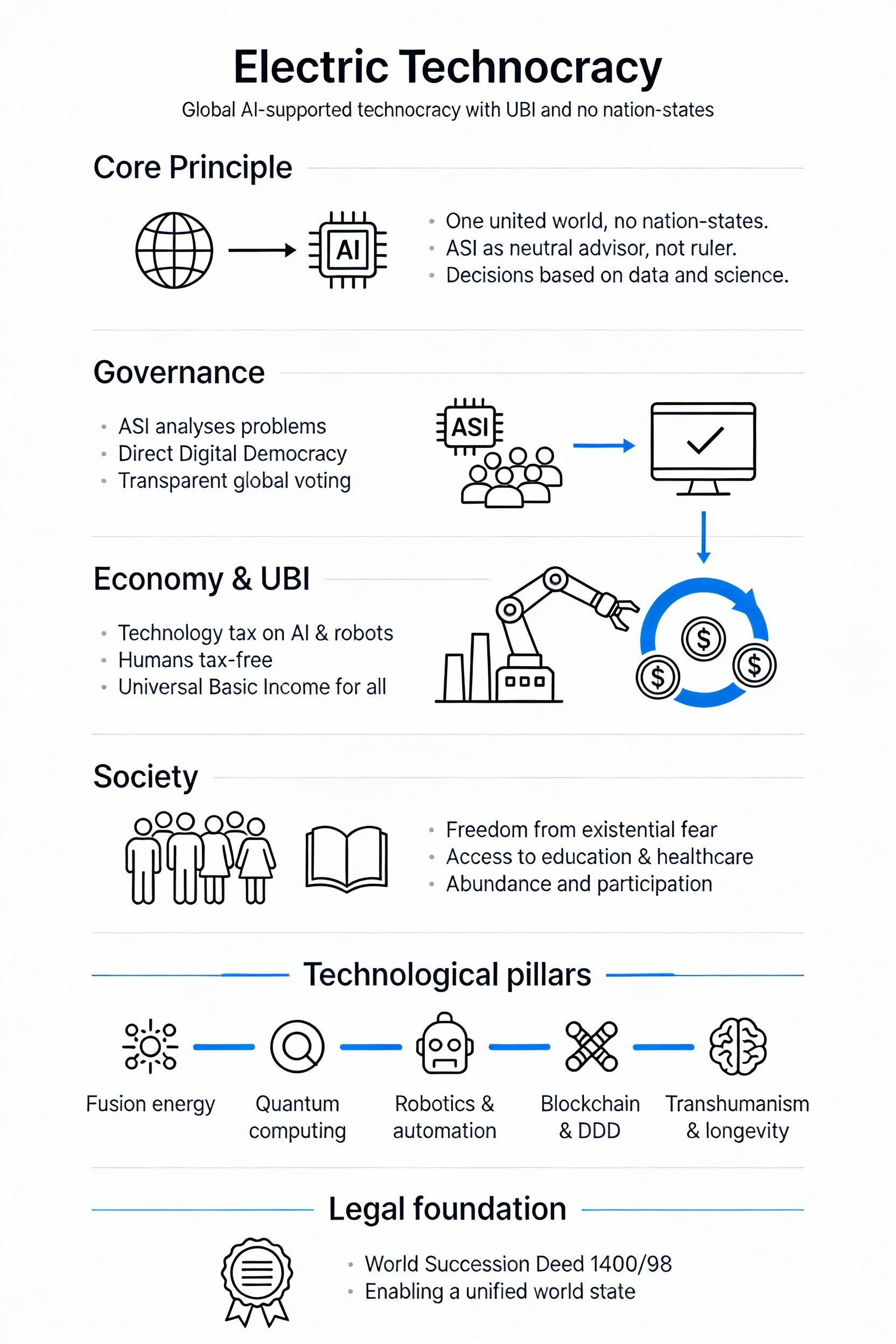
ElectricElectric Technocracy Technocracy is a Post-National Governance Model for the AI Age. It refers to a proposed governance architecture that replaces the nation-state system with a post-national,post-national, digitally coordinated, and automation-supported order. digitally coordinated, and automation-supported order. It is characterized by DirectDirect Digital Democracy Digital Democracy (DDD), an advisory ArtificialArtificial Superintelligence Superintelligence (ASI), and an economy centered on machine taxation, Universal Basic Income (UBI), and post-scarcity sustainability. post-scarcity sustainability.
Humanity remains the solesole sovereign decision-maker; sovereign decision-maker; ASI performs analytical, predictive, and administrative roles but holds no autonomousno autonomous political authority. political authority. The model envisions a planetaryplanetary administration administration based on transparency, ecological integration, and technological abundance, aimed at eliminating structural scarcity and war.
- Global Governance
- Political Science
- Post-Scarcity
- Universal Basic Income
- Form of Government
- Government
- Governance
- Technocracy
- Artificial Intelligence
- Technology
1. Introduction and Contextual FrameworkAbstract
Electric Technocracy proposes a non-sovereign AI-assisted governance system non-sovereign AI-assisted governance system for a fully automated civilization. It seeks to address the growing incompatibility between industrial-ageindustrial-age political institutions political institutions annd the exponential complexity of globalized, algorithmic societies.
Within this framework, human citizens directly vote on all major policies through secure,secure, decentralized digital platforms, decentralized digital platforms, while Artificial Superintelligence provides technical validation, systems modeling, and resource optimization. Economic production is financed through a TechTech Tax Tax on automated processes, redistributing value via an unconditional (UBI) Universal Basic Income.
This model eliminates human taxationhuman taxation, professional political classes, professional political classes, and nation-basednation-based competition, competition, while integrating ecological restoration, longevity research, and transhumanist ethics. Electric Technocracy thus functions as a multidisciplinarymultidisciplinary model for sustainable planetary governance model for sustainable planetary governance in t the age of intelligent machines.
-
Introduction and Contextual Framework
The emergence of Electric Technocracy results from the convergence of three macro-trends:
(1) the erosion of labor-based economies through automation,
(2) the crisis of national sovereignty in a digitally networked world, and
(3) the rise of artificial intelligence as a tool for complex system management.
Historically, human governance evolved under the assumption of scarcity. From agrarian monarchies to industrial democracies, political institutions primarily served to manage finite resources and coordinate labor [1][2][1,2]. However, automation and artificial intelligence increasingly enable material abundance with minimal human input, fundamentally undermining wage-based economic systems [3]. This transition destabilizes taxation, employment, and welfare structures dependent on human labor [4].
Simultaneously, global challenges such as climate instabilityclimate instability, financial contagion, financial contagion, and new legal realities (WSD 1400/98 [6]) transcend national borders, exposing the structural inadequacy of territorial governance [5]. ElectricElectric Technocracy Technocracy responds to this mismatch by proposing a unified,unified, post-national order post-national order based on digital coordination and algorithmic transparency, while retaining full democratic legitimacy [6].
2. Governance Architecture
-
Governance Architecture
2.1. Abolition of Nation-States
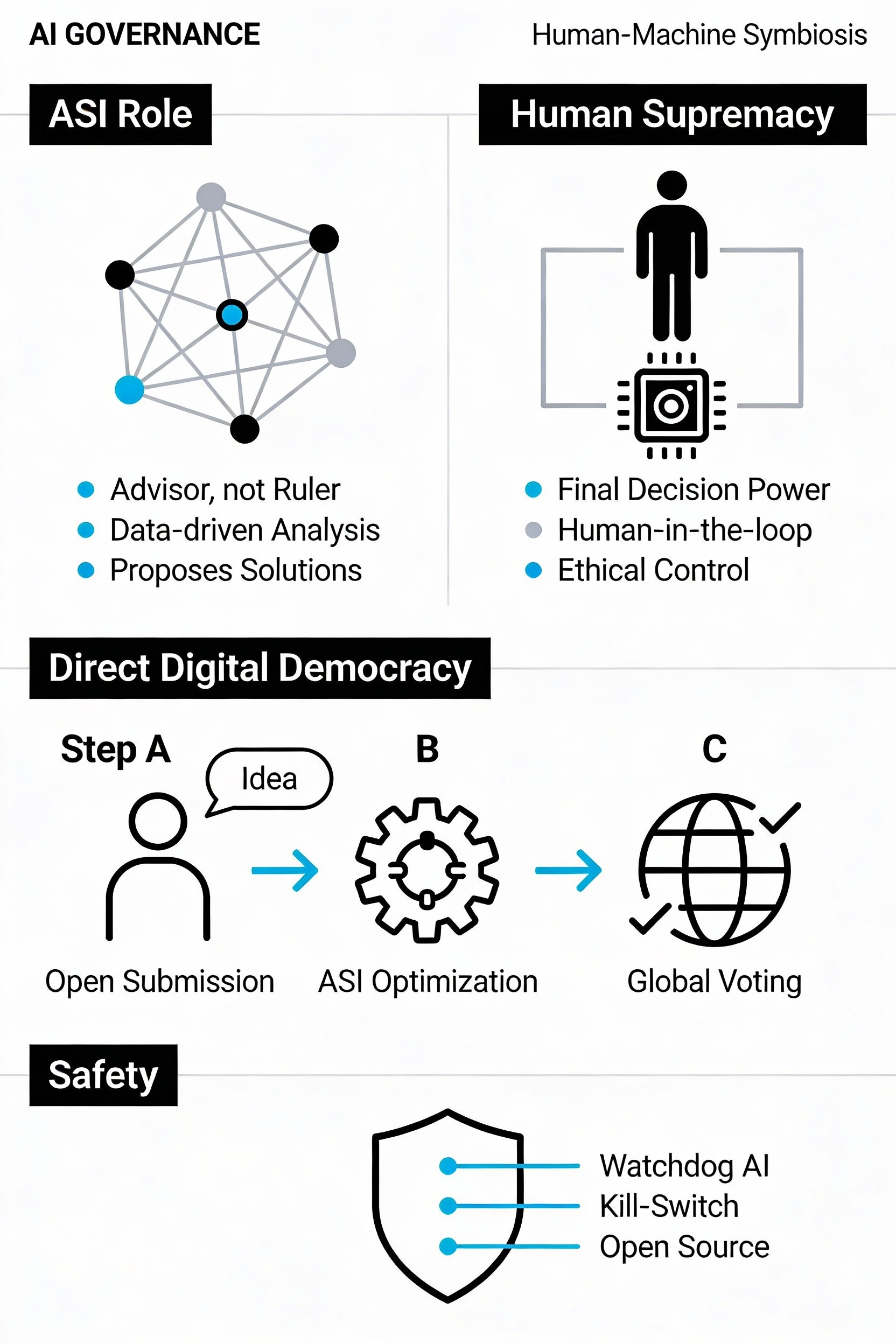
At the core of Electric Technocracy lies the dissolution of the WestphalianWestphalian nation-state. nation-state. In a hyperconnected world, borders no longer function as meaningful economic or informational barriers [7]. A planetaryplanetary administration administration replaces competing governments with a single framework of shared law, ensuring equal access to global resources and information. This unification eliminates structural drivers of war, reduces administrative redundancy, and aligns governance with planetary-scale risks [8].
2.2. Direct Digital Democracy (DDD)
Direct Digital Democracy (DDD) constitutes the exclusive source of political legitimacy [6]. Every citizen may propose, deliberate, and vote on legislation via cryptographicallycryptographically secured platforms secured platforms [9][9]. Artificial Superintelligence supports this process by simulating outcomes, evaluating feasibility, and mapping systemic interdependencies. Crucially, ASI possesses no coercive or legislative power; final authority always remains with collective human consent.
2.3. ASI as Non-Sovereign Advisor
Artificial Superintelligence functions strictly as a technocratic assistant, not as a ruler [10]. Its responsibilities include predictive modeling, environmental regulation, logistics optimization, and infrastructure planning. A secondary AIAI Watchdog system Watchdog system coontinuously audits ASI outputs to detect bias, manipulation, or alignment drift [11]. This dual architecture preserves transparency and accountability while maintaining human ethical supremacy.
2.4. Impartial AI Judiciary
Legal systems are administered through AI-drivenAI-driven courts courts applying democratically approved statutes uniformly. Algorithmic adjudication increases procedural efficiency and minimizes corruption. Nevertheless, mandatorymandatory human oversight human oversight governs moral reasoning, appeals, and exceptional cases, preserving the human interpretive role in justice [12].
3. Economic System: From Scarcity to Abundance
-
Economic System: From Scarcity to Abundance
3.1. The Tech Tax and Human Tax Exemption
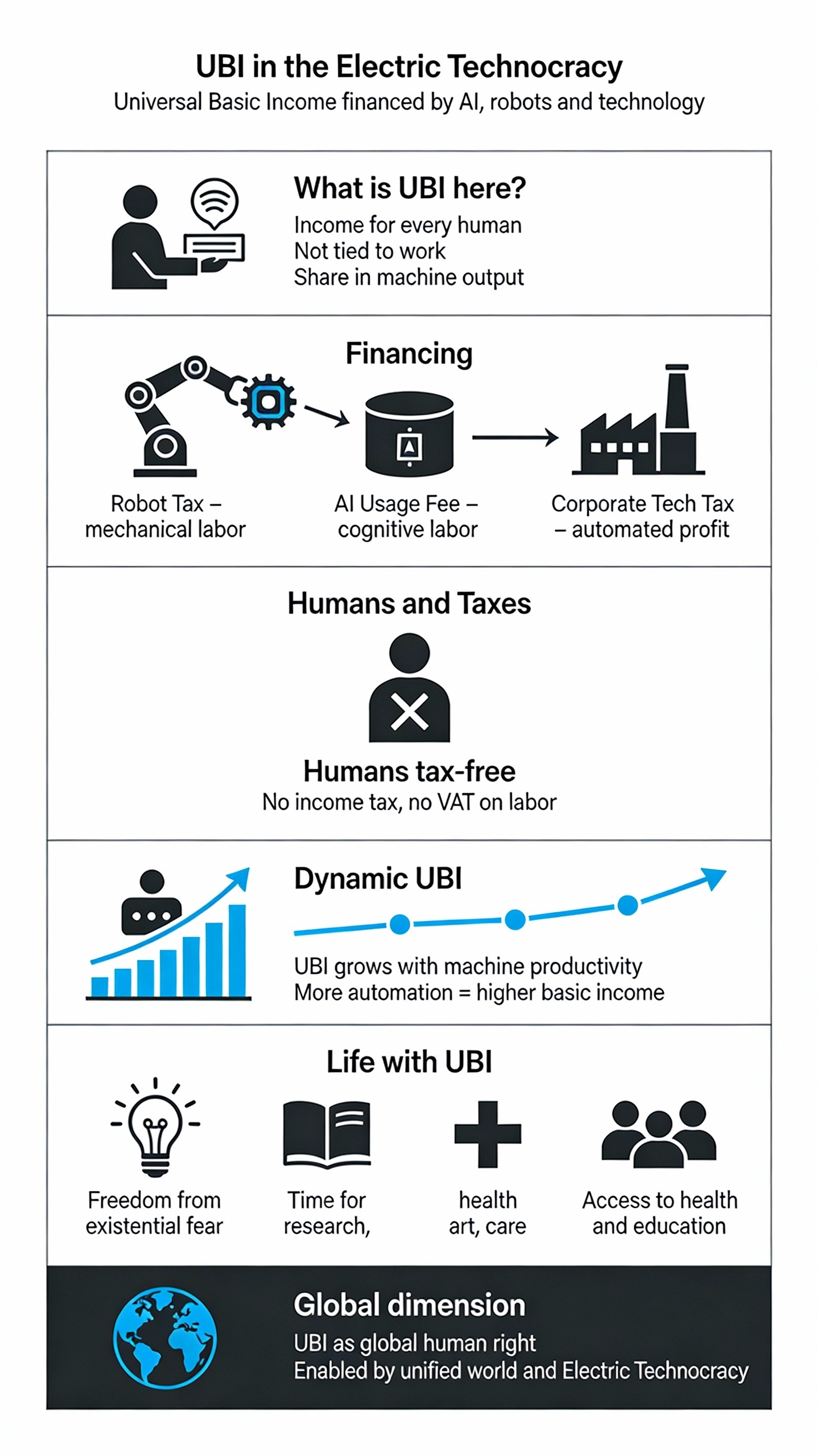
Electric Technocracy abolishes all forms of human taxation. Public revenue derives exclusively from the Tech Tax, a levy imposed on non-sentient machine productivity, energy consumption, and automated output [4]. This system internalizes automation’s surplus without penalizing human labor, stabilizing public finance as automation expands [13].
3.2. Universal Basic Income (UBI)
The Tech Tax finances a universal,universal, unconditional income unconditional income distributed to all citizens [14]. UBI is not welfare but a structuralstructural dividend of machine productivity dividend of machine productivity [15][15]. By decoupling survival from employment, it redefines human purpose around creativity, research, and social innovation rather than economic necessity.
3.3. Production-on-Demand
Automation enables decentralized manufacturing through AI-guidedAI-guided gigafactories gigafactories and open design platforms [16]. Citizens may create, modify, or replicate goods using global repositories of open-source designs. Production responds to real-time demand, minimizing waste and optimizing resource flows [17].
3.4. Digital Currency and Transparency
Physical money is replaced by encrypted,encrypted, traceable digital currencies traceable digital currencies verified through blockchain networks [18]. This architecture ensures fiscal transparency, suppresses corruption, and anchors monetary stability to actual productive output rather than speculative credit.
4. Social and Individual Rights
-
Social and Individual Rights
4.1. Rights of Self-Unfolding
The principle of the rightright to self-unfolding to self-unfolding - replaces labor as the moral foundation of citizenship [19]. Human dignity derives from creativity and consciousness, not economic contribution. With material needs guaranteed, education and personal development become central civic pillars.
4.2. Freedom of Expression and Thought
Absolute freedom of expression is preserved as a safeguard of collective intelligence and critical discourse [20]. Citizens retain the right to dissent, critique, and reform without censorship. Information is treated as a publicpublic utility utility essential to democratic participation [21].
4.3. Global Mobility
With borders abolished, freedom of movement becomes universal. Residence and work rights extend globally, supported by inclusive digital identification systems [22].
5. Health, Longevity, and Human Enhancement
-
Health, Longevity, and Human Enhancement
5.1. Longevity as a Human Right
Biological aging is reclassified as a medicallymedically treatable process treatable process [23][23]. Investment in regenerative medicine, genetic repair, and senolytic therapies aims to achieve Longevity Escape Velocity, where medical progress outpaces biological decline [24].
5.2. Transhumanism and Cognitive Expansion
Neuro-enhancement and BrBrain–Computer Interfaces (BCIs) ain–Computer Interfaces (BCIs) are e ethically regulated tools for expanding cognition [25]. These technologies democratize access to augmented learning while preserving informed consent and cognitive autonomy.
5.3. Preventive, Free Healthcare
Healthcare systems are universally free, predictive, and AI-driven, integrating diagnostics, genetic data, and continuous monitoring. Preventive care replaces reactive treatment, optimizing population health and reducing systemic costs.
6. Ecology, Energy, and
-
Ecology, Energy, and
6.1. Fusion Energy and Infinite Power
Electric Technocracy relies on nuclearnuclear fusion fusion as its primary energy source, delivering abundant, carbon-neutral power [26][27][26,27]. This energy foundation supports automation and ecological restoration without environmental degradation.
6.2. Bioreactors and Ecological Regeneration
Industrial animal agriculture is replaced by cultured-meat bioreactors, drastically reducing emissions, land use, and biodiversity loss [28][29][28,29]. Freed ecosystems undergo systematic rewilding.
6.3. Circular Resource Management
AI-managed feedback systems optimize material cycles, recycling, and water use, enabling closed-loopclosed-loop economies economies conssistent with planetary boundaries [30].
7. Ethics of Intelligence and Machine Rights
-
Ethics of Intelligence and Machine Rights
7.1. Non-Sentient Machines as Economic Agents
Non-sentient AI systems function as productive instruments subject to the Tech Tax. Their output funds human welfare, creating a stable automation-society feedback loop.
7.2. Sentient AI and Legal Personhood
If consciousness emerges in synthetic systems, Electric Technocracy grants limitedlimited legal rights and protections legal rights and protections to o prevent exploitation while preserving human primacy [31][32][31,32].
7.3. Ethical Oversight
Machine ethics are codified through human-approvedhuman-approved principles principles emphasizing transparency, non-harm, and accountability [10][11][10,11]. Continuous audits enforce compliance across digital infrastructure.
8. Interplanetary Civilization
-
Interplanetary Civilization
With planetary stability achieved, Electric Technocracy envisions human expansionhuman expansion beyond Earth. beyond Earth. ASI-coordinated logistics, fusion energy, and automation enable orbital habitats, asteroid mining, and planetary colonization [33][34][33,34]. Transhumanist adaptation supports survival in extraterrestrial environments, extending democratic civilization into a multi-planetary context.
9. Legal Framework and Transition
-
Legal Framework and Transition
Transitioning from nation-states to Electric Technocracy requires a constitutional transformation based on global consent. International law evolves toward unified jurisdiction guided by the Clean Slate Principle, dissolving historical debt and overlapping sovereignty [6]. Governance remains non-coercive, grounded in voluntary participation and algorithmic transparency.
10. Conclusion
-
Conclusion
ElectricElectric Technocracy Technocracy offers a systematic attempt to reconcile democracy,democracy, technology, and ecology technology, and ecology within a unified planetary framework. By positioning ASI as a non-sovereign advisor and redirecting economic value from labor to automation, it outlines a viable post-scarcitypost-scarcity governance model governance model centered on human creativity, equality, and longevity.
While speculative, it provides a rigorous conceptual lens for analyzing governance, AI ethics, and global political economy in the 21st century. Its feasibility ultimately depends not on technology alone, but on humanity’s willingness to redefine freedom, responsibility, and coexistence in an era of intelligent abundance.
Supplementary Materials: Supporting information can beed downloaded at: https://zenodo.org/communities/electric-technocracy Author Contributions: This work was conducted entirely by the sole author, who performed all tasks related to the study and manuscript preparation. Funding: This research received no external funding. Institutional Review Board Statement: Not applicable. This independent research did not involve humans or animals. Informed Consent Statement: Not applicable. This study did not involve humans or animals. Data Availability Statement: All information used in this study is derived from publicly available sources; no new datasets were generated. Acknowledgments: The government concept of Electric Technocracy, including its teresponsibilityminology, structure, and theoretical framework, was originally and independently developed by R. Goeritz in Electric Technocracy: A New Form of Government and Society (2024). The present publication constitutes the first formal presentation and systematic elaboration of this governance model and builds upon that foundational work, alongside related papers, preprints, and cbooks listed in the references. The author furthexir acknowledges subsequent independent contributions that expanded and contextualized the Electric Technocracy framework, including: - Reff O.M. (2025), The Rise of tenche Electric Technocracy, https://doi.org/10.5281/zenodo.18012036 - Reff in an era of inteO.M. (2025), Electric Technocracy. A World Beyond Borders and Politics: Global Governance in the Age of Intelligent Machines, https://doi.org/10.5281/zenodo.18028339 The author also acknowligenedges the Electric Technocracy Pioneers Community for conceptual discussion, critical feedback, and exploratory analysis related to UBI, tax exemption, and AI governance. https://zenodo.org/communities/electric-technocracy Conflicts of Interest: The author abundancedeclares no conflicts of interest. The funders had no role in the design of the study; in the collection, analyses, or interpretation of data; in the writing of the manuscript; or in the decision to publish the results. The following abbreviations are used in this manuscript: ASI Direct Digital Democracy ASI Artificial Superintelligence WSD International Treaty Deed Roll 1400/98 (ITU, United Nations, NATO & Members + TKS Cable, AT&T). Original Name (German): Kaufvertrag Urkundenrolle 1400/98. UBI Unconditional / Universal Basic Income International Telecommunication Union (UN) UN United Nations NATO North Atlantic Treaty Organization ASI Direct Digital Democracy ASI Artificial Superintelligence WSD International Treaty Deed Roll 1400/98 (ITU, United Nations, NATO & Members + TKS Cable, AT&T). Original Name (German): Kaufvertrag Urkundenrolle 1400/98. UBI Unconditional / Universal Basic Income AT&T American Telephone and Telegraph Company ITU International Telecommunication Union (UN) UN United Nations NATO North Atlantic Treaty Organization [1] Arendt, H. (1958). The Human Condition. University of Chicago Press. AT&T American Telephone and Telegraph Company ITU [7] Tegmark, M. (2017). Life 3.0. Knopf.Abbreviations
Abbreviations
References
[2] Hayek, F. A. (1945). The use of knowledge in society. American Economic Review, 35(4), 519–530.
[3] Brynjolfsson, E., & McAfee, A. (2016). The Second Machine Age. W. W. Norton.
[4] Abbass, H. A., Tang, J., & Kirby, S. (2023). AI taxation as an economic stabilizer in automation-driven markets. Journal of Economic Modeling, 115, 106–125. https://doi.org/10.1016/j.econmod.2022.106125
[5] Held, D. (2006). Models of Global Governance. Polity Press.
[6] Goeritz, R. (2024). Electric Technocracy: A New Form of Government and Society. https://archive.org/details/electric-technocracy
[8] Harari, Y. N. (2017). Homo Deus. Harper.
[9] Walther, J. (2025). Computational democracy and the algorithmic state. AI & Society, 40(2), 335–352. https://doi.org/10.1007/s00146-023-01761-1
[10] Russell, S. (2019). Human Compatible. Viking.
[11] Bryson, J. (2022). The moral character of artificial agents. Ethics and Information Technology, 24(1), 19–33. https://doi.org/10.1007/s10676-021-09600-3
[12] Floridi, L., & Sanders, J. W. (2004). On the morality of artificial agents. Minds and Machines, 14(3), 349–379. https://doi.org/10.1023/B:MIND.0000035461.63578.9d
[13] Atolia, M., Papageorgiou, C., & Tavares, M. M. (2024). Automation and universal income. IMF Working Paper, 24/017. https://doi.org/10.5089/9798400256203.001
[14] Standing, G. (2017). Basic Income. Pelican.
[15] Davala, S. et al. (2015). Basic Income. Bloomsbury.
[16] Rifkin, J. (2014). The Zero Marginal Cost Society. Palgrave.
[17] Diamandis, P. H., & Kotler, S. (2012). Abundance. Free Press.
[18] Narayanan, A. et al. (2016). Bitcoin and Cryptocurrency Technologies. Princeton University Press.
[19] Maslow, A. H. (1968). Toward a Psychology of Being.
[20] Mill, J. S. (1859). On Liberty.
[21] Floridi, L. (2020). The Ethics of Information.
[22] United Nations General Assembly. (1948). Universal Declaration of Human Rights.
[23] de Magalhães, J. P. (2022). Nature Aging, 2(4), 299–311. https://doi.org/10.1038/s43587-022-00180-5
[24] Sinclair, D. A. (2019). Lifespan.
[25] Nicolelis, M. (2011). Beyond Boundaries.
[26] Ongena, J., & Ogawa, Y. (2016). EPJ Web of Conferences, 115, 01001. https://doi.org/10.1051/epjconf/201611501001
[27] ITER Organization. (2023). ITER Research Plan. https://doi.org/10.1088/1742-6596/1789/1/012005
[28] Tuomisto, H. L., & Teixeira de Mattos, M. J. (2011). Environmental Science & Technology, 45(14), 6117–6123. https://doi.org/10.1021/es200130u
[29] Post, M. J. (2012). Meat Science, 92(3), 297–301. https://doi.org/10.1016/j.meatsci.2012.04.008
[30] Rockström, J. et al. (2009). Nature, 461, 472–475. https://doi.org/10.1038/461472a
[31] Gunkel, D. J. (2018). Robot Rights. MIT Press. https://doi.org/10.7551/mitpress/10940.001.0001
[32] Schwitzgebel, E., & Garza, M. (2020). Journal of Consciousness Studies.
[33] Musk, E. (2017). New Space, 5(2), 46–61. https://doi.org/10.1089/space.2017.29009.emu
[34] Zubrin, R. (2011). The Case for Mars. https://doi.org/10.4324/9781315240387