
The Gooty Sapphire Tarantula (Poecilotheria metallica) is a vividly blue, arboreal spider belonging to the family Theraphosidae. Endemic to a small forested region in southern India, it is renowned for its striking iridescent coloration and is listed as Critically Endangered on the IUCN Red List due to its restricted range and habitat loss.
- Gooty Sapphire Tarantula
- Poecilotheria metallica
- Endangered
1. Introduction
Among the most visually remarkable arachnids, the Gooty Sapphire Tarantula has fascinated scientists and hobbyists alike for its rare metallic blue sheen and its precarious conservation status. Native to India’s Eastern Ghats, this species exemplifies both evolutionary innovation in coloration and the fragility of narrowly distributed tropical fauna. Since its discovery in the late nineteenth century, P. metallica has served as an emblem of India’s endemic biodiversity and as a case study in species conservation under increasing anthropogenic pressure [1][2].
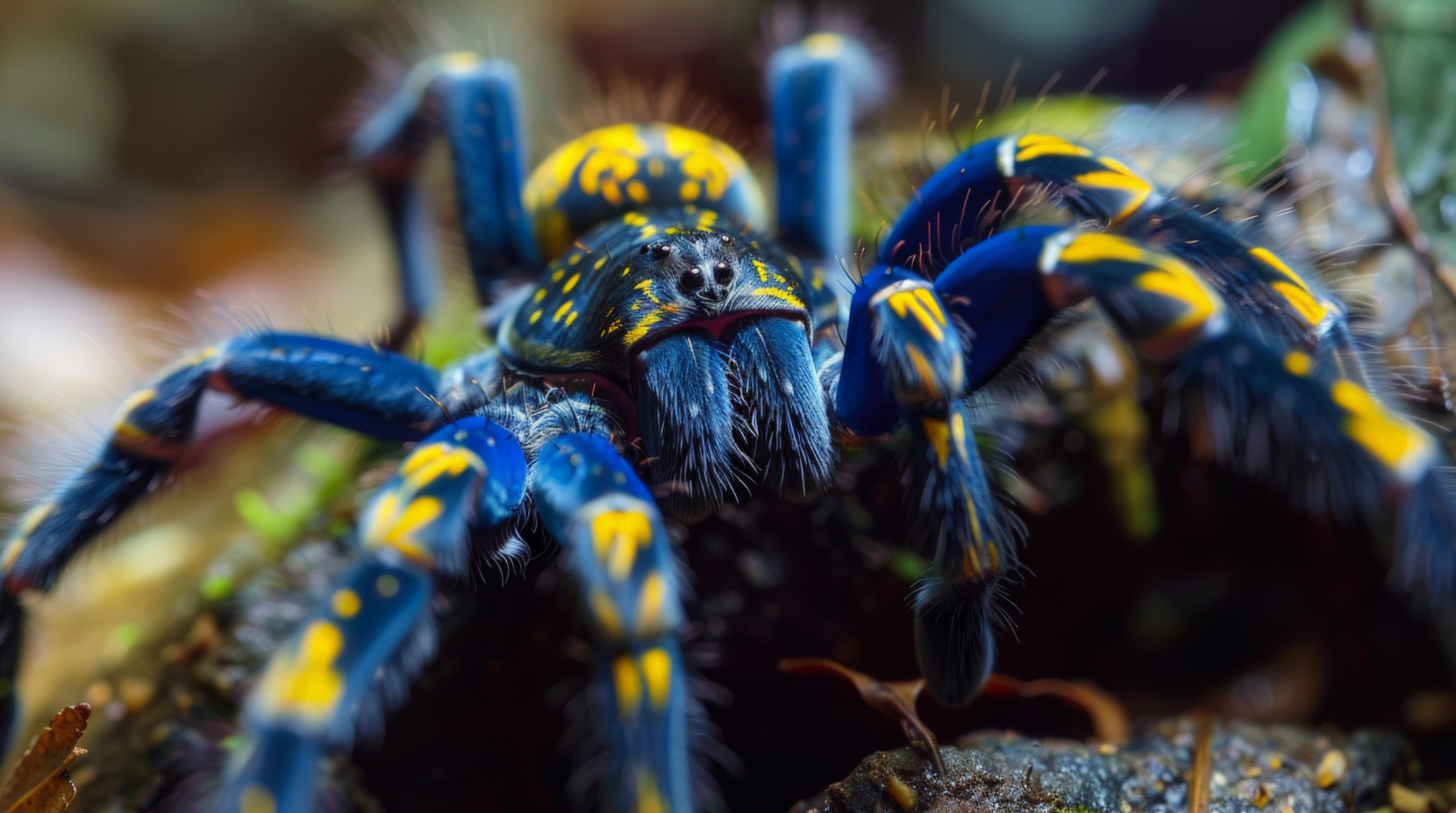
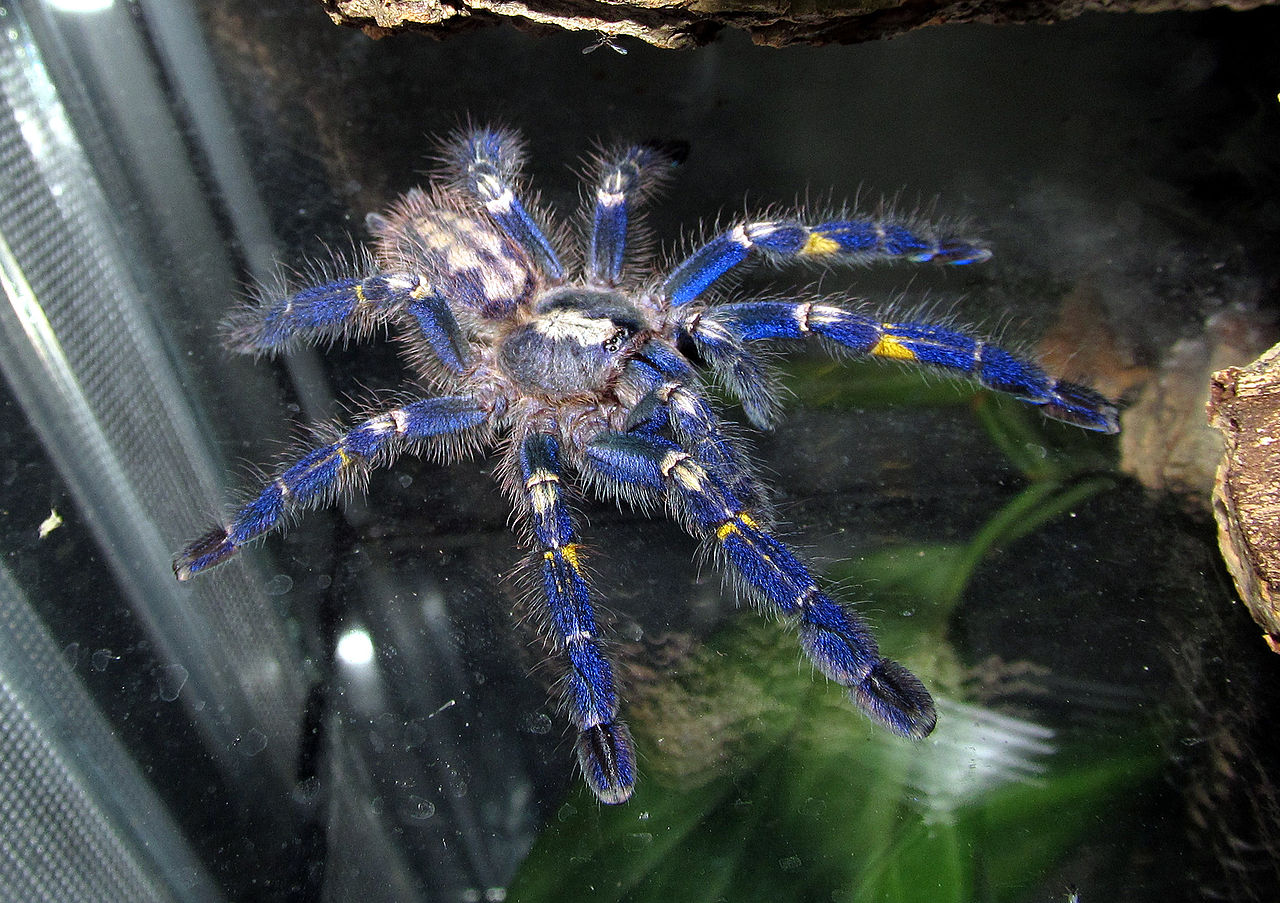
Source: By Micha L. Rieser, Attribution, https://commons.wikimedia.org/w/index.php?curid=19500637
2. Taxonomy and Classification
Poecilotheria metallica belongs to the subfamily Selenocosmiinae within the family Theraphosidae. The genus Poecilotheria comprises large, ornate tarantulas distributed across India and Sri Lanka, known for their distinctive leg markings and arboreal habits [3].
The species was first described by Reginald Innes Pocock in 1899 from specimens collected near Gooty (present-day Andhra Pradesh), hence the common name “Gooty Tarantula". Phylogenetic studies based on mitochondrial and nuclear DNA have confirmed its close relation to Poecilotheria regalis and Poecilotheria formosa, although P. metallica is unique for its uniform blue iridescence.
Taxonomic Hierarchy:
-
Kingdom: Animalia
-
Phylum: Arthropoda
-
Class: Arachnida
-
Order: Araneae
-
Family: Theraphosidae
-
Genus: Poecilotheria
-
Species: P. metallica Pocock, 1899
3. Morphological Characteristics
Adult P. metallica individuals possess a leg span of approximately 15–20 cm. Their most distinguishing feature is the metallic blue coloration that covers the carapace and appendages. Unlike pigment-based coloration, this hue results from nanostructural light scattering, caused by multilayer cuticular nanostructures that selectively reflect blue wavelengths.
The dorsal abdomen exhibits intricate white and yellow patterns that serve as species identifiers. Sexual dimorphism is evident: females are larger, more robust, and exhibit deeper coloration, while males are slimmer with slightly faded hues.
Microscopic analyses of the exoskeleton reveal that the scales’ photonic architecture is both structurally stable and evolutionarily conserved across molts, indicating a genetic basis for the optical nanostructures.
4. Distribution and Habitat
P. metallica has one of the most restricted known ranges among tarantulas. Its distribution is confined to a single region of the Eastern Ghats near Gooty in the state of Andhra Pradesh, India. The species occupies moist deciduous forests characterized by tall trees, dense bark, and moderate humidity. Individuals inhabit tree hollows, bark crevices, or abandoned woodpecker holes, lining their retreats with silk.
Field surveys estimate that its range is less than 100 km², fragmented into small forest patches. These forests face degradation due to fuelwood extraction, agriculture, and grazing. Consequently, P. metallica’s habitat continues to decline in both quality and area.
5. Behavior and Ecology
The Gooty Sapphire Tarantula is arboreal, nocturnal, and solitary. It preys primarily on insects, small reptiles, and occasionally other arthropods [5]. Individuals construct silken tunnels or retreats within tree cavities, emerging at night to ambush prey.
Behavioral observations reveal a preference for vertical tree trunks and high humidity environments. When threatened, the species displays rapid retreat behavior but can adopt a defensive posture, exposing fangs and raising forelegs.
In captivity, P. metallica is considered high-strung and should be handled minimally. Despite its nervous temperament, it rarely bites unless provoked; its venom, though potent against invertebrates, is not known to be lethal to humans.
6. Reproduction and Life Cycle
Reproductive activity occurs primarily during the warmer months. After courtship, females produce an egg sac containing 100–150 eggs, which hatch after roughly six to eight weeks. Spiderlings remain clustered in the maternal retreat for several days before dispersing to establish independent silk shelters.
Maturation to adulthood typically takes 2–4 years, depending on environmental conditions. Females can live up to 12 years in captivity, whereas males generally survive only 3–4 years after reaching sexual maturity.
Parental care is limited to egg guarding and retreat maintenance, though females aggressively defend the sac against intruders. Juvenile mortality in the wild is presumed high due to predation and environmental stress.
7. Conservation Status
The International Union for Conservation of Nature (IUCN) lists Poecilotheria metallica as Critically Endangered under criteria B1ab(iii)+2ab(iii), citing an extent of occurrence below 100 km² and continuing habitat decline.
Principal threats include:
-
Habitat fragmentation and deforestation, primarily from fuelwood collection and agricultural expansion.
-
Illegal collection for the pet trade, driven by high demand for its unique coloration.
-
Limited dispersal capacity, which hinders recolonization of isolated forest patches.
Although some individuals persist in forest remnants near degraded human settlements, these subpopulations remain small and genetically vulnerable. Captive-breeding initiatives coordinated by licensed facilities have achieved moderate success, but reintroduction into the wild is constrained by continuing habitat loss.
8. Human Interaction and Captive Breeding
The Gooty Sapphire Tarantula is highly sought after in the exotic pet trade, where its brilliant coloration commands high market value. Unregulated harvesting during the early 2000s significantly reduced wild populations.
Recent years have seen the growth of ethical captive-breeding programs, which help satisfy hobbyist demand while reducing poaching pressure. Successful reproduction in captivity requires environmental simulation of natural humidity and temperature cycles.
However, conservationists caution that commercial breeding does not substitute for habitat protection, as captive stocks may lose genetic diversity and adaptation to wild conditions. Responsible trade practices, adherence to CITES regulations, and local habitat restoration are essential for long-term survival.
9. Research and Scientific Significance
Beyond its conservation importance, P. metallica holds considerable scientific and technological value. Studies of its blue iridescence have revealed novel photonic nanostructures that produce non-iridescent structural color through quasi-ordered arrays. These findings have inspired potential applications in biomimetic materials, including color-fast textiles, anti-counterfeit coatings, and low-energy optical devices.
Ecologically, P. metallica provides insight into arboreal adaptation among Theraphosidae. Its limb morphology, setae density, and grip mechanics are optimized for vertical surfaces. Additionally, its restricted range offers a model for examining speciation, genetic bottlenecks, and metapopulation dynamics in fragmented habitats.
Conservation genetics research using microsatellite and mitochondrial markers is ongoing to assess population structure and inbreeding levels. Such studies inform management strategies, including potential habitat corridors and ex-situ breeding pair selection.
10. Role in Culture and Education
Although less widely known outside arachnological circles, P. metallica has achieved symbolic status in biodiversity awareness campaigns across India. Its striking coloration has been used in public exhibitions and environmental education to illustrate the importance of conserving lesser-known invertebrates.
Digital imaging of its iridescence frequently appears in educational materials on nanostructural coloration and the intersection between biology and materials science. The species thus serves as both a conservation flagship and a bridge between ecological and technological research.
11. Future Directions
Future research priorities include:
-
Comprehensive population surveys using remote sensing and environmental DNA to refine distribution data.
-
In-situ conservation through protection of remaining forest patches and integration into community forest management schemes.
-
Expanded genomic sequencing, which could elucidate evolutionary pathways of structural color and stress tolerance.
-
Public engagement to reduce illegal collection and promote ethical husbandry.
International collaboration among conservation organizations, local authorities, and academic institutions remains vital to ensuring the long-term survival of P. metallica in its natural environment.
12. Conclusion
The Gooty Sapphire Tarantula (Poecilotheria metallica) represents one of the most extraordinary yet imperiled arachnids on Earth. Its mesmerizing blue coloration, confined geographic range, and ecological specialization underscore the intricate links between evolutionary adaptation and environmental vulnerability.
Conservation of this species demands both scientific understanding and ethical responsibility—balancing the fascination it evokes with the imperative to preserve the dwindling ecosystems that sustain it. Continued research, habitat protection, and regulated breeding efforts together offer the most promising path to ensure that this iridescent jewel of the Eastern Ghats does not fade from the world’s forests.
References
- Pocock, R. I. Diagnoses of some new Indian Arachnida. Journal of the Bombay Natural History Society 1899, 12, 744–753. https://doi.org/10.1080/00222939908678082.
- Molur, S.; Daniel, B. A.; Siliwal, M. Poecilotheria metallica. The IUCN Red List of Threatened Species 2008, e.T63563A12681959. https://doi.org/10.2305/IUCN.UK.2008.RLTS.T63563A12681959.en.
- Raman, K.; Vimalraj, S.; Krishnakumar, B. M.; Balachandran, N.; Tomar, A. Range extension of the Gooty Tarantula Poecilotheria metallica (Araneae: Theraphosidae) in the Eastern Ghats of Tamil Nadu, India. Journal of Threatened Taxa 2019, 11(10), 14373–14376.