
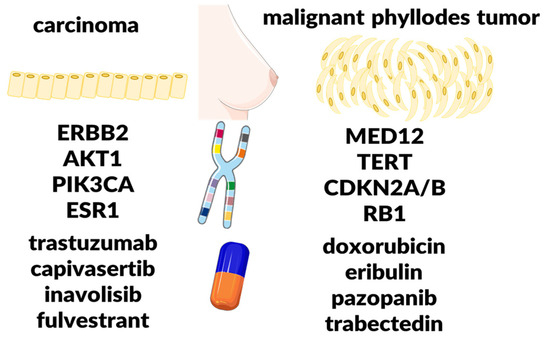
Phyllodes tumors are rare fibroepithelial neoplasms of the breast, and their malignant forms present significant diagnostic and therapeutic challenges. This review summarizes current knowledge across the benign-to-malignant spectrum, focusing on diagnostic approaches, histopathological classification, molecular alterations, and treatment strategies. While recent molecular studies have revealed recurrent genetic mutations, their clinical implications remain under investigation. Surgical excision remains the cornerstone of treatment, and systemic therapies are generally adapted from soft tissue sarcoma protocols. Future efforts should focus on improving diagnostic accuracy, identifying molecular targets for therapy, and fostering international collaboration to advance clinical research in this rare tumor type.
- phyllodes tumor
- MED12
- TERT
- review
- chemotherapy
- sarcoma
- molecular diagnostics
References
- Masuda, N.; Lee, S.J.; Ohtani, S.; Im, Y.H.; Lee, E.S.; Yokota, I.; Kuroi, K.; Im, S.A.; Park, B.W.; Kim, S.B.; et al. Adjuvant Capecitabine for Breast Cancer after Preoperative Chemotherapy. N. Engl. J. Med. 2017, 376, 2147–2159.
- Modi, S.; Jacot, W.; Yamashita, T.; Sohn, J.; Vidal, M.; Tokunaga, E.; Tsurutani, J.; Ueno, N.T.; Prat, A.; Chae, Y.S.; et al. Trastuzumab Deruxtecan in Previously Treated HER2-Low Advanced Breast Cancer. N. Engl. J. Med. 2022, 387, 9–20.
- Bardia, A.; Jhaveri, K.; Kalinsky, K.; Pernas, S.; Tsurutani, J.; Xu, B.; Hamilton, E.; Im, S.A.; Nowecki, Z.; Sohn, J.; et al. TROPION-Breast01: Datopotamab deruxtecan vs chemotherapy in pre-treated inoperable or metastatic HR+/HER2- breast cancer. Future Oncol. 2024, 20, 423–436.
- Turner, N.C.; Oliveira, M.; Howell, S.J.; Dalenc, F.; Cortes, J.; Gomez Moreno, H.L.; Hu, X.; Jhaveri, K.; Krivorotko, P.; Loibl, S.; et al. Capivasertib in Hormone Receptor-Positive Advanced Breast Cancer. N. Engl. J. Med. 2023, 388, 2058–2070.
- Lissidini, G.; Mulè, A.; Santoro, A.; Papa, G.; Nicosia, L.; Cassano, E.; Ashoor, A.A.; Veronesi, P.; Pantanowitz, L.; Hornick, J.L.; et al. Malignant phyllodes tumor of the breast: A systematic review. Pathologica 2022, 114, 111–120.
- Jones, A.M.; Mitter, R.; Springall, R.; Graham, T.; Winter, E.; Gillett, C.; Hanby, A.M.; Tomlinson, I.P.; Sawyer, E.J. A comprehensive genetic profile of phyllodes tumours of the breast detects important mutations, intra-tumoral genetic heterogeneity and new genetic changes on recurrence. J. Pathol. 2008, 214, 533–544.
- Borella, F.; Porpiglia, M.; Gallio, N.; Cito, C.; Boriglione, L.; Capella, G.; Cassoni, P.; Castellano, I. Borderline Phyllodes Breast Tumors: A Comprehensive Review of Recurrence, Histopathological Characteristics, and Treatment Modalities. Curr. Oncol. 2025, 32, 66.
- Suzuki, S.; Saito, Y. Genomic Analysis of Advanced Phyllodes Tumors Using Next-Generation Sequencing and Their Chemotherapy Response: A Retrospective Study Using the C-CAT Database. Medicina 2024, 60, 1898.