
Syndrome T, or SORSHOT, refers to persistent symptoms in patients affected by hypothyroidism who appear euthyroid by TSH levels. Seen in about 10% of hypothyroid patients, causes are unclear but likely include psychosomatic factors, inadequate treatment, autoimmunity, and neuropathy. Common symptoms are fatigue, heart-related issues, mood changes, weight gain, and pain. No standard treatment exists, but options may include combined hormone therapy, personalised dosing, and nutritional supplementation.
- thyroid
- hypothyroidism
- syndrome T
- SORSHOT
- quality of life
- endocrinology
1. Introduction
Syndrome T (aka SORSHOT) is the designation for the complex of continued symptoms and reduced quality of life (QoL) in patients with hypothyroidism that seem to be sufficiently treated from a TSH-centric perspective. The affected suffer from persistent complaints despite being in a formally euthyroid condition (i.e. thyrotropin concentration is in its reference range) [1][2][3][4][5].
2.
Terminology
The term “syndrome T”, which is more common in Europe, traces back to "thyroprivic syndrome" for type 1 syndrome T [5] and “syndrome thyroiditis” for type 2 syndrome T, recognising a clustering of symptoms in autoimmune thyroiditis [63][74]. In the USA, the alternative term SORSHOT ("syndrome of residual symptoms of hypothyroidism on T4") is partly favoured, including hypothyroidism after thyroidectomy or radioiodine therapy [85]. On the other hand, the term “syndrome T” also includes latent autoimmune thyroid disease, i.e., autoimmune thyroiditis with preserved euthyroidism.
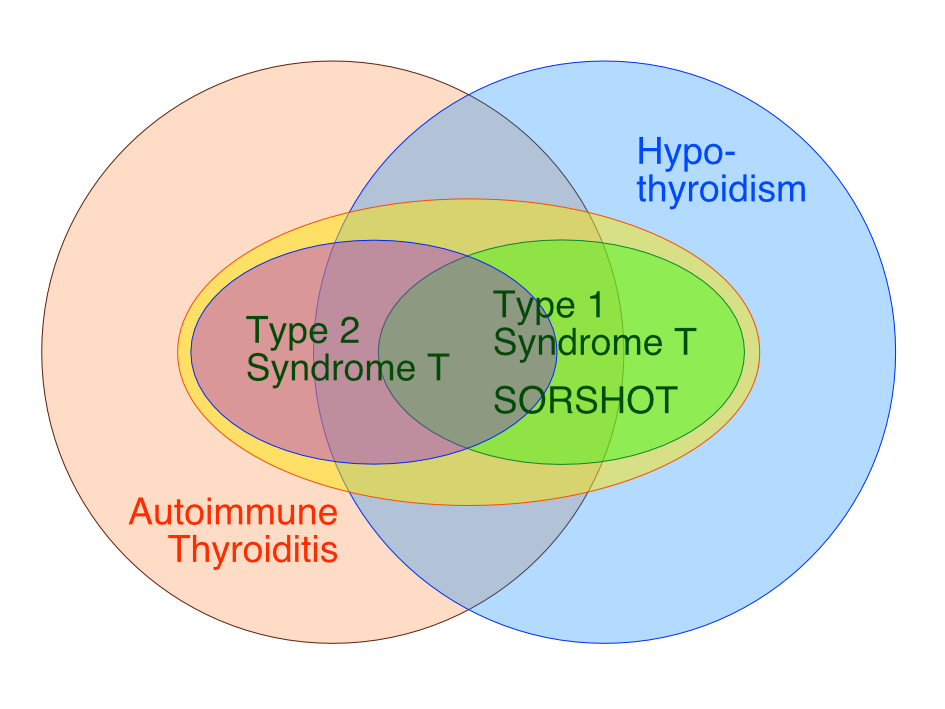 Types of syndrome T and SORSHOT
3. Epidemiology
The prevalence of syndrome T is estimated to be between 5 and 15% of all patients with hypothyroidism or autoimmune thyroiditis [9]. Some studies report a proportion of up to 25% among hypothyroid patients [10]. Sinnce about 5% of the population of developed countries suffers from hypothyroidism, this translates to a population prevalence of about 0.5%.
4.
Aetiology
Up to now, the exact cause of the syndrome T remains unknown. It is probably one of the multifactorial symptom complexes. Potential reasons to be discussed include [96][117]:
- awareness of being affected by a chronic disease (psychosomatic aspects, nocebo effect)
- insufficient dosage of substitutive therapy with L-thyroxine (i.e. under treatment, the concentrations for TSH and free thyroxine are in their respective reference ranges, but they miss the personal set point of the feedback loop, a non-ergodic system)
- insufficient modality of therapy (i.e. treatment with L-thyroxine alone, missing an increased need for L3 or Liothyronine in the setting of step-up-hypodeiodination)
- immunity of the thyroid with consecutive release of inflammatory mediators and, potentially, cross-immunity, e.g. to epitopes of the peripheral and central nervous system
- clustering of other autoimmune conditions in cases of chronic thyroiditis (including, but not limited to, adrenal failure, type 1 diabetes and hypoparathyroidism)
- Autonomic and sensorimotor neuropathy (probably resulting from both impaired thyroid signalling and autoimmunity) [12]
- awareness of being affected by a chronic disease (psychosomatic aspects, nocebo effect)
- insufficient dosage of substitutive therapy with L-thyroxine (i.e. under treatment, the concentrations for TSH and free thyroxine are in their respective reference ranges, but they miss the personal set point of the feedback loop, a non-ergodic system)
- insufficient modality of therapy (i.e. treatment with L-thyroxine alone, missing an increased need for L3 or Liothyronine in the setting of step-up-hypodeiodination)
- immunity of the thyroid with consecutive release of inflammatory mediators and, potentially, cross-immunity, e.g. to epitopes of the peripheral and central nervous system
- clustering of other autoimmune conditions in cases of chronic thyroiditis (including, but not limited to, adrenal failure, type 1 diabetes and hypoparathyroidism)
- Autonomic and sensorimotor neuropathy (probably resulting from both impaired thyroid signalling and autoimmunity)[8]
Comorbidities account for only 14% of the difference in QoL between patients and controls [13].
5. Symptoms
Typical complaints include fatigue, tachycardia (both postural and at rest), palpitations, gastrointestinal symptoms, depression, anxiety, unstable weight (and, especially, weight gain), intolerance to both heat and cold, and diffuse, fibromyalgia-like pain [1][2][96].
6.
Therapy
Currently, a universal treatment program has not been established [149]. A significant subgroup of the affected may benefit from a combination therapy with levothyroxine (L-T4) and liothyronine (L-T3) [1510][3][4], especially in cases of some polymorphic variants of the DIO2 gene, which encodes the type 2 deiodinase [1611]. Other promising approaches include dosage of L-T4 based on reconstructing the setpoint of thyroid homeostasis with cybernetic methods (Thyroid SPOT), treatment of comorbidities, and immunomodulation with selenium and vitamin D [1712].
Therefore, treatment of syndrome T requires a personalised approach [1813].
References
- Dietrich JW, Bazika-Gerasch B. Lebensqualität bei Schilddrüsenerkrankungen. Forum Sanitas. 2022, 4, 25-8.
- Torquil Watt; Mogens Groenvold; ÅsE Krogh Rasmussen; Steen Joop Bonnema; Laszlo Hegedüs; Jakob Bue Bjorner; Ulla Feldt-Rasmussen; Quality of life in patients with benign thyroid disorders. A review. Eur. J. Endocrinol.. 2006, 154, 501-510.
- Giulia Carvalhal; Daniele Carvalhal de Almeida Beltrão; Fabricia Elizabeth de Lima Beltrão; Miriam O Ribeiro; Matthew D Ettleson; Helton Estrela Ramos; Antonio C Bianco; Treatment Preferences in Patients With Hypothyroidism. J. CliJulian Berberich; Johannes W. Dietrich; Rudolf Hoermann; Matthias A. Müller; Mathematical Modeling of the Pituitary–Thyroid Feedback Loop: Role of a TSH-T3-Shunt and Sensitivity Analysis. Front. Endocrinol. Metab.. . 2024, 110, 887-900.18, 9, 91.
- Antonio C. Bianco; Emerging Therapies in Hypothyroidism. AJohannes W. Dietrich; John E. M. Midgley; Rudolf Hoermann; Editorial: “Homeostasis and Allostasis of Thyroid Function”. Fronnut. Rev. MedEndocrinol.. 2024, 75, 307-319.18, 9, 287.
- Yusuf Öztürk; Hatice Erdoğan Özbuğday; Zuhal Dağ; Muhammet Kocabaş; A Risk Scoring System Integrating Clinical and Ultrasonographic Parameters for Predicting Hypothyroidism After Hemithyroidectomy. Diagn.. 2026, 16, 2550.Antonio C. Bianco. Rethinking Hypothyroidism. Why Treatment Must Change and What Patients Can Do; University of Chicago Press: Chicago, IL, United States, 2022; pp. ISBN 978-0226823164.
- Julian Berberich; Johannes W. Dietrich; Rudolf Hoermann; Matthias A. Müller; Mathematical Modeling of the Pituitary–Thyroid Feedback Loop: Role of a TSH-T3-Shunt and Sensitivity Analysis. FronWilmar M. Wiersinga; Paradigm shifts in thyroid hormone replacement therapies for hypothyroidism. Nat. Rev. Endocrinol.. 2018, 9, 91.4, 10, 164-174.
- Johannes W. Dietrich; John E. M. Midgley; Rudolf Hoermann; Editorial: “Homeostasis and Allostasis of Thyroid Function”. FM. Nebuchennykh; S. Løseth; S. I. Mellgren; Aspects of peripheral nerve involvement in patients with treated hypothyroidism. Euront. J. EndocrinNeurol.. 20018, 9, 287.9, 17, 67-72.
- Antonio C. Bianco. Rethinking Hypothyroidism. Why Treatment Must Change and What Patients Can Do; University of Chicago Press: Chicago, IL, United States, 2022; pp. ISBN 978-0226823164.Bojana Bazika-Gerasch; Nina Kumowski; Elena Enax-Krumova; Miriam Kaisler; Lynn Bernadette Eitner; Christoph Maier; Johannes W. Dietrich; Impaired autonomic function and somatosensory disturbance in patients with treated autoimmune thyroiditis. Sci. Rep.. 2024, 14, 1-12.
- Wilmar M. Wiersinga; Paradigm shifts in thyroid hormone replacement therapies for hypothyroidism. NatRudolf Hoermann; John E. M. Midgley; Rolf Larisch; Johannes W. Dietrich; Lessons from Randomised Clinical Trials for Triiodothyronine Treatment of Hypothyroidism: Have They Achieved Their Objectives?. J. Thyroid. Revs. Endocrinol.. . 2014, 8, 2010, 164-174.8, 1-9.
- Jessica Hidalgo; Bryan A. Vallejo; Cristian Soto Jacome; Ivan N. Ayala; Sandra Cordova; Mayra Duran; Elizabeth Golembiewski; David Toro-Tobon; Juan P. Brito; Real Practice Assessment of Persistent Symptoms After Initiation of Levothyroxine. Wilmar M. Wiersinga; Leonidas Duntas; Valentin Fadeyev; Birte Nygaard; Mark P.J. Vanderpump; 2012 ETA Guidelines: The Use of L-T4 + L-T3 in the Treatment of Hypothyroidism. Endocur. PrThyroid.. J.. 20123, 30, 95-100., 1, 55-71.
- M. Nebuchennykh; S. Løseth; S. I. Mellgren; Aspects of peripheral nerve involvement in patients with treated hypothyroidism. Allan Carlé; Jens Faber; Rudi Steffensen; Peter Laurberg; Birte Nygaard; Hypothyroid Patients Encoding Combined MCT10 and DIO2 Gene Polymorphisms May Prefer L-T3 + L-T4 Combination Treatment – Data Using a Blind, Randomized, Clinical Study. Eur. JThyroid. NeurolJ.. 2009, 17, 67-72.17, 6, 143-151.
- Bojana Bazika-Gerasch; Nina Kumowski; Elena Enax-Krumova; Miriam Kaisler; Lynn Bernadette Eitner; Christoph Maier; Johannes W. Dietrich; Impaired autonomic function and somatosensory disturbance in patients with treated autoimmune thyroiditis. SE. Li; P. M. Yen; J. W. Dietrich; M. K.-S. Leow; Profiling retrospective thyroid function data in complete thyroidectomy patients to investigate the HPT axis set point (PREDICT-IT). J. Endocri. Repnol. Investig.. 2024, 10, 44, 1-12., 969-977.
- Ellen Molewijk; Eric Fliers; Koen Dreijerink; Ad van Dooren; Rob Heerdink; Quality of life, daily functioning, and symptoms in hypothyroid patients on thyroid replacement therapy: A Dutch survey. J. Clin. Transl. Endocrinol.. 2024, 35, 100330.Rudolf Hoermann; Johannes W. Dietrich. Treatment of Hypothyroidism; Springer Nature: Dordrecht, GX, Netherlands, 2025; pp. 133-162.
- Rudolf Hoermann; John E. M. Midgley; Rolf Larisch; Johannes W. Dietrich; Lessons from Randomised Clinical Trials for Triiodothyronine Treatment of Hypothyroidism: Have They Achieved Their Objectives?. J. Thyroid. Res.. 2018, 2018, 1-9.
- Wilmar M. Wiersinga; Leonidas Duntas; Valentin Fadeyev; Birte Nygaard; Mark P.J. Vanderpump; 2012 ETA Guidelines: The Use of L-T4 + L-T3 in the Treatment of Hypothyroidism. Eur. Thyroid. J.. 2012, 1, 55-71.
- Allan Carlé; Jens Faber; Rudi Steffensen; Peter Laurberg; Birte Nygaard; Hypothyroid Patients Encoding Combined MCT10 and DIO2 Gene Polymorphisms May Prefer L-T3 + L-T4 Combination Treatment – Data Using a Blind, Randomized, Clinical Study. Eur. Thyroid. J.. 2017, 6, 143-151.
- E. Li; P. M. Yen; J. W. Dietrich; M. K.-S. Leow; Profiling retrospective thyroid function data in complete thyroidectomy patients to investigate the HPT axis set point (PREDICT-IT). J. Endocrinol. Investig.. 2020, 44, 969-977.
- Rudolf Hoermann; Johannes W. Dietrich. Treatment of Hypothyroidism; Springer Nature: Dordrecht, GX, Netherlands, 2025; pp. 133-162.