The number of students studying outside their home countries has increased in recent years, and the United Kingdom has long been positioned as a leading destination, consistently being ranked among the top five English-speaking countries for international education. However, in 2024, the UK experienced a significant decline in international student enrolments, with Australia surpassing the UK to take second place globally. This decline coincided with an increasingly restrictive political climate, particularly reflected in changes to student visa policies and new limitations on dependents. The reduction in international student numbers poses serious financial risks to UK universities, many of which rely heavily on tuition from overseas students, and brings broader organizational challenges, including staffing cuts, programme restructuring, and reduced support services. Societally, it impacts local economies, reduces cultural diversity, and weakens the UK’s soft power and global educational influence. This entry explores the current state of the UK’s international student supply chain, examines emerging post-2024 challenges, and outlines key implications to inform institutional and policy-level responses.
1.1. History of International Students
The concept of ‘studying abroad’ can be dated back to the beginnings of human history
[1], and in terms of specialized higher education institutions (HEIs), it can be traced to North Africa and Iberia
[2][3][2,3], which led to the first Western universities in Europe
[4][5][6][7][8][4,5,6,7,8]. However, non-elite individuals could not access such opportunities prior to the social changes and human resource needs of the Industrial Revolution (1750–1900), from which advancements in transportation allowed more international students (hereinafter ‘int-students’) from overseas to travel for higher education
[9][10][9,10], given the need to train colonial elites to administer to emerging European empires
[11].
The contemporary concept of ‘ordinary’ int-students studying abroad to achieve their own educational and socio-economic goals only began to emerge in the mid-20th century, due to the administrative and technical skills required for emerging nation states, commensurate with the universal expansion of universities and university places worldwide from 1950 onwards
[12][13][12,13]. Such trends were reflected by the rapid growth of global higher educational enrolment during this period.
The late 20th century marked the maturation of the int-student supply chain
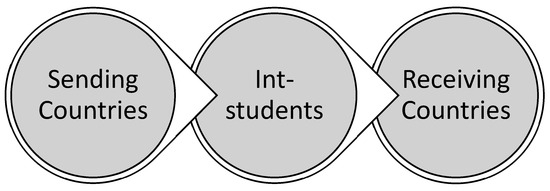
[14], consisting of three key elements: sending countries, which are nations where students seek to study abroad; receiving countries, which are the destinations to which these students travel for education; and int-students, who are individuals pursuing academic opportunities abroad, serving as the central link between sending and receiving countries in global education mobility (
Figure 1).
Figure 1. Key elements of international student supply chain.
1.2. The UK Context
From the beginning of this trend, the most popular study destinations included the USA, the UK, Australia, Canada, France, Germany, New Zealand, and Spain
[14]. By the end of the 20th century, other study destinations began making a serious impression, particularly as universities in non-Anglophone countries (particularly in Europe) began offering courses in English, further shaping the global landscape of international education, and making ‘studying abroad’ a global industry as well as an international educational phenomenon
[15]. Competition increased between different receiving countries around the globe as well as between universities within the same country, corresponding with an increasing orientation toward corporate business models in the administration of universities from the late 20th century onwards, and with macroeconomic trends reflected in the neoliberalist political economy
[16].
The UK has been among the leading countries for international education, consistently attracting thousands of int-students every year since time immemorial, and students from across the globe make significant economic, cultural, and academic contributions to the country
[17]. Specifically, the contribution of int-students to the UK economy grew from GBP 31.3 billion in 2018/19 to GBP 41.9 billion in 2021/22
[18]. Therefore, any decline in the int-student supply chain will have a direct impact on UK institutions and the UK as a whole, particularly in ‘university towns’ whose local economies and native employment largely depend on universities (the net contribution of int-students equates to a mean sum of GBP 58 million per UK parliamentary constituency per annum, but naturally this contribution is greater in university towns where int-students reside and study).
However, recent figures indicate a drop in the number of int-students coming to study in the UK, which is emerging as a major challenge for UK institutions. This decline has already led to staff reductions. To take one example from news reports concerning various universities’ precarious financial situation, in January 2025, Cardiff University announced that it planned to cut around 400 staff positions in order to ‘secure’ its future
[19].
1.3. Research Context
Based on the recent drop in UK int-student applications, this entry reviews related sources to help various stakeholders in the UK higher education system (e.g., university admissions departments and government policymakers) to gain a better understanding of the international student supply chain and the post-2024 challenges facing the UK higher education market.
This entry adopts a narrative review approach
[20], which is particularly suited to exploring complex and evolving issues such as int-student mobility and the recent decline in enrolment within the UK higher education sector. This narrative review method enables a flexible and interpretive synthesis of the literature, allowing the author to draw from diverse sources and perspectives to critically analyze trends, identify emerging patterns, and explore the underlying causes of the 2024 decline in int-student numbers.
This study was guided by the overarching research question: What is the current status of the int-student supply chain, with a focus on the UK market, and what potential challenges does this pose for the UK’s international education sector?
To address this question, this study synthesized data from the academic literature, government reports, think tank publications, higher education policy documents, and relevant grey literature published between 2005 and early 2025. The most recent and relevant publications (from 2023 to 2025) were prioritized to ensure that findings reflect up-to-date trends and developments.