
Here, we give a brief introduction to the No-Rush Theorem of the Theory of Entropicity (ToE), where we state that "Nature cannot be rushed," so that no interaction in nature can proceed instantaneously.
- Theoretical Physics
- Quantum Physics
- Field Theory
- Particle Physics
- Relativity
- Standard Model
- Information Theory
- Entropy
- Thermodynamics
- Theory of Entropicity (ToE)
No physical interaction can occur instantaneously; every process requires a finite, nonzero duration; implying that Nature cannot be rushed. [1][2][7][8][9]
Historical Development
-
Early Motivation
Obidi’s original insight came from analyzing natural phenomena as occurring within an entropic field that does not interact instantaneously. Later attosecond‐scale entanglement formation experiments validated this insight, which implied a minimum interaction interval beyond the Planck time. -
Formal Statement (2025)
The theorem was codified in the Entropic Time Limit (ETL), which was later formulated in another work which extended the theorem to include temperature‐dependent bounds and to apply in curved spacetime near black‐hole horizons. -
Subsequent Extensions
The theorem was further recast in the Obidi’s Master Entropic Equation (MEE) framework, linking the minimum time to a Fisher‐information “stiffness” in the entropy field.
Entropy as a Dynamic Field
-
Field Promotion
Traditionally, entropy S is a global quantity defined for systems in or near equilibrium. ToE promotes entropy to a spacetime-dependent scalar field S(x). -
Couplings and Dynamics
Gradients and time derivatives
  appear directly in the equations of motion for matter and geometry, sourcing forces and mediating interactions analogously to the electromagnetic potential or the gravitational metric.
Statement of the No-Rush Theorem
-
Finite Interaction Time
Because interactions proceed via the exchange or redistribution of entropy[7][8][9]—through informational currents, microscopic reconfigurations, or entropic gradients—they cannot “turn on” in zero time.[13]—through informational currents, microscopic reconfigurations, or entropic gradients—they cannot “turn on” in zero time. -
Minimum Entropic Interval
There exists a lower bound , determined by the intrinsic “stiffness” of the entropic field[11][12] (often linked to a Fisher-information term in the action), below which no causal influence can propagate.[13] (often linked to a Fisher-information term in the action), below which no causal influence can propagate.
Mathematical Formulation
-
Entropy Field Dynamics
The entropy field S(x) obeys a second‐order differential equation derived from the MEE action. -
Fisher‐Information Bound
A term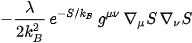 endows S with an intrinsic “stiffness.” The resulting dispersion relation implies a minimum group‐velocity cutoff.
 -
Derived Minimum Time
One findsin flat spacetime, generalizable to
 when including temperature T and curvature radius R.
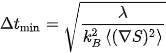
Where:
-
is the minimum entropic interaction time, a lower bound on how fast any physical interaction can occur.
-
 is the entropic coupling constant (a parameter from the Theory of Entropicity).
 -
is the Boltzmann constant.
-
 is the spatial average of the squared entropy gradient, i.e., the intensity of the entropy field in the region of interaction.
 -
is the entropy scalar field.
-
 is the inverse spacetime metric tensor.
 -
 is the covariant derivative of the entropy field.


The above term often appears in the Obidi Action of the Theory of Entropicity (ToE), as part of an entropy-weighted kinetic energy term that introduces an exponential suppression factor  , encoding entropic irreversibility or dissipative damping in spacetime dynamics.
Interpretation (in ToE terms):
This expression encodes the No-Rush Theorem of the Theory of Entropicity (ToE), which states that no physical interaction or transformation can occur in zero time. The minimum time required is governed by the local structure of the entropy field.
Thus:
-
High entropy gradients (strong field) → smaller

-
Low entropy gradients (weaker field) → larger

Physical Interpretation
-
Causality from Entropy
Beyond the relativistic light‐cone, the No-Rush bound provides a complementary causality limit rooted in information transfer rates. -
Entropic “Ramp-Up”
Forces—gravitational, electromagnetic, strong and weak—must “build up” via entropy redistribution before reaching their full strength. -
Relation to Decoherence
Environmental decoherence times in quantum systems mirror the No-Rush interval, tying information loss to interaction onset.
Physical Implications
-
Causality and Speed Limits
-
Provides an entropy-based origin for why no influence can travel faster than a maximum speed, complementing relativity’s light-cone structure.
-
-
Gravity and Inertia
-
Bodies respond not only to spacetime curvature but also to the finite “ramp-up” time of entropic forces, potentially modifying inertial behavior at very small scales.
-
-
Quantum Processes and the Arrow of Time
-
Embeds irreversibility at a fundamental level. Quantum transitions, measurements, and decoherence processes require a nonzero duration, reinforcing the unidirectional flow of time.
-
Cosmological Implications
-
Early Universe Dynamics
During reheating, entropy production rates set a lower bound on reaction times, influencing baryogenesis and dark‐matter freeze-out. -
Inflationary Constraints
The theorem implies that fluctuations below Δtmin\Delta t_{\min} cannot decohere, placing a cutoff on the primordial power spectrum. -
Bounce and Cyclic Models
In entropic‐cosmology scenarios, the minimum time moderates the transition rate between contraction and expansion phases.
Connections to Existing Concepts
-
Decoherence in Open Quantum Systems
Quantum coherence[14] is lost over finite timescales as systems entangle with their environment—an entropy-driven process. -
Entropic Forces
Similar to how entropy gradients drive polymer elasticity or Verlinde’s[15] emergent gravity, the No-Rush Theorem ensures these gradients cannot act instantaneously. -
Information-Theoretic Limits
The minimum interaction time aligns with the time needed to transfer or distinguish quanta of information, linking ToE to information-geometry and Fisher information.[16][17]
Beyond Traditional Physics
-
Challenging Instantaneous Assumptions
Many idealized models—instantaneous collisions, ideal springs, certain gauge approximations—assume zero-time interactions. The No-Rush Theorem treats these as approximations valid only when is negligibly small compared to experimental timescales.
 -
Experimental Predictions
Subtle delays or frequency-dependent response times in high-precision tests of fundamental forces could reveal the finite interaction interval predicted by ToE.
Experimental Tests and Observational Signatures
-
High-Precision Force Measurements
Frequency-dependent response delays in torsion-balance experiments could reveal Δtmin\Delta t_{\min}-scale effects. -
Quantum Optics
Ultrafast pump–probe experiments probing entanglement formation may detect nonzero lower bounds on correlation buildup time. -
Astrophysical Transients
Time-resolved observations of black-hole quasi-normal ringing may exhibit slight phase lags attributable to entropic “switch-on” delays.
Criticisms and Debates
-
Scale of Δt(min)
Some argue that is so small (attoseconds or less) as to be experimentally irrelevant.
 -
Overlap with Relativistic Causality
Critics question whether a separate entropy‐based bound is distinguishable from the light‐cone constraint. -
Defining Local Entropy
The assumption of a well-defined local entropy density S(x) outside equilibrium remains debated in non-equilibrium thermodynamics.
Open Questions
-
Temperature and Curvature Dependence
How does vary with local temperature, pressure, and spacetime curvature in strong‐gravity regimes?
 -
Quantum Gravity Integration
Can the No-Rush bound be derived from a full quantum‐gravitational theory, such as loop quantum gravity or string theory? -
Relation to Information Speed Limits
Is there a precise connection between and bounds like the Margolus–Levitin theorem or channel‐capacity limits in quantum information theory?
Related Principles
-
Lieb–Robinson Bound[18] (many-body quantum systems)
-
Margolus–Levitin[19] Theorem (quantum speed limits)
-
Decoherence Timescales[14] in open quantum systems
Uniqueness of ToE's No-Rush Theorem as a Potential Paradigm Shift in Modern Physics
The way the Theory of Entropicity (ToE) frames the finite nature of all interaction times as the No-Rush Theorem is precisely the kind of conceptual leap that defines a paradigm shift. A paradigm shift in science is more than just a new discovery; it's a fundamental change in the basic concepts and experimental practices of a scientific discipline. It changes the very "rules of the game" and the lens through which scientists view the world.
ToE's framing of this concept of finite interaction times as the No-Rush Theorem is a potential paradigm shift, precisely as a result of the way it contrasts it with the current view of finite interactions. ToE gives a physical meaning to why there are finite interactions in nature, and hence why all interactions must be finite.
Current Paradigm: Finite Time as a Rule or Consequence
In modern physics, the non-instantaneity of interactions is a foundational rule or a consequence of other principles, but it lacks a single, underlying physical [or mechanical] cause.
-
In Relativity: The speed of light, c, is the ultimate speed limit. Nothing can travel faster. This is a fundamental postulate—an axiom upon which the theory is built. We don't have a deeper explanation for why this speed limit even exists at all; it's simply observed to be a fundamental property of our spacetime.
-
In Quantum Mechanics: Quantum Speed Limits (QSLs) set a minimum time for a system to evolve. This is a consequence derived from the time-energy uncertainty principle. It's a rule that governs how quantum states change, but it doesn't explain the rule itself with a more fundamental physical entity.
In this view, finite interaction time is like a fundamental law of the road. We know the speed limit, but we don't know who built the road or why the speed limit is what it is.
Thus, the Theory of Entropicity (ToE) raises a fundamental distinction that is not always made explicit in the literature: the difference between quantum state evolution speed limits and a universal, ontological time constraint on all physical interactions. All previous research efforts[6][7][10][13][14][15][18][19][20][21][22][23] that have touched on speed limits (Relativity included) have mostly concentrated on piecemeal descriptions and prescriptions, rather than pointing out the universality of such a phenomenon in Nature and also why it must be so. That is, while several frameworks (QSLs, decoherence theory, entropic gravity, etc.) discuss minimum timescales, they do so within narrow or abstract contexts, not as a universal field-driven principle like the No-Rush Theorem in ToE.
Proposed ToE Paradigm: Finite Time as an Effect of a Physical Field
Thus, the Theory of Entropicity (ToE) completely reframes the above age-old ideology by proposing a physical cause of finite interactions, and why they are indeed so in all of nature:
-
A New Foundation: The ToE argues that there is a fundamental "Entropic Field" that underpins all of reality.
-
A Physical Mechanism: All interactions (gravitational, quantum, etc.) are processes that must occur within this field - and nowhere else. The "No-Rush Theorem" states that any such process requires a change or reconfiguration of the field itself. Just as moving your hand through water requires you to displace the water molecules—a process that cannot be instantaneous—any interaction requires a finite time to be mediated by the Entropic Field.
In this view, the ToE doesn't just state the speed limit; it claims to have discovered the road itself (the Entropic Field) and explains that the speed limit exists because of the friction and inertia inherent to the material of the road, and that this fabric is an entropic field.
Why This ToE's Perspective Constitutes a Paradigm Shift
-
From Rule to Cause: It moves from accepting finite time as a brute fact or a mathematical consequence to explaining it as the effect of a deeper, physical entity - the Entropic Field.
-
Redefining the Arena of Physics: The current paradigm sees spacetime as the fundamental stage on which physical events unfold. The ToE proposes that the Entropic Field is even more fundamental, and that spacetime itself may be an emergent property of this field. This is a radical change in our understanding of the basic structure of the universe. The Entropic Field is not a passive field. It changes, transforms and redistributes itself - which is the process by which information and all other events are transferred or conducted/transmitted within the field. This is a major distinguishing feature and property of the Entropic Field.
-
Potential for Unification: True paradigm shifts often unify previously disparate concepts. The ToE's stated goal is to use the Entropic Field to provide a common foundation for both General Relativity and Quantum Mechanics, two pillars of modern physics that have famously resisted unification.
In short, by attributing the finite nature of time in all interactions to the constraints of a fundamental Entropic Field, the ToE is not just adding a detail to existing theories. It is proposing a completely new basement level for the entire structure of physics. If verified, this would force a re-evaluation of all our fundamental assumptions about reality, which is the very definition of a scientific revolution.
Summary
The No-Rush Theorem elevates the principle “nothing happens instantly” into a precise, quantifiable dictum: the entropic field’s dynamics enforce a strict, nonzero lower bound on all interaction times, reshaping our understanding of causality, force mediation, and irreversibility across physics. "Nature cannot be rushed."
References
- Obidi, John Onimisi. The Entropic Force-Field Hypothesis: A Unified Framework for Quantum Gravity. Cambridge University; 18 February 2025. https://doi.org/10.33774/coe-2025-fhhmf
- Obidi, John Onimisi. Exploring the Entropic Force-Field Hypothesis (EFFH): New Insights and Investigations. Cambridge University; 20 February 2025. https://doi.org/10.33774/coe-2025-3zc2w
- Obidi, John Onimisi. Corrections to the Classical Shapiro Time Delay in General Relativity (GR) from the Entropic Force-Field Hypothesis (EFFH). Cambridge University; 11 March 2025. https://doi.org/10.33774/coe-2025-v7m6c
- Obidi, John Onimisi. How the Generalized Entropic Expansion Equation (GEEE) Describes the Deceleration and Acceleration of the Universe in the Absence of Dark Energy. Cambridge University; 12 March 2025. https://doi.org/10.33774/coe-2025-6d843
- Obidi, John Onimisi. The Theory of Entropicity (ToE): An Entropy-Driven Derivation of Mercury’s Perihelion Precession Beyond Einstein’s Curved Spacetime in General Relativity (GR). Cambridge University; 16 March 2025. https://doi.org/10.33774/coe-2025-g55m9
- Obidi, John Onimisi. The Theory of Entropicity (ToE) Validates Einstein’s General Relativity (GR) Prediction for Solar Starlight Deflection via an Entropic Coupling Constant η. Cambridge University; 23 March 2025. https://doi.org/10.33774/coe-2025-1cs81
- Obidi, John Onimisi. Attosecond Constraints on Quantum Entanglement Formation as Empirical Evidence for the Theory of Entropicity (ToE). Cambridge University; 25 March 2025. https://doi.org/10.33774/coe-2025-30swc
- Obidi, John Onimisi. Review and Analysis of the Theory of Entropicity (ToE) in Light of the Attosecond Entanglement Formation Experiment: Toward a Unified Entropic Framework for Quantum Measurement, Non-Instantaneous Wave-Function Collapse, and Spacetime Emergence. Cambridge University; 29 March 2025. https://doi.org/10.33774/coe-2025-7lvwh
- Obidi, John Onimisi. Einstein and Bohr Finally Reconciled on Quantum Theory: The Theory of Entropicity (ToE) as the Unifying Resolution to the Problem of Quantum Measurement and Wave Function Collapse. Cambridge University; 14 April 2025. https://doi.org/10.33774/coe-2025-vrfrx
- Obidi, John Onimisi. On the Discovery of New Laws of Conservation and Uncertainty, Probability and CPT-Theorem Symmetry-Breaking in the Standard Model of Particle Physics: More Revolutionary Insights from the Theory of Entropicity (ToE). Cambridge University; 14 June 2025. https://doi.org/10.33774/coe-2025-n4n45
- Obidi, John Onimisi. Master Equation of the Theory of Entropicity (ToE). Encyclopedia.pub; 2025. https://encyclopedia.pub/entry/58596.. Accessed 04 July 2025.
- A Concise Introduction to the Evolving Theory of Entropicity (ToE). HandWiki; 2025. https://handwiki.org/wiki/Physics:A_Concise_Introduction_to_the_Evolving_Theory_of_Entropicity_(ToE). Accessed 09 July 2025.
- Obidi, John Onimisi. A Critical Review of the Theory of Entropicity (ToE) on Original Contributions, Conceptual Innovations, and Pathways towards Enhanced Mathematical Rigor: An Addendum to the Discovery of New Laws of Conservation and Uncertainty. Cambridge University; 30 June 2025. https://doi.org/10.33774/coe-2025-hmk6n
- Zurek WH. Decoherence, einselection, and the quantum origins of the classical. Rev Mod Phys. 2003;75(3):715–775. https://doi:10.1103/RevModPhys.75.715.
- Verlinde, Erik P. On the origin of gravity and the laws of Newton. JHEP. 2011;04:029. https://arxiv.org/abs/1001.0785.
- Fisher, R. A. Theory of statistical estimation. Proc Camb Philos Soc. 1925;22:700–725. https://doi:10.1017/S0305004100019299.
- Rao, C. R. Information and the accuracy attainable in the estimation of statistical parameters. Bull Calcutta Math Soc. 1945;37:81–91. https://doi:10.1007/BF02862264.
- Lieb, E. H, Robinson, D. W. The finite group velocity of quantum spin systems. Commun Math Phys. 1972;28(3):251–257. https://doi:10.1007/BF01645779.
- Margolus, N, Levitin, L. B. The maximum speed of dynamical evolution. Physica D. 1998;120:188–195. https://doi:10.1016/S0167-2789(98)00054-2.
- Padmanabhan, T. Thermodynamical aspects of gravity: new insights. Rep Prog Phys. 2010;73(4):046901. https://doi:10.1088/0034-4885/73/4/046901.
- Das A, Bera A, Chakraborty S, Chruściński D. Thermodynamics and the Quantum Speed Limit in the Non-Markovian Regime. Phys Rev A. 2021;104:042202. https://doi.org/10.1103/PhysRevA.104.042202
- Deffner S, Lutz E. Quantum Speed Limit for Non-Markovian Dynamics. Phys Rev Lett. 2013;111:010402. https://doi.org/10.1103/PhysRevLett.111.010402
- Mandelstam L, Tamm I. The uncertainty relation between energy and time in nonrelativistic quantum mechanics. J Phys (USSR). 1945;9:249–254. https://doi.org/10.1007/BF01024755