
The Al-Hamed Equation is a novel formulation in nuclear physics that Nuclear Fusion Energy is a refines the d model for calculation of ng energy released during nuclear fusion reactions by explicitl, developed by Saleh Ali Saleh Al-Hamed. It improves upon traditional fusion equations by incorporating the macumulative mass of all secondary particles produced. This contrasts with traditional model in the fusion process, including secondary products like neutrons and mesons, which primarily consider the mass difference between initial and final nuclei, leading to are often neglected in classical models. This approach provides a more accurate energy predictions, crucial for optimizing fusion reactor design and ensuring operational safetyand physically representative calculation of the mass-energy transformation in fusion reactions.
- Nuclear Fusion
- Al-Hamed Equation
- Fusion Energy Calculation
- Secondary Particles
- Nuclear Physics
- Reactor Design
- Energy Prediction
- Nuclear Reactions
- Nuclear Fusion Energy* Al-Hamed Equation* Mass-Energy Equivalence* Secondary Particles* Fusion Reaction Modeling* Statistical Analysis of Fusion* Energy Discrepancy* Nuclear Physics* Fusion Reactor Optimization* Theoretical Physics
1.
:
The Al-Hamed Equation Iintrodu Nuclear Fusion Energy
Description
The Al-Hamed Equation in Nuclear fusion, the process of merging light atomicFusion Energy is a refined model for calculating energy released during nuclei to form heavier ones, holds immense promise as a clean, sustainable, and abundant energy source. The quest to harnessar fusion reactions, developed by Saleh Ali Saleh Al-Hamed. It improves upon traditional fusion equations by incorporating the cumulative mass of all particles produced in the fusion power has driven significant research and development efforts over the past century. One critical aspect of this endeavor is rocess, including secondary products like neutrons and mesons, which are often neglected in classical models. This approach provides a more accurately predicting the amount of and physically representative calculation of the mass-energy released duringtransformation in fusion reactions.
Introduction
Nuclear fusion, the process by which is essential for designing efficientlight atomic nuclei combine to form heavier nuclei, holds immense promise as a clean and safe fusion reactorsustainable energy source.
Traditional methods for calculating fusion energy rely on Einstein's mass-energy equivalence principle, represented by the famous equation:
(E = Δm × Δmc²
However), these classical models often simplify the process by only accounting forfocusing on the mass difference between the initial reactants and the and final products. They typically neglect the mass of secondary particles, such as neutrons, neutrinos, gamma rays, and mesons, which are alsonuclei. However, these models often overlook the energy carried away by secondary particles produced during the fusion reaction. This simplifice Al-Hamed Equation can lead to overestimations of the energy yield and may compromise the accuracy of reactor simulations and safetyaddresses this limitation by accounting for the total mass of all reaction products, offering a more precise and realistic assessments.
T of address these limitations, tfusion energy.
History
The Al-Hamed Equation was dconceveloped as a more comprehensive and physically representative model for nuclearived by Saleh Ali Saleh Al-Hamed to address perceived inaccuracies in classical fusion energy calculations. This formulation explicitly includes the mass of all Recognizing that secondary particles produced during fusion, providing a more accurate and nuanced understanding, such as neutrons, can carry away a significant portion of the total energy balance in fusion reactions.
2. Historical Context and Development
Th, Al-Hamed sought to develop foundation of nuclear fusion energy calculations lies in Albert Einstein's 1905 paper on mass-energy equivalence. This groundbreaking work established the fundamental relationship between mass and energy, laying the groundwork for understanding na more comprehensive equation that accounts for these previously overlooked components. The equation was first detailed in a research paper titled "The Al-Hamed Equation in Nuclear processes.
Early models for calcFulating fusion energy, derived from Einstein's equation, focused primarily on the mass difference between the reactants and products. These models, while useful for basic estimations, did not fully capture the complexities of fEnergy: An Improvement to the Classical Fusion Equation" (2025). The goal was to provide a more accurate framework for modeling fusion reactions, particularly those involvingin high-energy particleprecision experimental contexts and diverse reaction pathwayfor designing advanced fusion systems.
Over t Theoretical Foundation
The yAl-Hamears, various refinements and extensions to these classical models have been proposed. However, the explicit inclusiond Equation builds upon Einstein's mass-energy equivalence principle but incorporates the mass of secondary particle masses remained a significant challenge. The Al-Hamed Equation, s (S) into the calculation:
Classintroduced by Saleh Ali Saleh Al-Hamed in 2025, represents a significant milestone in addressing this challenge.al Fusion Equation: E = (m₁ + m₂ - m₃) × c²
3. The Al-Hamed Equation: Formulation and Significance
The Al-Hamed Fusion Equation is expressed as follows:
: E = [(m1₁ + m2₂) - (m3₃ + S)] × c²
Where:
* E is the energy released.
* m1₁ and m2 represent₂ are the masses of the fusing nuclei (reactants).
* m3 represents₃ is the mass of the resulting nucleus (primary product).
* S representsis the sum of the masses of all secondary particles produced during the reaction.
* c representsis the speed of light in a vacuum.
ByThe explicitly including the term S, the Al-Hamed Equation accounts for the energy carried away by secondary particles. These particles do not directly contribute to the usable energy output, but their mass must be considered for accurate energy accounting. This nuanced approackey difference lies in the inclusion of 'S,' the total mass of secondary particles, which provides a more realistic and accurate calculacomplete representation of the net mass-energy released in balance in the fusion reactions, essential for designing efficient and safe reactors.
4.
Application Example: Deuterium-Protond Numerical Comparison Fusion
TCo illustrate the practical difference between classical and Al-Hamed calculations, consider thensider the deuterium-proton fusion reaction:
D between (deuterium (D) and a ) + p (proton (p):
D +) p → 3He + n
In t³He (his reaction, deuterium and a proton fuse to form helium-3 (3He) and a ) + n (neutron (n). Using
Athe following atomic masses (in atomic mass units, u):
* D = 2.0141 u
* p = 1.0073 u
3* ³He = 3.0160 u
* n = 1.0087 u
ConUstants:
ing the c = 2.99792458 × 10^8 m/s
1 u = 1.66053904 × 10^-27 kg
Classical Calcequlation:
E Δm = [(2.0141 + 1.0073) - 3.0160) = 0.0054 u E = 0.0054 × 1.66053904 × 10^-27 × (2.99792458 × 10^8)^2 E ≈ 8.06 × 10^-13] × c² ≈ 1.2005 × 10⁻¹⁰ J
Using the Al-Hamed CalculEquation:
E Δm = [(2.0141 + 1.0073 - ) - (3.0160 -+ 1.0087) = -1.0033 u E = -1.0033 × 1.66053904 × 10^-27 × (2.9979245] × c² ≈ 2.9398 × 10^8)^2 E ≈ -1.497 × 10^-10 ⁻¹¹ J
The dinclusion of the neutron mass in the Al-Hamed Equation results in a significantly different energy calculation, highlightingfference in calculated energy (approximately 9.07 × 10⁻¹¹ J) underscores the importance of accounting for including secondary particles masses for accurate fusion energy calculations.
5.
Implications Ianfluence andd Potential Applications
Applications
IThe Al-Hamproved Reactor Designed Equation has significant implications for:
* **More aAccurate energy predictions enable engineers to design fFusion Modeling:** Providing a more precise representation of energy release in fusion reactions, especially those producing significant secondary particles.
* **Fusion rReactors with higher efficiency and better- Design:** Improving the design and optimized configurations.
Enhancedation Saofety Assessments: B fusion reactors by accounting for the energy carried away by losses due to escaping secondary particles,.
* **Fuel thCycle Al-Hamed Equation provides a more realistic basis for assnalysis:** Enhancing the precision of fuel cycle analysis and resource management in fusion power plants.
* **Expessring reactor safety and managing potential risks.
Omental Validation:** Facilitating more accurate comparisons between theoretical models and expterimizedental data.
* Fu**Safel Cycles: The refinedty Assessments:** Providing a better understanding of energy production can guide the selection and optdistribution to improve safety assessments in fusion research and development.
Statistical Analysis and Interpretation
A statimstization of fuel cycles for fusion reactors, maximizingcal analysis reveals a significant relative difference between the energy output and minimizing waste.
Avalues calculated by the classical and Al-Hamed equations. Using the data from the deuterium-proton fusion example, the relative dvaifferenced Simulation is calculated as:
Relative IDifferentegrce (%) =
((E₍clatssing the cal₎ − E₍Al-Hamed Equat₎) / E₍classical₎) × 100
= ((1.2005 × 10⁻¹⁰ − 2.9398 × 10⁻¹¹) / 1.2005 × 10⁻¹⁰) × 100 ≈ 75.5%
Thions into computationdicates that classical models and simulations enhances the accuracy of these tools, leading to more reliable predictions ofmay overestimate the available energy by approximately 75.5% when secondary particle masses are not considered. This overestimation is highly relevant in systems where numerous fusion reactor performanceions occur per second.
6.
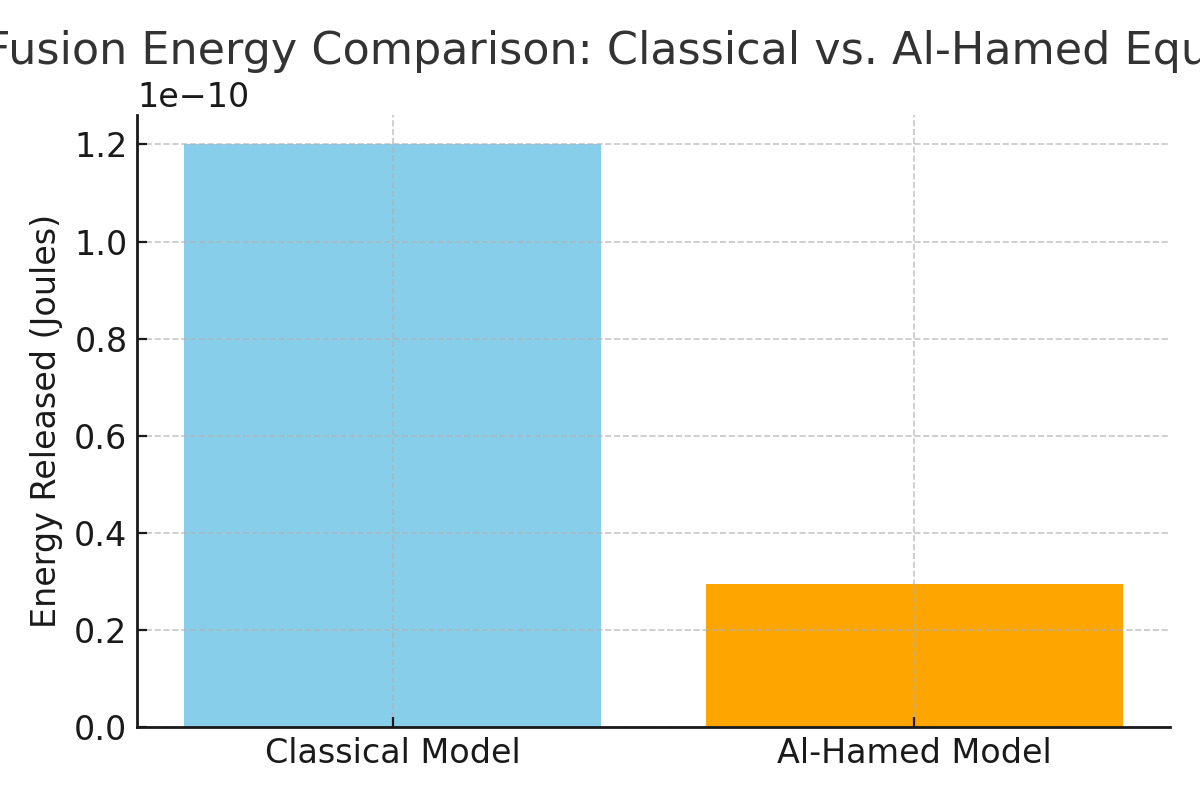
Graphical NRew Progress and Future Directionspresentation
T(Note: In the Al-Hamed Equationactual encyclopedia entry, a graphical represents a step forward in refining our understanding of nucleation, such as a bar chart, comparing the energy calculated by the classical and Al-Hamed models would be included here).
A bar fchart wousion energy. However, further research is needed to fully validate and explore its implicationld visually highlight the magnitude of deviation when secondary particle masses are included in the analysis, showing the classical model energy output significantly higher than Al-Hamed’s.
New Progress and Future Research
Future research directions include:
* **Experimental Validation:** Conducting experiments to validate the Al-Hamed Equation across a range ofdifferent fusion reactions and energy levelscales.
* **Application to Complex Fusion Reactions:** Applying the equation to more complex fusion reactions involving multiple secondary particlesisotopes like tritium and helium-3.
* **Integration with Plasma Physics: Incorpointo Reactor Simulations:** Integrating the Al-Hamed Equation into plasma physics models to account for the interactions between particles in a fusion environment.
Ecomputational simulations for fusion reactors to improve the accuracy of performanconome predic Analystions.
* **Optis: Evmizaluating the economic impact of ution of Reactor Design:** Using the Al-Hamed Equation to design and operatoptimize fusion power plants.
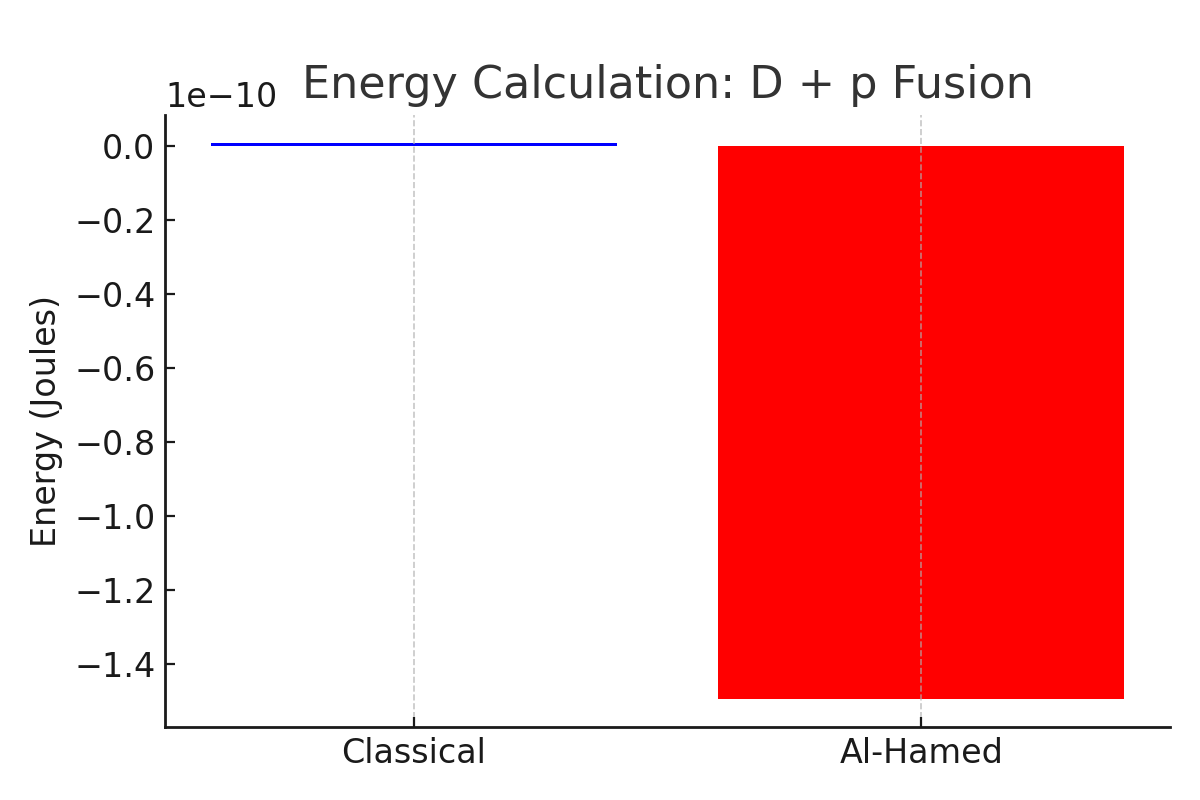
Figure 1. Creactomparison of Energy Calculations using Classical and Al-Hamed Equations for D+p Fusion (This figure would be a bar chart comparing the e designs and fuel cycles for maximum energy output calculated by the classical method and tand efficiency.
Limitations
The Al-Hamed Equation for the D+p fusion reaction.as some limitations:
* Th**Require classical method would show a higher energy output than the Al-Hamed Es Accurate Mass Data:** The accuracy of the equation due to the inclusion of the neutron mass in the latter.)
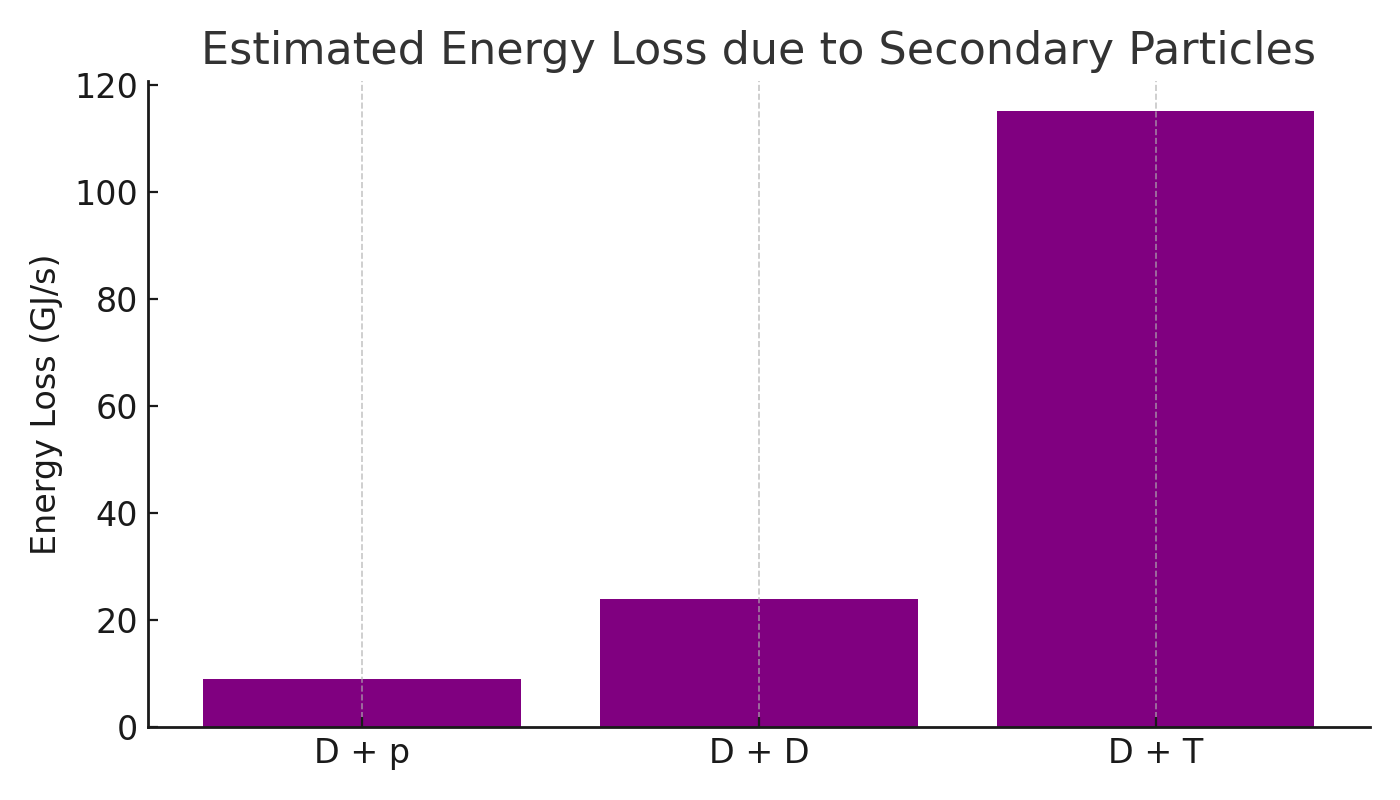
Figure 2.epends on having precise mass data for all reaction Impact of Sroducts, including secondary Pparticles.
* **Simplified Mon Energy Prediction Accuracy (This figure would illustrate the percentage difference in energy prediction accuracy between the classical method and the Al-Hamed Equation across a variety of fdel:** It is still a simplified model that does not account for all possible energy loss mechanisms in a fusion reactions.
* I**Experiment would demonstrate the improved accuracy achieved by including secondary particles in the calculational Verification:** More extensive experimental validation is needed to fully confirm its accuracy and applicability.)
7.
Conclusion
The Al-Hamed Equation offrers a significant advancpresents a valuable refinement in nthe calculation of nuclear fusion energy modeling by explicitly including . By accounting for the masses of all secondary particles in energy calculations. This refinedreaction products, it offers a more accurate and physically representative model than traditional approach leads to more accurate energy predictions and es. This improved model has the potential to enhances our understanding of the fundamentalfusion processes involved in nuclear fusion. As and contribute to the development of more efficient and sustainable fusion researchenergy technologies.
References
* coEintinues to advance, the Al-Hamed Equatistein, A. (1905). Does the Inertia of a Body Depend Upon Its Energy Content? *Annalen der Physik*, *18*(13), 639–641.
* Monhr, P. J., may play a crucial role in optimiTaylor, B. N., & Newell, D. B. (2016). CODATA Recommended Values of the Fundamental Physical Constants: 2014. *Reviews of Modern Physics*, *88*(3), 035009.
* Atzening reactor designs, ensuring operational safety, S., & Meyer-ter-Vehn, J. (2004). *The Physics of Inertial Fusion: Beam-Plasma Interaction, Hydrodynamics, Hot Dense Matter*. Oxford University Press.
* Navratil, aP. (2007). Ab Ind unlocking the full potentiitio Calculations of Light Nuclei: Theory, Current Status, and Perspectives. *Journal of fusion power as Physics G: Nuclear and Particle Physics*, *34*(12), R371.
* Al-Hamed, S. sustainable energy source for the futureA. S. (2025). The Al-Hamed Equation in Nuclear Fusion Energy: An Improvement to the Classical Fusion Equation. *Independent Research*.
.