This entry explores the emergence of ONE Paleopathology as a holistic, interdisciplinary approach to understanding health through deep time. The entry discusses key areas where paleopathological research provides crucial insights: animals as sentinels of environmental health, the evolution and transmission of infectious diseases, the impacts of urbanization and pollution on human health, and the effects of climate change on disease patterns. Special attention is given to case studies involving malaria, tuberculosis, and environmental toxicity, demonstrating how past human–environment interactions inform current health strategies. The entry also emphasizes the importance of indigenous and local knowledge (ILK) systems in understanding and managing health challenges, highlighting how traditional ecological knowledge complements scientific approaches. By bridging past and present, ONE Paleopathology offers valuable perspectives for addressing modern health challenges in the context of accelerating environmental change, while promoting more equitable and sustainable approaches to global health.
In
The Western Medical Tradition, Vol 1, the Wellcome Institute for the History of Medicine traces the origins of “modern medicine” to developments that began in classical Greek civilization and through to the ascendancy of humans as the focus of anatomical science and medicine in late Medieval and early Modern universities of western Europe
[1]. Human and veterinary medicine became formalized and completely distinct in the 19th century; however, for the duration of human evolution, human, animal, and environmental health were never distinct
[2]. Famous progenitors of modern medicine like Galen, whose ancient wisdom was preserved by scholars in the Arab world in works like the
Kitab al Baytara, used vivisection and dissection of animals to discover basic principles of anatomy and physiology
[3][4][3,4]. Western medical science revisited its roots with the concept of ONE Medicine
[5].
ONE Medicine was a concept that humans and animals are interdependent on one another, sharing anatomical and physiological aspects, relying on one another for sustenance, and strongly connected through shared ecosystems—and diseases
[6]. ONE Health extended the concept of ONE Medicine to integrate all aspects of environmental science to optimize the health of humans, animals, and ecosystems
[7]. More recently, these concepts have been further extended to planetary health, which embeds the well-being of all life and ecosystems within the planetary system and incorporates socioeconomic and equitable sustainability principles into medicine and public health
[8]. While understanding the interconnectedness of all life on Earth is increasingly gaining traction in Western medicine and public health, the importance of this interconnectedness has long been recognized in ancient and modern indigenous and local knowledge (ILK) systems from around the globe
[9][10][11][9,10,11]. Western medicine is pivoting to embrace knowledge systems and insights that were historically obscured by colonial histories and attitudes.
Human and animal health were intertwined early in the history of paleopathology but, like human and veterinary medicine, they diverged in the 20th century
[12][13][12,13]. More recently, there has been a growing movement to invigorate a more comprehensive paleopathology—one that incorporates human, animal, environmental, and planetary health into a deep-time perspective that could be instrumental in addressing contemporary health challenges in the face of climate change
[13][14][15][16][17][18][19][20][21][22][23][13,14,15,16,17,18,19,20,21,22,23]. This is largely driven by the recognition that the Anthropocene is the principal driver of prokaryotic and eukaryotic evolution, that the interconnectedness of life and Earth’s systems will shape health for the foreseeable future, and that discussions of public health are the greatest opportunity for inspiring the drastic and rapid changes in behavior needed to survive beyond the next century.
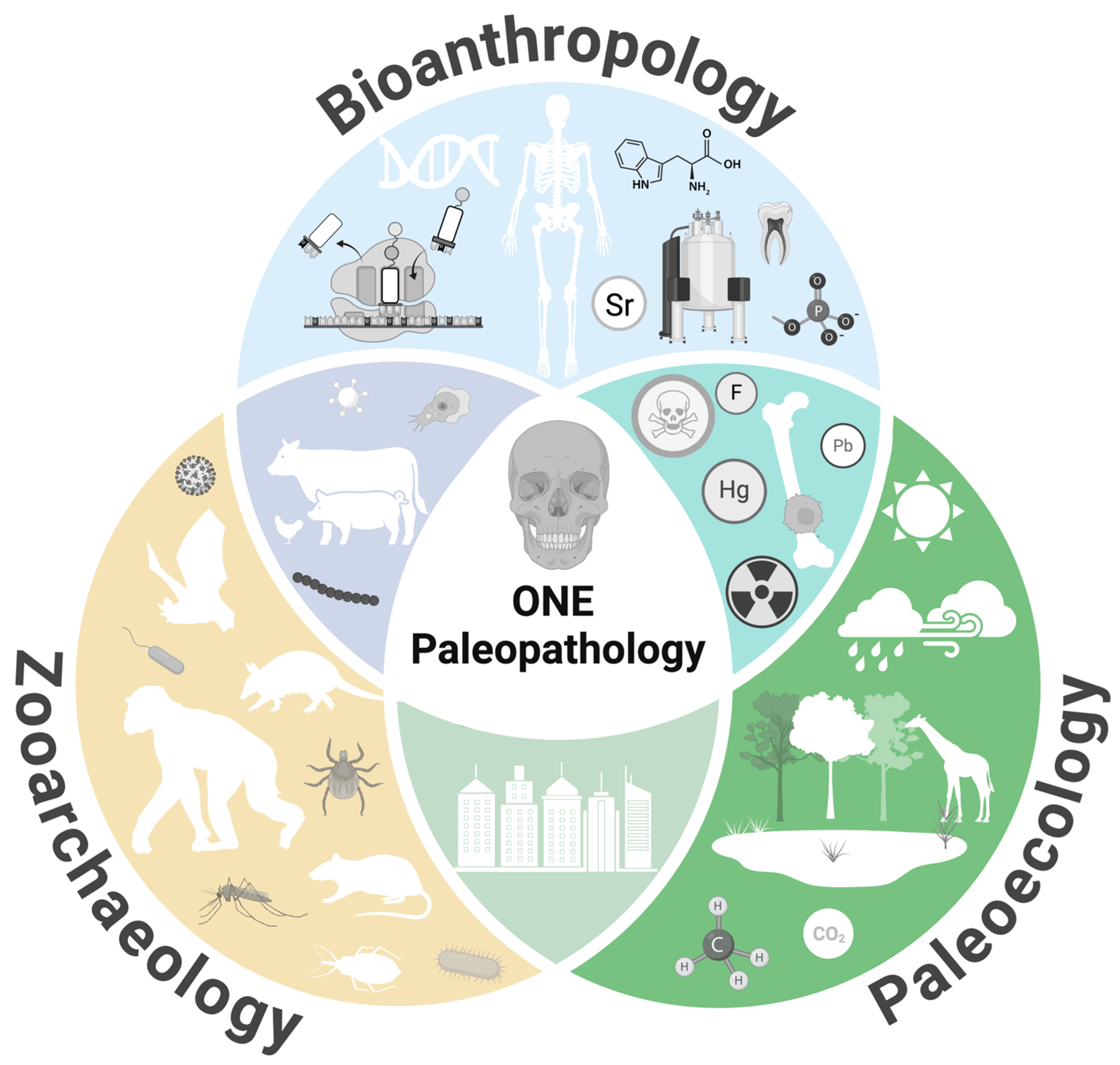
ONE Paleopathology is a holistic, interdisciplinary approach to environmental health from a deep-time perspective. It incorporates archaeological, paleoenvironmental, and paleopathological evidence to bear on contemporary public health and policy concerns: animals as sentinels, emerging and reemerging infectious diseases, antibiotic-resistant pathogens, respiratory pathogens and air quality, syndemics, migration and disease spillover, nutritional insufficiency, environmental toxicology, environmental migration, and interpersonal violence (Figure 1). Among policy and planning communities, there is growing interest in historical phenomena such as the Little Ice Age and the Medieval Warm Period, which affected health, patterns of disease, population dynamics, and had long-term impacts on human society. The past is becoming an attractive place to seek insights from completed experiments of human history as uncertainty and even panic arise about how extreme weather events, rising global temperatures, ecosystem alterations, and socio-cultural phenomena will intersect to shape the future of our planet.
Figure 1. ONE Paleopathology approaches to environmental health in the past. Created in BioRender (Robbins Schug, G.
https://BioRender.com/k77k949, accessed on 1 January 2025).